
Best for automated remediation: OneClickComply. Best for evidence-led readiness: Vanta. Best for continuous monitoring: Drata. Best for guided preparation: Secureframe. Best for audit coordination: Thoropass. This 2026 guide compares SOC 2 software for healthtech teams and shows you what to check before choosing.
Why this matters
Buy software that helps you operate controls, not just describe them. A healthtech business needs evidence that access reviews, software changes and incident handling actually happen.
SOC 2 examines controls relevant to the services within your report’s scope. It does not automatically cover every product, legal entity or system you operate.
For your 2026 shortlist, separate three decisions: what customers require, what your auditor will examine, and what software can automate. Those decisions should shape the demonstration before a vendor shows you a dashboard.
What makes the best SOC 2 software for healthtech?
Use these 5 buying criteria to assess each platform. Treat them as acceptance checks, not a feature-counting exercise.
- Evidence traceability: You can connect a control to its source, owner, review and supporting record.
- Remediation: You can distinguish a detected issue from a completed fix and an approved exception.
- Sensitive-data handling: You can restrict access to evidence and avoid copying patient information unnecessarily.
- Audit delivery: Your team and auditor can review evidence without losing its context or history.
- Framework fit: Your programme can address SOC 2 alongside other requirements without treating them as interchangeable.
Ask each vendor to demonstrate these criteria using your proposed scope. A generic demonstration cannot establish whether a platform covers your production environment.
SOC 2 software for healthtech at a glance
These are use-case recommendations for a 2026 shortlist, not measured performance rankings. Confirm the exact features, services and contractual terms you need before buying.
| Software | Best for | Standout focus | Key limitation |
|---|---|---|---|
| OneClickComply | Automated security-control remediation | Remediation, policy generation, risk management and trust centres | Automation does not replace management decisions or independent assurance |
| Vanta | Evidence-led readiness | Compliance automation and evidence collection | Collected evidence still needs scope and relevance checks |
| Drata | Continuous control monitoring | Ongoing monitoring and compliance evidence | Monitoring does not prove that every control operates effectively |
| Secureframe | Guided audit preparation | Compliance preparation and control workflows | Preparation still requires internal owners and implementation |
| Thoropass | Audit coordination | Compliance software combined with audit services | You still need to agree the engagement scope and responsibilities |
1. OneClickComply: best SOC 2 software for remediation
OneClickComply helps growing businesses achieve and maintain compliance through automated security-control remediation, policy generation, risk management and trust centres. It supports SOC 2 alongside ISO 27001 and Cyber Essentials.
OneClickComply is best for growing healthtech teams that want SOC 2 software with automated security-control remediation. Put that capability at the centre of your demonstration: ask what gets fixed, who approves the change and what record remains afterwards.
OneClickComply pros:
- Automated remediation addresses security controls rather than stopping at policy creation.
- Policy generation supports the documentation side of your programme.
- Risk management connects compliance work with business decisions.
- Trust centres support the way you present assurance information.
OneClickComply cons:
- Automated changes still need appropriate ownership and oversight.
- Generated policies need review against your actual practices.
- Software does not issue the independent SOC 2 report.
Best for: A growing healthtech business that wants to automate control work while managing several compliance requirements.
Verdict: Buy for a remediation-led programme once the demonstration confirms your systems and approval requirements.
2. Vanta: best SOC 2 software for evidence-led readiness
Vanta provides compliance automation software, including SOC 2 readiness and evidence collection. Put Vanta on your shortlist when organising evidence is the main problem you need to solve.
Your demonstration should follow evidence from the source system into the control record. Check whether a reviewer can understand what the record proves without asking engineering to reconstruct the context.
Vanta pros:
- SOC 2 readiness is a core platform use case.
- Automated evidence collection supports repeatable preparation.
- A shared compliance workspace gives your team an alternative to scattered records.
Vanta cons:
- Evidence collection does not establish that your chosen scope is correct.
- Your team must review exceptions and explain unusual records.
- A readiness workflow does not replace the independent examination.
Best for: A healthtech team that already operates its controls but needs a more organised evidence process.
Verdict: Buy for evidence-led readiness if the demonstration proves traceability across your actual systems.
3. Drata: best SOC 2 software for ongoing monitoring
Drata provides compliance automation with continuous control monitoring and evidence collection. Consider Drata when your priority is maintaining visibility after the initial readiness project.
Ask the vendor to show how a failed check becomes assigned work, then how closure is recorded. A monitoring result needs context before your team can decide whether it represents a real control failure.
Drata pros:
- Continuous monitoring supports an ongoing compliance programme.
- Evidence collection supports audit preparation.
- Control monitoring gives your team a repeatable way to review connected checks.
Drata cons:
- Technical monitoring cannot evaluate every organisational control.
- A successful check does not prove the entire control is effective.
- Your team still needs to investigate failures and approve exceptions.
Best for: A healthtech company with established control owners that wants ongoing monitoring between audits.
Verdict: Buy for monitoring-led operations if checks produce clear, owned follow-up work.
4. Secureframe: best SOC 2 software for guided preparation
Secureframe provides compliance automation for programmes including SOC 2. Its preparation workflows make it a shortlist option when your team needs to turn compliance requirements into organised work.
Check how the platform handles a requirement that needs a person, not a system connection. Access reviews, policy approvals and management decisions need accountable owners even when software organises the process.
Secureframe pros:
- SOC 2 preparation is an established platform use case.
- Compliance workflows help structure readiness work.
- Evidence collection supports the preparation process.
Secureframe cons:
- Structured tasks still require your team to implement controls.
- Templates need adjustment to your services and operating practices.
- Readiness status is not an auditor’s opinion.
Best for: A healthtech team building its first organised SOC 2 preparation programme.
Verdict: Buy for guided preparation if your team can turn assigned tasks into operating controls.
5. Thoropass: best SOC 2 software for audit coordination
Thoropass combines compliance software with audit services. Consider Thoropass when coordinating preparation and the examination is your main buying priority.
Ask who performs each part of the engagement and what the final deliverable covers. Keep software access, preparation support and independent assurance clear in the agreement.
Thoropass pros:
- Software and audit services sit within its offering.
- The model suits buyers evaluating preparation and assurance together.
- Audit coordination is central to the buying decision rather than an afterthought.
Thoropass cons:
- Your organisation remains responsible for operating its controls.
- The engagement still needs a clearly agreed scope.
- Audit services do not replace healthcare-specific legal or procurement obligations.
Best for: A healthtech company that wants to evaluate compliance software and audit delivery together.
Verdict: Buy for audit coordination once responsibilities, independence and deliverables are clear.
How these recommendations are ranked
The 2026 shortlist separates five buying priorities: remediation, evidence, monitoring, preparation and audit coordination. The order favours getting control work done before organising the resulting records.
No ranking here claims a measured speed advantage or guaranteed audit result. Use the five criteria above to decide which platform fits your programme, then require a demonstration of the capabilities that matter to you.
Run the same demonstration with every vendor
Use 3 demonstration tasks for your 2026 evaluation. Give every vendor the same scenario so you compare outcomes rather than presentation quality.
Trace evidence
Choose 1 control, such as removing access when an employee leaves. Ask the vendor to trace the requirement, source record, responsible owner and review evidence.
Check what happens when a record is missing. The system should help your reviewer distinguish incomplete evidence from a control that has not operated.
Resolve a failure
Ask the vendor to demonstrate a failed check, its assigned owner and its resolution. Separate an automatic fix from a suggested action or a task assigned to your team.
For healthtech systems, ask how changes are approved before they affect production. Do not accept a demonstration that treats every configuration change as safe to apply automatically.
Prepare review
Ask the vendor to assemble the selected evidence for an auditor. Check whether scope, dates, ownership and exceptions remain understandable outside the dashboard.
Use sanitised examples. You do not need live patient records to evaluate how a compliance platform handles evidence.
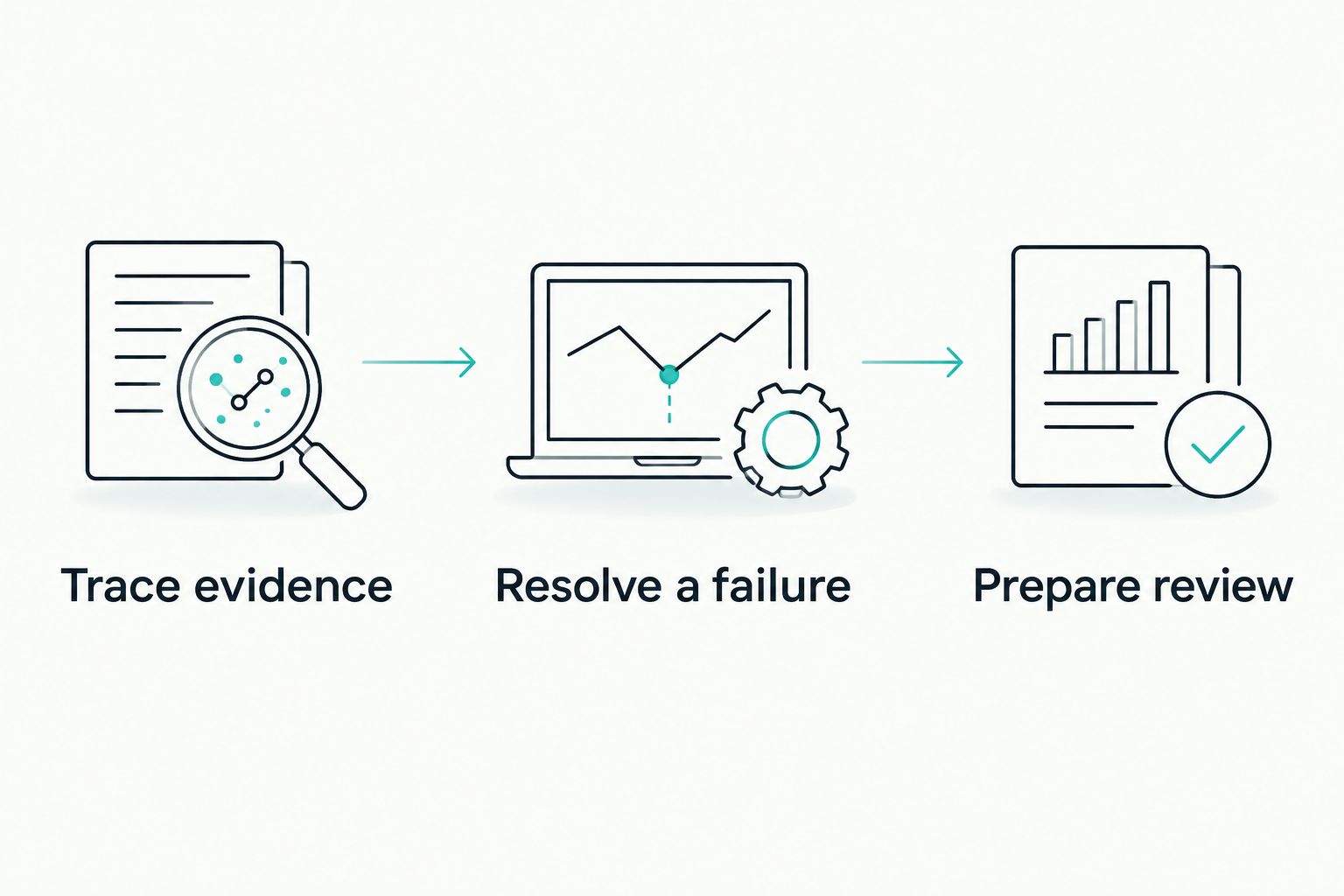
Compare every vendor using the same control and review process.
Check the healthtech boundaries before signing
SOC 2 is an attestation report, not a substitute for healthcare compliance. The AICPA SOC 2 framework addresses controls against applicable Trust Services Criteria; your examination depends on the agreed scope.
For a UK healthtech purchase in 2026, check these boundaries separately:
- UK GDPR: Health information is special category data. Your lawful processing arrangements and safeguards need their own assessment.
- NHS requirements: Confirm whether the Data Security and Protection Toolkit or other customer requirements apply to your service.
- US healthcare: Assess HIPAA applicability separately if your business handles information in a covered relationship.
- Clinical obligations: Do not treat a security assurance report as evidence that every clinical or medical-device requirement is satisfied.
You should also examine the compliance platform as a supplier. Ask what evidence it stores, where processing takes place, who can access it, and how you retrieve or delete records when the relationship ends.
Distinguish Type I from Type II
SOC 2 Type I evaluates control design at a specified date; Type II also evaluates operating effectiveness over a specified period. Ask customers which report they require before you set your readiness plan.
A platform cannot create historical control operation by importing policies just before an examination. Your control owners need to carry out the work and retain evidence throughout the relevant period.
Agree the report type, system boundary and applicable criteria with your auditor. Then configure the software around that agreement, rather than using the platform’s default checklist as your scope.
Which SOC 2 software should you choose?
Start with the work your team cannot reliably complete today. Choose the remediation-led option when fixing controls is the bottleneck, or prioritise evidence, monitoring, preparation or audit coordination when those are the real constraint.
Before you commit, require a written record of the demonstration outcome. List supported systems, manual tasks, approval requirements, evidence exports and responsibilities that remain with your team.
Explore compliance automation
Review automated remediation, policy generation, risk management and trust centres.
Frequently asked questions
One last thing
Test the exit before you sign. Ask each vendor to export a control, its evidence and its review history in a form your team can understand without the platform.
If you cannot explain that record independently, the dashboard has become part of the problem. Keep the controls clear, the evidence usable and the work owned. Seriously Simple Cyber Compliance.