
Yes. A startup can get ISO 27001 certified in under six months in 2026, provided you establish a clear scope, implement the required processes, produce evidence and complete the external audits. Six months is a planning target, not a guaranteed delivery time: unresolved findings and the certification body's schedule affect the finish date.
Why this matters
A customer deadline gives you a target. It does not prove your security programme is ready for certification. Start with an ISO 27001 gap analysis so you can separate work already completed from controls that still need implementing.
For your 2026 plan, distinguish three milestones: implementing the requirements, completing the certification audits and receiving the certification decision. Tell customers which milestone you have actually reached.
Can a startup get ISO 27001 certified in under six months?
Yes, but the deadline must follow a credible readiness assessment. ISO/IEC 27001 does not prescribe a universal minimum implementation period. It requires an information security management system that meets its requirements and works in practice.
A small team is not automatically ready because it uses cloud services. You still need clear responsibilities, a risk assessment, appropriate controls, operating records and management oversight.
Use this sequence to assess whether your six-month target is defensible. The steps describe dependencies, not fixed durations.
Establish the scope
Define the services, people, locations, systems and information covered by certification. Include the dependencies that support those activities, even when another business operates them.
Write a scope that matches what you intend to tell customers. A certificate covering a limited service does not establish that every part of your business falls within the certified boundary.
- Identify the product or service customers need assurance about.
- Map the information it handles and where that information goes.
- Record supporting systems, suppliers and team responsibilities.
- Explain the boundaries and interfaces clearly.
Assess the risks
Identify what threatens the confidentiality, integrity and availability of information within scope. Evaluate those risks using a consistent method, then decide how you will treat them.
Assign owners who can make decisions. A register full of unowned risks is a record of unfinished work, not a completed risk process.
Your Statement of Applicability explains the necessary controls, the reasons for including them and their implementation status. It also records the justification for excluding reference controls from Annex A.
Implement controls
Turn risk decisions into working practices. Depending on your assessed needs, this includes access management, staff awareness, supplier oversight, incident handling and recovery arrangements.
Give each action an owner and a clear completion condition. Replace vague tasks such as improve access security with a defined change and evidence showing that change works.
Do not mark a control complete because someone has written a policy about it. Check the actual settings, actions and records.
Record evidence
Keep evidence while people perform the work. Access reviews, approved changes, training records and recovery tests demonstrate activities that a policy alone cannot prove.
Make the records traceable. An auditor should be able to connect a requirement or risk to the control, its owner and evidence of operation without relying on an explanation from memory.
Review readiness
Complete an internal audit and management review. Use the findings to correct gaps and improve the management system before the external assessment of implementation.
The internal audit needs objectivity and impartiality. Avoid asking someone to provide the only independent judgement on work they designed and operate.
Complete external assessment
Initial certification normally involves Stage 1 and Stage 2 audits. Stage 1 reviews readiness and relevant documented information; Stage 2 evaluates implementation and effectiveness.
The certification body makes the certification decision after its process is complete. An audit booking, a software dashboard or a completed policy library is not a certificate.
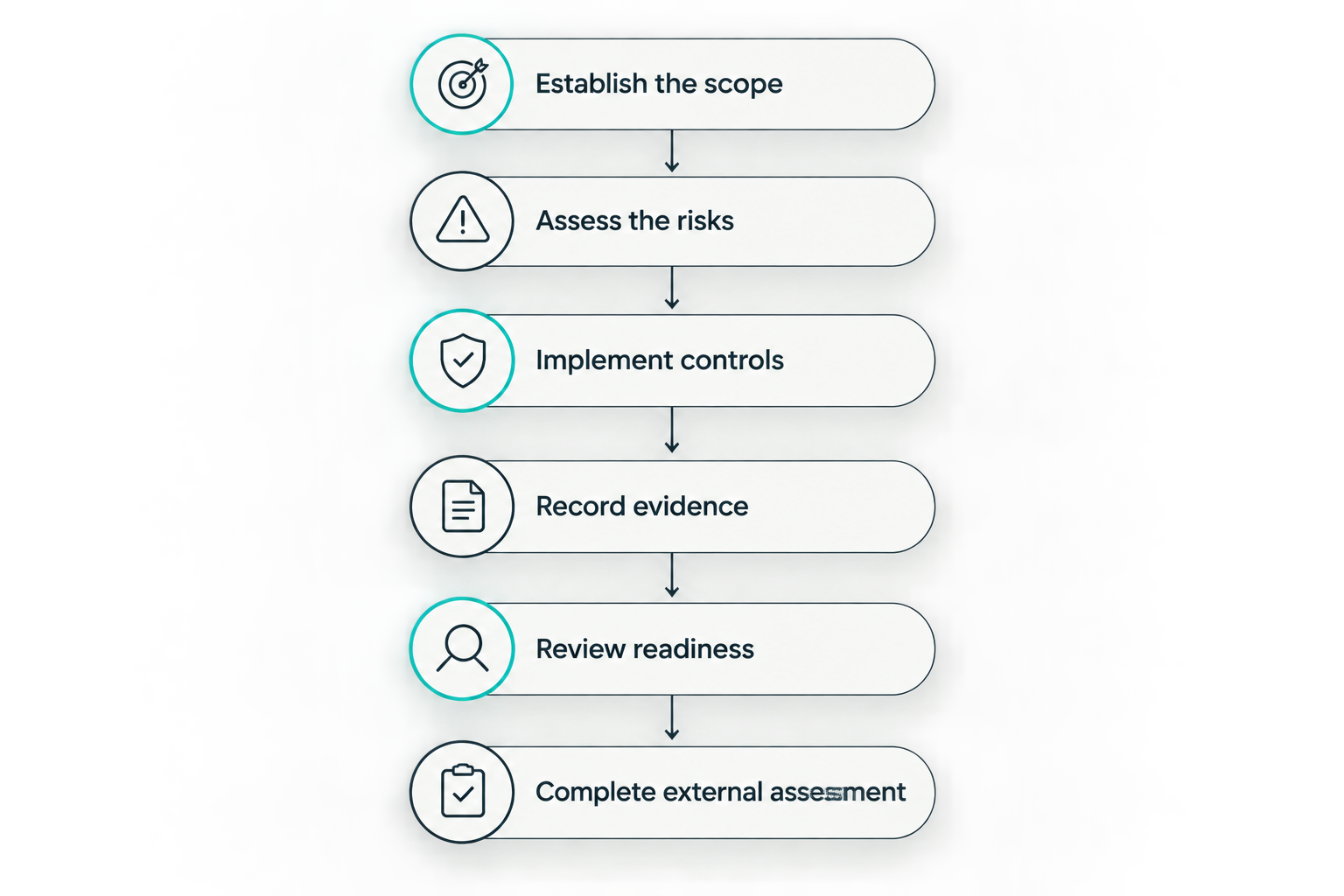
The sequence ends with external assessment, not with completing the policy library.
Why the ISO 27001 timeline varies
Your starting position matters more than your company age. For a 2026 certification target, assess these factors before committing to a customer-facing date.
- Scope: More services, locations and dependencies create more work to assess and demonstrate. Keep the boundary accurate rather than artificially narrow.
- Existing practices: Established access reviews, change approvals and incident processes give you something to assess. Informal habits need turning into repeatable practices.
- Ownership: Progress depends on people with authority to approve policies, fix systems and accept risks. Assign responsibility before distributing tasks.
- Evidence quality: Current, relevant records support assessment. Unlabelled screenshots and retrospective explanations make the evidence harder to evaluate.
- Audit arrangements: The certification body must assess your scope and agree the audit arrangements. Discuss these early rather than treating assessment as an immediate final step.
- Findings: Identified nonconformities require an appropriate response under the certification body's process. Leave room to investigate causes and demonstrate corrective action.
Commit to the work you control; confirm external milestones with the certification body. That distinction makes your plan more useful than a single promised completion date.
What should your six-month certification plan contain?
Build your 2026 plan around completion conditions rather than equal blocks of calendar time. Different activities can run alongside each other, but dependencies still apply.
For example, evidence collection starts when a control operates. It should not wait until every policy has been approved.
| Workstream | Completion condition | Dependency to resolve |
|---|---|---|
| Scope and responsibilities | Approved boundary and named owners | Agreement on what customers need covered |
| Risks and treatment | Assessed risks and approved treatment decisions | Understanding of systems, information and suppliers |
| Policies and controls | Approved rules reflected in working practices | People authorised to implement changes |
| Evidence | Relevant records linked to controls | Controls operating in the real environment |
| Internal assurance | Internal audit and management review completed | Sufficient implementation to evaluate |
| External certification | Audit process and certification decision completed | Readiness, findings and certification-body arrangements |
Keep a separate list of blocked decisions. A missing approval deserves different attention from a technical task that an engineer has already scheduled.
When a customer asks for progress, report completed milestones and unresolved dependencies. Do not describe a target date as confirmed certification.
Should you use spreadsheets, software or a consultant?
Choose support around the work your team cannot reliably own. A spreadsheet organises information, software handles repeatable tasks, and a consultant contributes expertise; none makes the independent certification decision.
| Approach | Best for | Advantage | Limitation |
|---|---|---|---|
| Spreadsheets and shared documents | Teams able to maintain records themselves | Direct control over the structure | Your team manages updates, ownership and traceability manually |
| Compliance automation software | Teams needing repeatable compliance workflows | Handles supported tasks and organises compliance activity | People still make risk decisions and validate results |
| Specialist consultant | Teams needing implementation guidance | Helps interpret requirements and challenge decisions | Your business must still operate the resulting processes |
OneClickComply is best for growing businesses that want ISO 27001 compliance automation. Its platform generates policies, manages risk and automates security-control remediation.
OneClickComply does not replace your responsibility for the management system or the certification body's independent assessment. Check that generated policies describe your actual business, and review automated changes through your own approval process.
You can assess OneClickComply against the specific work identified in your gap analysis. Ask what your team will still need to own, rather than judging software by a promised certification date.
Where does penetration testing fit into the plan?
Penetration testing supports the assessment of technical weaknesses where it is appropriate to your risks and systems. It does not replace the wider management system or establish ISO 27001 conformity by itself.
When comparing penetration testing providers for startups, define the systems, test objectives and reporting requirements before choosing an engagement. That makes the findings relevant to your risk treatment rather than a disconnected report.
Plan who will assess the findings, implement fixes and verify the response. A completed test is not the same as completed remediation.
Keep the timing connected to your implementation work. Testing an environment that you immediately rebuild gives you different assurance from testing the environment you intend to present for assessment.
Can you certify faster by reducing the scope?
A focused scope can reduce implementation work, but it must remain accurate. Include the processes and dependencies needed to deliver the service you claim is covered.
Do not exclude a supporting function simply because another team owns it. Examine its relationship with the scoped service and document how you manage that relationship.
Use plain language when explaining the certificate to customers. State what it covers, and avoid suggesting that excluded services have also been assessed.
Do you need six months of evidence before the audit?
Six months of evidence is not a universal ISO 27001 requirement. You need sufficient evidence for the certification body to assess whether your management system meets the requirements and operates effectively.
Discuss evidence expectations with the certification body against your actual scope and implementation. Do not invent historical records or backdate activities to make the programme look older.
A newly approved process needs operating evidence, not a fictional history. If the evidence is insufficient, address that readiness gap openly.
What should you do if the deadline starts slipping?
Protect the accuracy of the certification claim before protecting the target date. Identify whether the delay comes from implementation, evidence, internal review, corrective action or external assessment arrangements.
Then give the blocked work a named decision-maker. Escalate approval delays to leadership instead of leaving them buried in a task list.
For a 2026 customer commitment, explain the current milestone and the remaining dependency. Ask whether the customer can assess your present security evidence while certification remains in progress, without implying that acceptance is guaranteed.
Frequently asked questions
One last thing
Ask your team to trace a real security activity from the policy through to its operating record. Can the owner explain what happened, show the evidence and identify what needs improving?
That exercise exposes the difference between organised documents and an operating management system. For your 2026 target, build the latter first. Seriously Simple Cyber Compliance.