
A virtual CISO can replace an in-house CISO role when the service covers your leadership needs and your team can carry out the work. It cannot replace your organisation’s accountability, internal decision-makers or technical delivery team. In 2026, the right test is whether the arrangement covers every responsibility—not whether someone holds the title.
Why this matters
Replacing a CISO changes who sets security priorities, challenges decisions and reports risk to your leadership team. Moving those responsibilities outside the business does not remove the work attached to them.
Before you select a service for 2026, separate leadership from implementation. The guide to structuring a compliance team as your company scales addresses the wider ownership question: who makes decisions, who performs tasks and who checks the results.
Can a virtual CISO service replace an in-house CISO entirely?
A virtual CISO can replace the position, but not the organisation’s responsibilities. The arrangement works when the contract, internal authority and delivery capacity match what your business actually needs.
Compare these 3 operating models before changing your team. Each solves a different leadership problem.
| Operating model | Best for | Main advantage | Main limitation |
|---|---|---|---|
| Virtual CISO | Businesses with defined leadership needs and capable internal delivery owners | External security leadership within an agreed scope | Availability, authority and implementation depend on the arrangement |
| In-house CISO | Businesses needing sustained security leadership across daily decisions | A dedicated role embedded in the organisation | One person still needs delivery support and specialist input |
| Hybrid leadership | Businesses needing an internal owner plus external expertise | Clear internal ownership with additional specialist support | Responsibilities overlap unless you define the boundaries |
Do not compare job titles alone. Compare the decisions each model must make, the work it must oversee and the access it needs to do both.
An external adviser who only reviews policies is not a complete replacement for an executive responsible for security strategy, staffing and incident decisions. Equally, a full-time appointment does not fix a programme without resources or authority.
Virtual CISO: best for defined leadership needs
A virtual CISO is a suitable replacement when you need experienced direction but can assign implementation to existing staff or contracted specialists. Your engineering, IT and business owners must have time to complete the agreed work.
Define the outputs before appointing the service:
- A security roadmap tied to business priorities.
- Risk reviews with named decision-makers.
- Leadership reporting that explains unresolved issues.
- Policy ownership and review responsibilities.
- Support for customer assurance and audit preparation.
- A documented incident escalation role.
These are requirements to agree, not features to assume. A provider’s title does not establish what the engagement includes.
Choose virtual leadership when the scope matches the work. Do not use it as a substitute for missing engineers, incident responders or operational managers.
The main trade-off is access to business context. Give the virtual CISO access to relevant planning discussions, system owners and unresolved risks; a meeting without that context produces advice detached from delivery.
In-house CISO: best for embedded decision-making
An in-house CISO fits when security leadership needs sustained involvement in product, operations, procurement and executive decisions. The reason to appoint one is the work requiring that involvement, not a company-size milestone.
Consider an internal role when you need someone to:
- Resolve competing priorities across departments.
- Lead and develop a security team.
- Participate closely in product and infrastructure changes.
- Own ongoing relationships with senior stakeholders.
- Coordinate a broad security programme across business units.
A dedicated role gives you an internal leadership position. It does not automatically provide monitoring, testing, legal advice or incident response capacity.
Choose an in-house CISO when daily leadership is the requirement. Set decision rights and delivery resources alongside the appointment, rather than expecting the new hire to supply an entire security function.
Hybrid leadership: best for shared delivery
A hybrid arrangement keeps an accountable internal security owner and adds external leadership or specialist support. That internal owner might coordinate work while the external adviser supports strategy, reviews or a defined transition.
The advantage is a clear connection between advice and execution. The limitation is duplicated work if both parties believe the other owns a decision.
For your 2026 operating plan, document who sets priorities, who approves exceptions and who reports to leadership. Give each responsibility a primary owner and an escalation route.
Choose hybrid leadership when you need internal continuity and external support. Avoid a structure where both parties advise but neither can move work forward.
Why the right CISO model varies
The right arrangement depends on your operating needs, not a universal employee threshold. Use these 6 factors to decide what belongs inside the business and what you can contract out.
- Decision frequency. List the security decisions arising during normal operations. Identify which need immediate leadership input and which can wait for a scheduled review.
- Delivery capacity. Confirm who changes configurations, fixes weaknesses and updates business processes. Advice needs someone able to act on it.
- Business complexity. Map the products, systems, suppliers and business units the security leader must understand. Define the access needed to oversee them.
- Incident responsibilities. Separate executive coordination from technical investigation and recovery. Check each responsibility against the proposed service scope.
- Assurance obligations. Identify the customer, contractual and audit commitments the programme must support. Assign ownership for keeping those commitments accurate.
- Authority. Establish who can approve expenditure, accept risk and resolve conflicting priorities. External advice is not the same as delegated authority.
Review the model when these factors change. A new product, acquisition or operating structure is a reason to reassess responsibilities rather than automatically renew the same arrangement.
How do you test whether a virtual CISO can replace your role?
Use these 5 steps before removing an internal position or signing a replacement agreement. Test the actual work, including tasks people perform informally.
1. Map responsibilities
List what the current CISO role owns. Include strategy, risk decisions, leadership reporting, team management, supplier reviews and incident coordination.
Distinguish ownership from participation. Attending a risk meeting is not the same as having authority to approve its decisions.
2. Assign authority
Name the internal executive who sponsors the programme. Record which decisions the virtual CISO can make and which require business approval.
Define how disagreements escalate. A security recommendation that conflicts with a product deadline needs an authorised decision-maker, not another unresolved meeting.
3. Confirm delivery
Assign the implementation work to named teams or providers. Check that those owners have the access and capacity to perform it.
For example, recommending tighter access controls is leadership work. Changing permissions, checking the result and recording the evidence are delivery tasks that still need owners.
4. Test escalation
Walk through an urgent incident, a major customer security request and a delayed security fix. Ask who responds, who decides and who communicates.
Check the proposed contract against each scenario. Do not infer emergency support from general wording about security leadership.
5. Plan continuity
Document how you retain risk records, policies, decisions and open actions if the provider changes. Keep access to your own programme information.
For a 2026 transition, make the handover a defined deliverable. A replacement model is not ready while critical knowledge remains with the departing person.
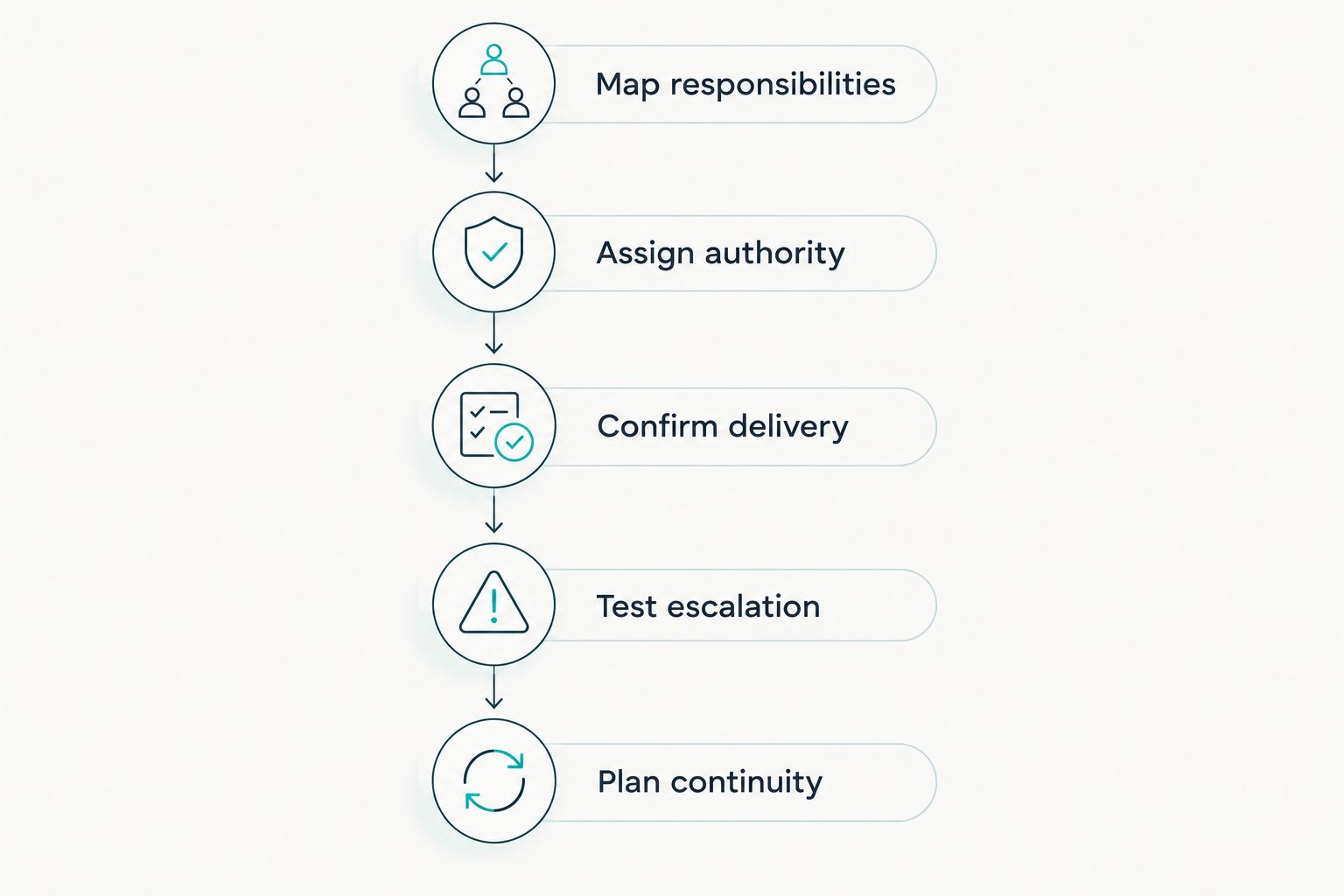
Confirm ownership and delivery before changing the leadership model.
A successful handover leaves every material responsibility with an owner. If the exercise reveals gaps, change the scope or retain internal capacity before making the switch.
What should a replacement service agreement include?
Write the agreement around decisions and outputs rather than a broad promise to manage security. Your 2026 scope should show what the provider owns, what you retain and how you judge completion.
Specify:
- Named leadership: who performs the role and how substitution works.
- Access arrangements: which meetings, records and system owners the adviser can reach.
- Deliverables: the roadmap, reports, reviews and other agreed outputs.
- Availability: scheduled access, urgent escalation and exclusions.
- Implementation boundaries: whether the provider advises, performs changes or verifies work.
- Handover terms: how records and outstanding actions return to your business.
Ask the provider to explain the exclusions as clearly as the deliverables. Security leadership, monitoring, penetration testing and emergency response are distinct activities; do not assume one engagement includes them all.
Keep acceptance criteria practical. A completed report should identify decisions and actions, while an approved policy should have a business owner responsible for putting it into practice.
Can compliance automation replace a virtual CISO too?
Compliance automation can handle defined tasks, not executive judgement. Software can support a security programme without deciding which business risks your leadership should accept.
OneClickComply is best for growing businesses that need compliance automation, not outsourced executive accountability. The platform supports control auto-remediation, policy generation, risk management and trust centres across programmes including ISO 27001, Cyber Essentials and SOC 2.
Use OneClickComply compliance automation alongside named leadership and delivery owners. Its role is to support compliance work; your business still needs people to approve decisions and confirm that policies reflect actual practice.
That distinction prevents a false choice between software and a security leader. You can automate repeatable work while retaining the judgement needed to set priorities, handle exceptions and challenge weak decisions.
Does ISO 27001 require an in-house CISO?
ISO 27001 does not require an employee with the CISO job title. It requires assigned information security responsibilities and authorities within an effective information security management system.
You can use external expertise, but the organisation still needs to fulfil its management responsibilities. Certification preparation is therefore a question of ownership and evidence, not simply whether your security leader appears on the payroll.
Who makes the final call during a security incident?
Your incident plan should identify the people authorised to make business and technical decisions. A virtual CISO’s involvement depends on the agreed role and availability, not the title alone.
Separate leadership coordination from containment, investigation, recovery and communications. Test those responsibilities before an incident so the external adviser is not your only assumed route to action.
Frequently asked questions
One last thing
Before replacing a CISO, ask who owns the next unresolved security decision. Name the person who can approve it, the team that will carry it out and the evidence that will show it is complete.
If you cannot name those owners, fix the operating model before changing the job title. That is Seriously Simple Cyber Compliance.