Yes. One platform can manage ISO 27001 and SOC 2 at the same time by organising shared controls, policies, risks and evidence in a single workspace. You still need separate assessment outcomes: ISO 27001 certification and a SOC 2 examination report. Share the work where requirements overlap, but keep each framework’s scope, evidence requirements and audit decisions distinct.
Why this matters
Running both programmes separately creates duplicate work when the same people, systems and security activities sit inside both scopes. You do not need competing copies of an access policy or separate requests for the same change record.
For your 2026 compliance plan, build a shared operating process before creating framework-specific task lists. The guide to reducing audit fatigue across multiple compliance frameworks explains the practical goal: stop asking teams to prove the same activity repeatedly.
Can one platform manage ISO 27001 and SOC 2 at the same time?
Yes, provided the platform connects common security activities to each framework without treating the requirements as identical. Centralise the work; preserve the differences.
ISO 27001 assesses an information security management system. SOC 2 examines controls relevant to the applicable Trust Services Criteria for a defined service organisation system.
| Area | ISO 27001 | SOC 2 | What a shared platform should handle |
|---|---|---|---|
| Outcome | Certification against the standard | An independent examination report | Separate assessment records and findings |
| Scope | Defined information security management system boundaries | Defined service organisation system and applicable criteria | Explicit boundaries for each programme |
| Risk | Risk assessment and treatment underpin the management system | Risk assessment supports the design and operation of relevant controls | Connected risks, owners and treatment actions |
| Controls | Controls selected through risk treatment, with a Statement of Applicability | Controls addressing the applicable Trust Services Criteria | Shared activities mapped to distinct requirements |
| Evidence | Records supporting management system and control implementation | Evidence supporting control design and, for Type II, operation over a period | Dated records with clear relevance and ownership |
| Oversight | Internal audit and management review are required | Management responsibilities and independent examination remain distinct | Assigned responsibilities and tracked actions |
Neither outcome automatically delivers the other. An ISO 27001 certificate does not replace a SOC 2 report, and a SOC 2 report does not establish that you meet every ISO 27001 requirement.
What work can you share between the frameworks?
Start with security activities your business already performs. Then assess whether each activity addresses requirements in both programmes.
Common candidates include:
- Access management: approvals, access reviews and removal of access when someone leaves.
- Change management: review, approval and records of changes to systems in scope.
- Incident management: documented response procedures and records of incidents handled.
- Supplier management: security reviews and decisions about relevant suppliers.
- People and policies: approved policies, assigned responsibilities and security awareness activities.
- Risk management: identified risks, treatment decisions and follow-up actions.
A shared activity does not make every associated record reusable. An access review covering your internal office tools does not prove that you reviewed access to a production system outside that review’s scope.
For your 2026 evidence library, record what each item proves before mapping it to either framework. Capture the system, relevant dates, responsible person and requirement it supports.
Reuse the evidence, not the assumption that it applies everywhere.
What must stay separate?
Keep the assessment logic visible even when you share the underlying work. A dashboard that merges everything into a single completion score hides important distinctions.
ISO 27001 management system requirements
ISO 27001 requires more than a collection of technical security checks. Your programme must address the management system itself, including context, leadership, planning, performance evaluation and improvement.
Maintain your risk assessment, treatment decisions and Statement of Applicability. Keep internal audit and management review records available alongside the controls they assess.
SOC 2 system description and examination requirements
SOC 2 requires attention to the defined system, management’s description and the applicable criteria. Security is included; other Trust Services categories depend on the examination scope.
Keep the examination scope and supporting evidence clearly identified. Do not assume that an organisation-wide policy proves how a particular service operates.
Evidence periods and assessment findings
SOC 2 Type I addresses control design at a specified date. SOC 2 Type II also addresses operating effectiveness over a specified period.
A current screenshot cannot, by itself, establish that a recurring control operated throughout an examination period. Keep historical records and assessment findings attached to the relevant programme, even when remediation work is shared.
How do you set up a combined compliance programme?
Use this sequence for a joint 2026 programme. Agree boundaries first, then organise the work around them.
1. Define scope
Write down the legal entities, services, systems, locations and teams covered by each assessment. Highlight differences rather than forcing the scopes to match.
Confirm those boundaries with the relevant assessors before building your evidence plan. A shared platform cannot correct an unclear scope.
2. Map controls
Describe the security activity in plain language, then connect it to the relevant framework requirements. Explain the mapping rather than relying on matching labels.
For example, an access-review activity needs a defined population, reviewer, process and record of decisions. The control title alone proves nothing.
3. Assign owners
Give every shared activity a named owner. Separate responsibility for performing the activity from responsibility for checking its evidence where appropriate.
Define who approves policy changes, accepts risks and closes exceptions. Software can organise those decisions; your business remains accountable for them.
4. Collect evidence
Capture records from the relevant systems and retain their context. Check that automated collection captures the population and detail your assessors need.
Preserve previous versions where they support historical assessment. Replacing an old document with today’s version can remove the evidence of what applied earlier.
5. Review gaps
Review each framework independently before declaring readiness. Check missing requirements, incomplete records, unresolved exceptions and differences in scope.
An activity can support both programmes while leaving a gap in one. Keep that distinction visible until you resolve it.
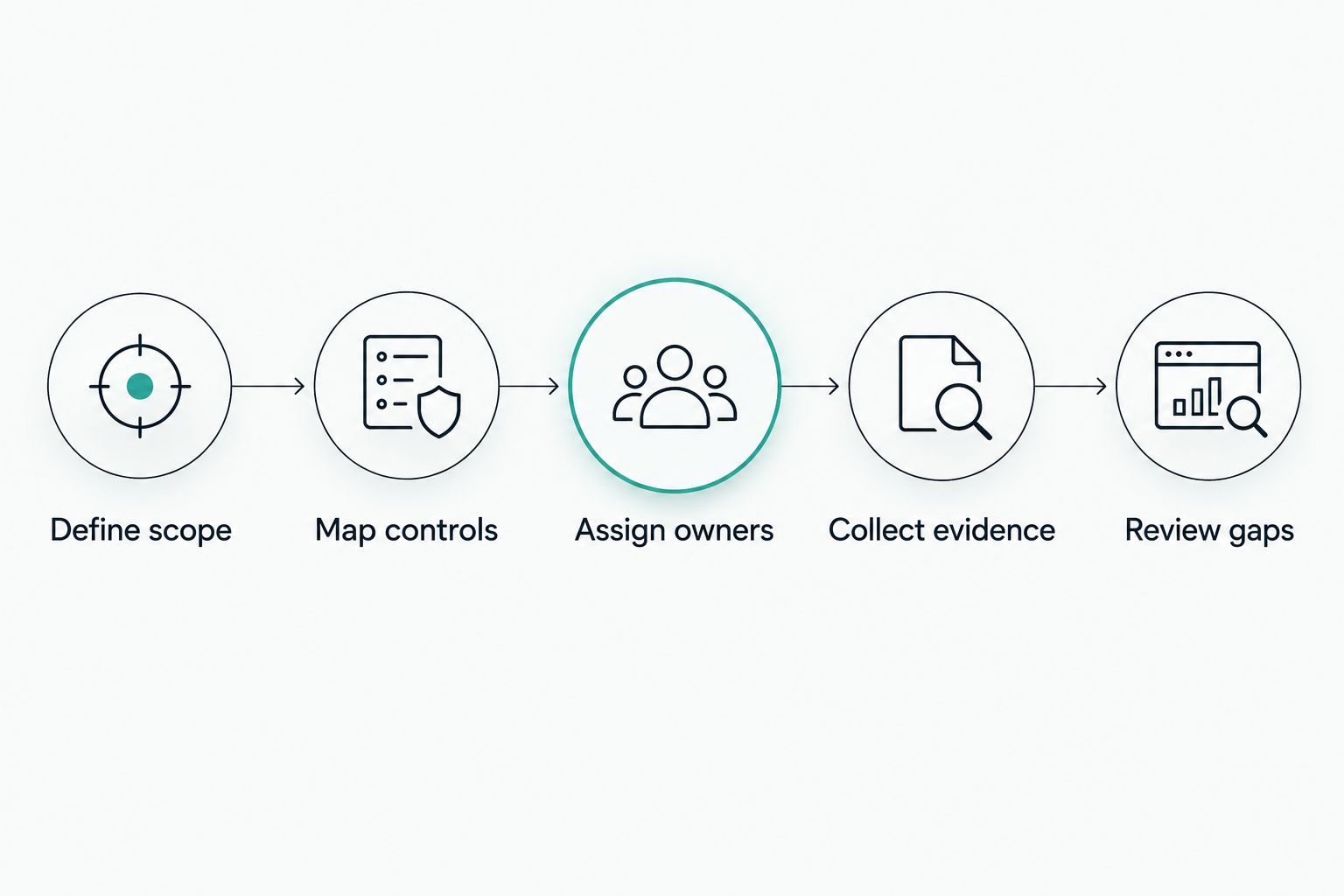
Define the assessment boundaries before mapping shared controls and collecting evidence.
Keep the sequence active after the initial assessments. Changes to services, suppliers or systems can affect the boundaries and evidence needs of either programme.
Why combined compliance effort varies
A platform brings work together, but your scope and existing practices determine what needs doing. These factors explain why a joint programme is not simply a second framework switched on in software:
- Scope differences: separate products or entities need evidence that reflects their actual boundaries.
- Existing security practices: documented, repeatable activities provide a stronger starting point than informal processes.
- Evidence history: a newly introduced control does not create records of earlier operation.
- System coverage: collection methods must reach the systems and records relevant to your assessments.
- Accountability: unresolved approvals, risk decisions and exceptions still require responsible people.
- Assessment requirements: certification and examination teams evaluate evidence against their respective requirements.
For 2026 planning, prioritise gaps that affect both programmes, but do not postpone framework-specific requirements. Shared work creates efficiency only when the separate outcomes remain achievable.
How do you check whether a platform really supports both?
Ask for a demonstration of a complete control workflow, not just two framework dashboards. Use an activity you understand, such as removing access when an employee leaves.
Ask the provider to show:
- Where the activity is defined and who owns it.
- How it connects to each framework’s requirements.
- Which records demonstrate that the activity happened.
- How the evidence retains dates, system context and history.
- What happens when a record is missing or a check fails.
- How an assessor receives the relevant evidence without unrelated information.
Then test a difference between the frameworks. Ask how the platform keeps ISO 27001 management review records distinct from SOC 2 examination evidence.
A useful answer demonstrates both shared work and separate requirements. A list of framework logos does not establish either capability.
Where OneClickComply fits
OneClickComply suits growing businesses seeking ISO 27001 and SOC 2 compliance automation. The platform supports both frameworks and provides security control auto-remediation, policy generation, risk management and trust centres.
Use OneClickComply to assess whether those capabilities match your compliance workflow. During a demonstration, check the specific control mappings, evidence history and assessment access your programme needs rather than assuming every workflow is included.
The practical benefit is support for managing compliance work across both frameworks. The boundary is equally clear: generated policies still need to reflect your business, remediation needs appropriate oversight, and independent assessors determine the assessment outcomes.
Do we need to start both frameworks together?
No. You can build shared security activities while scheduling the assessments separately.
Start with the outcome your customers or contracts require. Keep the other framework’s needs visible so you do not create avoidable rework, but do not expand the programme without a clear business requirement.
Can we use the same policy for both frameworks?
Yes, when the policy addresses the relevant requirements and accurately describes your organisation’s approach. Separate documents are not necessary merely because the frameworks have different names.
Keep framework-specific records separate where their purpose differs. A shared policy does not replace an ISO 27001 Statement of Applicability or a SOC 2 system description.
Does automation mean we can remove human review?
No. Automation can collect records, organise tasks and support remediation, but people still approve policies, assess risks and make exceptions.
Review automated outputs against your actual environment. A completed task is not the same as evidence that a control worked as intended.
Frequently asked questions
One last thing
Before your 2026 assessment planning meeting, choose a shared control and trace it from requirement to evidence to review. If you cannot explain why the record supports each framework, adding more records will not solve the problem.
Make the work shared and the proof specific. Seriously Simple Cyber Compliance.