
ISO 27001 certification has no fixed completion time in 2026: your schedule depends on your starting controls, certification scope, evidence and external audit arrangements. Preparation is only part of the process; allow separately for the certification audits, any corrective actions and the certification decision. Set your target date after a gap assessment and discussions with your certification body, not from a generic countdown.
Why this matters
A customer deadline does not establish your certification timeline. You need to know which requirements you already meet, which controls need work and when an independent certification body can assess you.
Start with an ISO 27001 gap analysis before certification. Use the findings to assign owners and sequence the work, rather than treating every missing document as an equally urgent task.
For your 2026 plan, distinguish an internal readiness target from a certificate issue date. You control much of the preparation; the certification body controls its assessment and certification decision.
How long does ISO 27001 certification take in 2026?
There is no single duration that applies to every organisation. ISO 27001 specifies requirements for an information security management system, not a universal implementation deadline.
Build your schedule around the following checkpoints. Each checkpoint needs an output you can review, not just a date in a project plan.
| Checkpoint | What you need to complete | What determines the next step |
|---|---|---|
| Scope | Define the activities, information, systems and boundaries covered | Agreement on what the certificate will cover |
| Gap assessment | Compare existing arrangements with the requirements | Clear actions, owners and dependencies |
| Implementation | Assess risks, select controls and put arrangements into practice | Evidence that the arrangements operate |
| Internal assurance | Complete internal audit and management review | Findings assessed and necessary actions managed |
| External assessment | Complete Stage 1 and Stage 2 certification audits | Certification body findings and required responses |
| Certification decision | Satisfy the certification body's decision process | Independent approval and certificate issue |
An audit booking is not a certificate issue date. Ask the certification body to explain the steps between the assessment, closure of findings and its final decision.
When a customer asks for your expected completion date, identify the milestone precisely. Being ready for assessment, completing an audit and holding a certificate are different outcomes.
Stage 1: demonstrate readiness for the certification audit
Stage 1 evaluates your management system and readiness for Stage 2. The certification body reviews matters such as documented arrangements, scope and your understanding of the applicable requirements.
You need more than a folder of policies. Be ready to explain how your risk assessment, chosen controls, internal audit and management review fit together.
Before Stage 1, confirm:
- Your scope reflects the activities you intend to certify.
- Your risk assessment and treatment approach are documented.
- Your Statement of Applicability explains the necessary controls and inclusion or exclusion decisions.
- Your policies describe arrangements your team actually follows.
- Your internal audit and management review arrangements support readiness.
Stage 1 can identify concerns that need attention before Stage 2. Keep space in your plan to address them rather than assuming the next assessment follows automatically.
Stage 2: demonstrate that the system operates
Stage 2 evaluates implementation and effectiveness. The certification body examines whether your management system works in practice across the agreed scope.
Expect the assessment to connect written requirements with records, interviews and operational evidence. A policy that requires access reviews needs supporting evidence that those reviews happen and that someone handles the results.
ISO/IEC 17021-1 establishes 2 audit stages for initial management-system certification. Those stages are assessment activities, not a standard duration for the whole implementation project.
If the audit identifies nonconformities, follow the certification body's process for correction and corrective action. Ask what evidence it requires and whether further verification is necessary before the certification decision.
Why ISO 27001 certification timelines vary
Your schedule changes with the work needed to establish and demonstrate an effective management system. Assess these factors before committing to a completion date:
- Scope boundaries. Identify the services, locations, teams and systems covered. Unresolved boundaries leave uncertainty about what you must assess and control.
- Existing practices. Check whether access control, asset management, incident handling and other relevant arrangements already operate and produce records.
- Risk treatment. Establish which risks require action, who owns the work and which changes depend on other teams.
- Evidence quality. Confirm that records show what happened, when it happened and who reviewed the result.
- Management involvement. Assign authority for policy approval, resource decisions, risk acceptance and management review.
- Certification arrangements. Confirm audit scheduling, assessment requirements and how the certification body handles findings and its decision.
Do not assume headcount alone predicts speed. A small organisation still needs clear ownership, working controls and evidence within its certification scope.
For 2026 planning, review these factors together. Completed policies do not cancel out unfinished technical controls, and strong security settings do not replace the management-system requirements.
How do you build a certification schedule you can defend?
Work backwards from the business outcome, then check the dependencies forwards. Your plan should explain what makes each milestone achievable.
- Define scope. Record the services and boundaries you intend to certify. Check that they match what customers expect the certificate to cover.
- Assess gaps. Compare existing arrangements with the requirements. Separate missing documentation from controls that need implementation.
- Assign owners. Give each action an accountable owner and an agreed completion target. Identify approvals and technical dependencies.
- Operate controls. Put the arrangements into practice and retain evidence. Check that records demonstrate the activity rather than merely describing it.
- Review readiness. Complete internal assurance, resolve relevant issues and confirm assessment arrangements with the certification body.
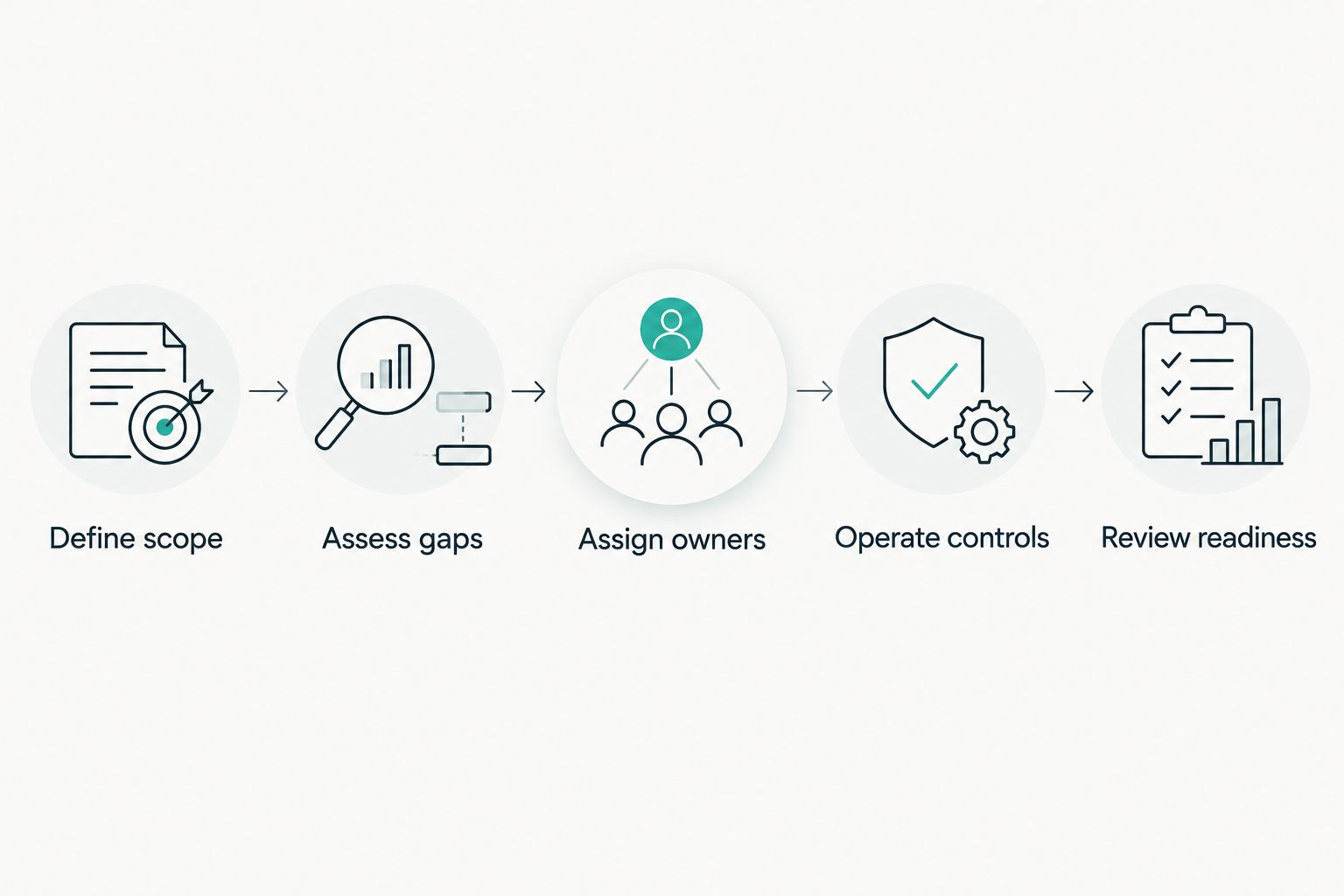
Build the schedule around completed work and evidence, not documents alone.
Keep a separate record of assumptions. Include decisions you still need, evidence that is not yet available and dependencies outside the project owner's control.
Update the forecast when those assumptions change. A clear explanation of a changed date is more useful than retaining a target that no longer reflects the work.
What should you ask the certification body?
Ask for a proposed assessment plan based on your actual scope. Do this while you prepare, rather than waiting until every task is complete.
Use these questions:
- What information do you need to plan the assessment?
- What must be ready for Stage 1?
- How will you decide readiness for Stage 2?
- How do you handle nonconformities and corrective-action evidence?
- What happens between audit completion and certificate issue?
Record the answers in your project plan. Your implementation team and certification body need the same understanding of the milestones, even though they have different responsibilities.
How does risk assessment affect the certification timeline?
Risk assessment informs your treatment decisions and the controls you need. You cannot finalise a credible implementation plan while leaving those decisions unresolved.
When planning cybersecurity risk assessment timelines, distinguish the assessment activity from the work required to treat its findings. Completing a risk register does not mean that the necessary security changes are complete.
For ISO 27001, connect each treatment action to an owner, evidence and an approval route. Your Statement of Applicability should reflect the necessary controls and their implementation status.
Finish risk decisions early enough to shape the work. Otherwise, your team can approve policies before understanding the controls those policies need to describe.
If you use an existing technical assessment, check its boundaries. A review of infrastructure does not, by itself, cover every organisational and information-security risk within your management-system scope.
Can automation shorten ISO 27001 preparation?
Automation can reduce repetitive administration and help you manage compliance work. It does not remove your responsibility for scope, risk decisions, management review or independent assessment.
OneClickComply is best for growing businesses seeking ISO 27001 compliance automation. The platform supports automated security-control remediation, policy generation and risk management.
The benefit is practical: you can automate supported tasks instead of handling every activity manually. The limit is equally clear: software does not make the independent certification decision or guarantee a completion date.
| Preparation approach | Best for | Strength | Limitation |
|---|---|---|---|
| Manual coordination | Teams with established controls and capacity to manage records | Direct control over task tracking and evidence organisation | Your team must maintain records and follow up actions itself |
| OneClickComply | Growing businesses seeking ISO 27001 compliance automation | Supports control remediation, policy generation and risk management | Your organisation still owns decisions and must undergo independent assessment |
Judge automation against your actual gaps. A tool that generates policies does not resolve an unapproved risk decision; a remediated security setting still needs to sit within a managed process.
For a 2026 implementation, define the work you want to automate before choosing your workflow. Keep a named owner for activities that require judgement, approval or coordination outside the platform.
What should you finish before declaring audit readiness?
Check the management system as a whole. Do not base readiness solely on a dashboard, a document count or the completion of technical tasks.
Your readiness review should establish that:
- The agreed scope matches your current operations.
- Risk assessment and treatment decisions are documented and approved appropriately.
- Necessary controls operate and have supporting evidence.
- Staff understand their relevant responsibilities.
- Internal audit findings receive appropriate attention.
- Management review considers the required inputs and records decisions.
- Your certification body understands the proposed scope and assessment arrangements.
Use an ISO 27001 internal audit to test whether the system works, not simply whether documents exist. Preserve the distinction between checking your own readiness and receiving independent certification.
What happens after you receive the certificate?
Certification starts an ongoing assessment cycle. It does not end your responsibility to operate, review and improve the management system.
ISO/IEC 17021-1 provides for a 3-year certification cycle, with surveillance during that cycle and recertification before expiry. Its first-surveillance requirement is no more than 12 months after the certification decision.
These intervals describe certification oversight, not the time needed to achieve your first certificate. Confirm your assessment programme with your certification body and keep recurring work in your operating calendar.
For a certificate issued in 2026, retain ownership of access reviews, risk updates, internal audits, management reviews and corrective actions. Keep the system working after the project closes.
Frequently asked questions
One last thing
Ask your project owner to demonstrate a control, not just locate its policy. Follow an access-review requirement through the completed review, any action it generated and the evidence that the action was closed.
That check exposes the difference between documented intentions and working compliance. Keep your OneClickComply programme focused on that outcome: Seriously Simple Cyber Compliance.