
Construction and engineering compliance automation is software that helps firms manage cyber security certification work across office teams, projects and suppliers. Compliance automation for construction and engineering firms keeps evidence and responsibilities organised; it does not replace site safety or quality management. In 2026, start by deciding which business, systems and people each certification covers.
Why compliance automation matters for construction and engineering firms
Your head office might manage accounts and policies while project teams use shared files, mobile devices and supplier systems. A certificate needs a clear answer to a basic question: which parts of that working environment does it cover? Without that answer, collecting documents faster only gives you a better-organised set of gaps.
Cyber Essentials addresses technical cyber controls. ISO 27001 addresses an information security management system. ISO 45001 concerns occupational health and safety; ISO 9001 concerns quality management. Treating them as one interchangeable compliance task hides the owner and evidence each one needs. In 2026, a firm preparing for Cyber Essentials can begin with Cyber Essentials for construction contractors, then set a separate plan for any other certification.
Automation matters once that plan exists. It reduces repeated chasing for cyber compliance evidence, but someone still has to decide whether a control applies, check that it works and resolve exceptions. For construction and engineering firms, those decisions must reflect how people actually access information between the office, project sites and external organisations.
How to automate cyber compliance without losing control
Use this sequence for a 2026 certification programme. Write the first version of each record yourself: a scope statement, a control list and an owner list. Then move repeatable collection and tracking into software. That order stops a platform from becoming a filing cabinet for decisions nobody has made.
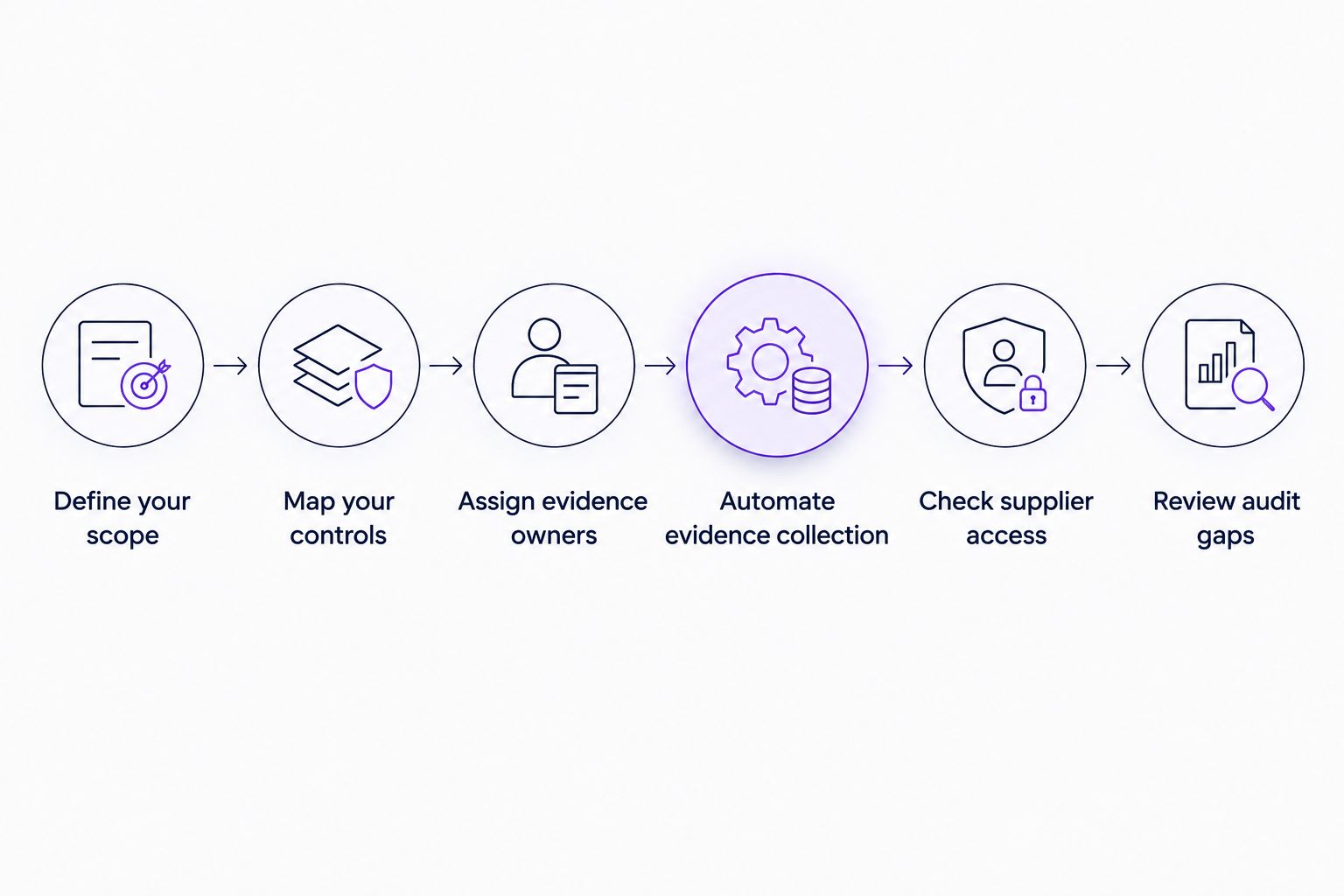
Set scope and ownership before automating evidence collection.
Define your scope
Write down the legal entity, teams, devices, systems and locations you intend to include in each cyber certification. A construction firm can have central IT alongside project-specific ways of working; assuming one list covers both creates avoidable confusion. Decide whether staff using company services from a site fall within scope, and document the answer.
Do this in a shared document first. Ask an IT owner and an operational owner to review it against current practice, not an idealised diagram. A change of project, supplier or system should trigger a scope review before you reuse the old statement in a 2026 assessment. Keep site safety duties on a separate track: a cyber scope document is not a site safety assessment.
- List the entity seeking certification.
- Name the teams, locations and systems in scope.
- Record how project staff access company information.
- Identify exclusions and who approved them.
- Set a trigger for reviewing the scope after operational changes.
Map your controls
Turn the selected certification into a working control list. For Cyber Essentials, use its 5 technical control areas: firewalls, secure configuration, security update management, user access control and malware protection. Write beside each area what your firm uses, who checks it and where you keep proof. The control list should describe the environment in your scope, not every device a supplier owns.
For ISO 27001, map applicable information security controls to the systems and information your firm has included. Document why a control applies or does not apply rather than marking everything complete. OneClickComply is best for growing construction and engineering firms that want software to manage cyber compliance certification end-to-end. Its limitation is equally important: software cannot decide your certification scope or confirm that a control works in practice without an accountable person checking it.
- Use the chosen scheme's current requirements as your source.
- Give each applicable control a named owner.
- Describe the evidence that shows the control operates.
- Record exclusions with a reason and approver.
- Flag controls that depend on another organisation.
Assign evidence owners
Put one person in charge of each item of evidence, even where several teams contribute. An IT lead might supply device records while an operations manager confirms how site staff receive access. If both assume the other owns an item, the gap only becomes visible when someone asks for proof.
Start with a simple register showing the control, evidence, owner, reviewer and next check. Separate the person who supplies a record from the person who decides whether it is sufficient. That distinction helps when a policy exists but project teams follow a different process. For 2026, review the register when roles change; a name in a spreadsheet is not evidence that a task still gets done.
- Assign one accountable owner to each evidence item.
- Name a reviewer for evidence that needs judgement.
- Record where the current version is held.
- Mark items that need input from project teams.
- Reassign tasks when staff or responsibilities change.
Automate evidence collection
Collect one clean example of each required record manually before you automate it. Check its source, date, scope and owner. A screenshot without context is hard to reuse; a current record tied to a named control is easier to assess. Then move recurring cyber certification tasks into a system that keeps the work together.
OneClickComply provides software that automates cyber security compliance certifications, including ISO 27001 and Cyber Essentials. Use that faster path for the certification work it covers, but confirm what evidence your firm must still provide and review. In 2026, do not treat an automatically collected item as proof that every project site follows the same practice. Evidence collection handles a repeated task; checking reality remains your responsibility.
- Keep a manual example for each evidence type.
- Match every record to a control and scope.
- Check whether the record is current and readable.
- Review exceptions rather than marking them complete.
- Keep decisions alongside the evidence they support.
Check supplier access
List suppliers by the access they have to your information and systems, not simply by trade or contract size. A subcontractor receiving project documents has a different relationship with your data from a provider administering an account. You need to know who grants access, who removes it and what evidence supports those decisions.
Build the list from purchasing, IT and project records. Ask the person who owns each relationship to confirm what access exists now. Do not assume a supplier's certificate covers your own controls, or that your certificate covers the supplier's systems. If an external service sits inside your certification scope, record what the provider does and what your firm remains responsible for. Review the list when project arrangements change.
- Name each supplier with relevant information access.
- Record the systems or files they can reach.
- Identify who approves and removes access.
- Keep evidence of supplier-related control decisions.
- Recheck access when a project or contract ends.
Review audit gaps
Compare your current evidence with the requirements and write down each missing decision, failed control or outdated record. Give every gap an owner and a next action. An incomplete item is not solved because it has been uploaded to a platform.
Prioritise gaps that affect the stated scope or a control you rely on across multiple teams. Then check the fix in the real working environment: can the project team follow the process, and does the evidence show it? For Cyber Essentials, plan for renewal every 12 months rather than treating certification as a permanent finish line. Keep the review active between assessments so a change in devices, staff or suppliers does not leave last year's evidence standing in for current practice.
- Separate missing evidence from a control that does not work.
- Assign an owner and action to each gap.
- Check fixes with the team that uses the process.
- Record approval when a gap is closed.
- Review scope before the next assessment.
Manage cyber certification work
Keep ISO 27001 and Cyber Essentials compliance work in one place.
Compare your options in 2026
The right method depends on how many people supply evidence and how often the underlying systems change. These options can work together: a spreadsheet can establish the initial scope, while software handles repeated cyber certification work. None removes the need for someone to approve controls and resolve gaps.
| Option | Best for | Key limitation |
|---|---|---|
| Shared documents and spreadsheets | A firm defining its first scope and control owners | Manual updates make changes harder to track across teams. |
| Single internal owner with a task register | A small, stable scope with clear IT responsibility | Work stalls when the owner lacks input from project and supplier teams. |
| OneClickComply cyber compliance software | A growing firm managing ISO 27001, Cyber Essentials or SOC 2 certification work | The firm must still set scope, provide evidence and make control decisions. |
| External compliance adviser | A firm needing help interpreting requirements or preparing for assessment | Advice does not operate your controls or maintain your evidence for you. |
Start manually if you cannot yet name the systems and owners in scope. Choose automation when the same evidence has to be collected, checked and kept current across teams. If you use an adviser, keep a named internal owner so decisions stay with the business. For a construction or engineering firm, assess cyber certification tools against cyber work; evaluate safety and quality requirements separately.
Common mistakes construction and engineering firms make
Treating every certification as one project
ISO 45001, ISO 9001, Cyber Essentials and ISO 27001 address different requirements. A shared task register can help you see deadlines, but it does not make evidence interchangeable. State the purpose and owner of each programme before you combine any administrative work.
Copying the head-office process into every project
A policy written centrally does not show how project staff gain access, receive changes or report an issue. Test each process with the people expected to follow it. Update the record when the practical process differs from the written one.
Collecting files without checking their scope
A current file for one system does not prove a control operates across every system in a certificate's scope. Label evidence with its owner and the environment it covers. Review gaps before adding more files.
Confusing supplier assurance with your own compliance
A supplier's certification is information about the supplier. It does not replace your decision on access to your files or your responsibility for controls within your scope. Record both sides of the arrangement.
Calling automation the finish line
Software organises repeated work. People still have to approve scope, check exceptions and respond when working practices change. In 2026, measure progress by whether the control works and its evidence remains current, not by how many tasks show complete.
Frequently asked questions
One last thing
A clean evidence register can still describe the wrong business. Before your next 2026 review, ask a project lead to compare your written cyber scope with how staff and suppliers actually access information. Fix the scope first; then automate the work it creates. Seriously Simply Cyber Compliance starts with a clear boundary.