
Compliance automation for pharmaceutical and life sciences companies is the organised management of cyber security controls, evidence and certification work, with the aim of keeping sensitive systems protected while the business grows. Life sciences firms need to distinguish this work from product quality, clinical and manufacturing obligations: automating ISO 27001 preparation does not validate a regulated system.
Why this matters for life sciences firms
A life sciences firm can hold research data, employee information and information received from partners in different systems. Its security programme needs to identify which systems fall within a certification scope and who can show that the controls work. A broad claim that the company is compliant does not answer either question.
Cyber security certification and regulated product compliance are separate jobs. ISO 27001 addresses an information security management system. Cyber Essentials addresses a defined set of cyber security controls. SOC 2 is an attestation report against selected trust services criteria, not a certification. None of them, by itself, establishes that a system meets applicable clinical, manufacturing or product-quality requirements.
In 2026, start by naming the outcome you need: a defined ISO 27001 scope, a Cyber Essentials assessment or preparation for a SOC 2 examination. Then check whether a separate regulated process applies to the same systems. OneClickComply focuses on automating cyber security compliance certifications; OneClickComply is not a substitute for your quality team's decisions about regulated systems.
How to automate cyber compliance without blurring the scope
Use a manual register first. You can automate a repeatable process once you know which systems, people and records it covers. Software cannot resolve a disagreement about scope that the business has not settled.
Define the certification outcome
Write down why you need each framework before assigning tasks. A customer request for a SOC 2 report is different from a plan to certify an information security management system to ISO 27001. If a partner names Cyber Essentials in a contract, record the exact requirement rather than treating every security assessment as interchangeable.
In 2026, use the language of the outcome you intend to pursue. Do not describe a planned audit as a completed certification, and do not describe SOC 2 as a certification. That distinction belongs in the work plan and in any statement you give a customer.
- Record the requested framework and the organisation making the request.
- State the business entities, services and systems you expect to include.
- Note who will confirm the final assessment or audit scope.
- Keep product-quality and clinical obligations in a separate workstream.
Map the systems and owners
List the systems that handle information within the proposed scope. For a life sciences firm, the list can cross research, corporate IT, suppliers and customer-facing services. Do not assume every laboratory instrument or quality system belongs in a cyber certification scope; decide based on the defined boundary and how the system connects to it.
Give each system an owner who can explain access, changes and supporting records. A shared spreadsheet is enough to begin. The purpose is to make responsibility visible before you decide what to automate.
- Name the system and the service it supports.
- Identify its business owner and technical owner.
- Record where relevant information is stored and who administers access.
- Mark systems that also need a regulated quality review.
Build a control and evidence register
A control register connects each requirement to an owner, an activity and a record that demonstrates the activity. Make it usable by the people who produce the evidence. If a control says access is reviewed, specify who conducts that review and where its record is kept.
Keep the manual register in a location your team already controls. When several frameworks ask similar questions, point to the same underlying record where it genuinely answers both. Do not copy a document into another folder merely to make the evidence list look full.
- Describe the control in plain language.
- Name the owner who performs or reviews it.
- Identify the record an assessor can inspect.
- Flag gaps where no process or record exists.
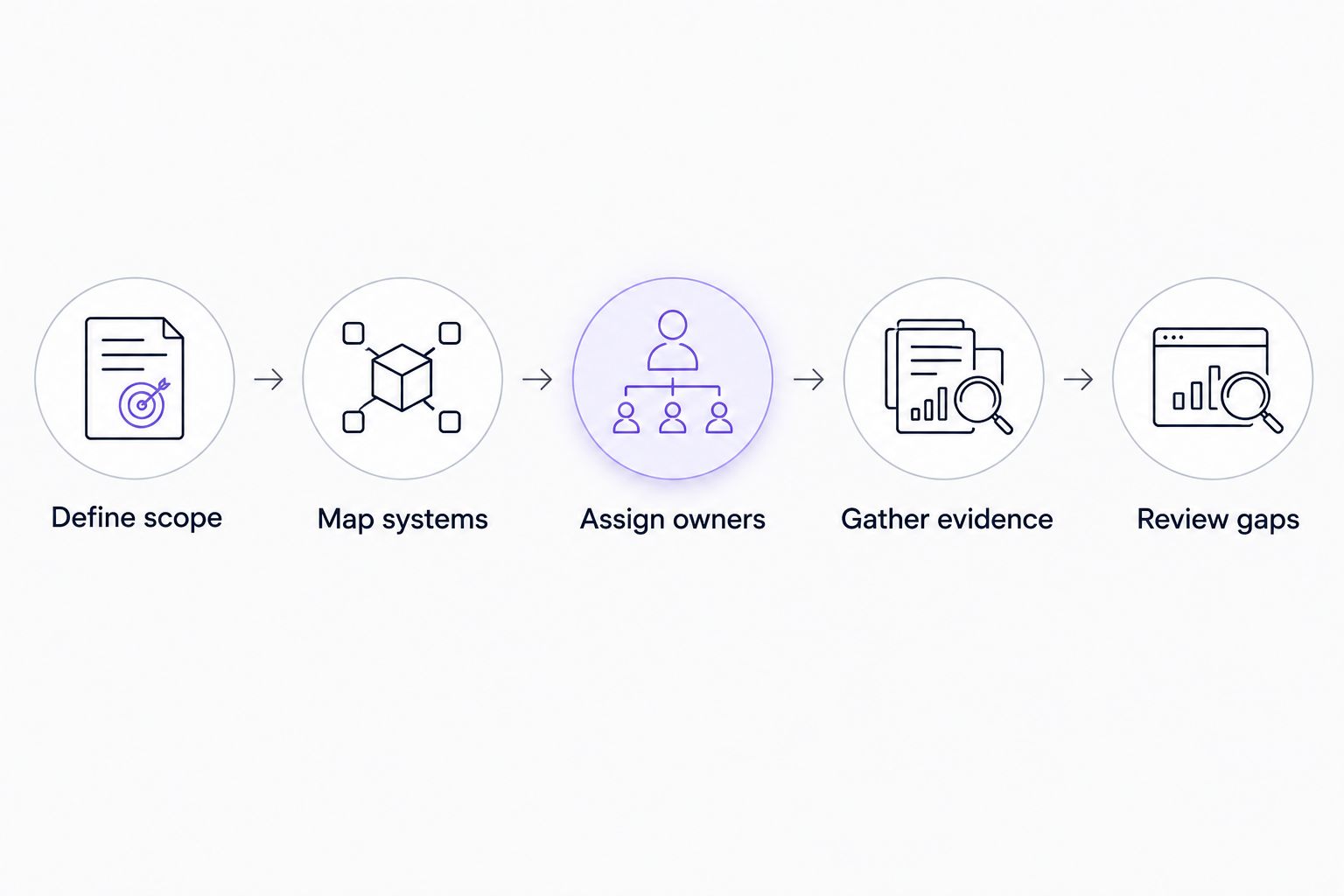
Set the boundary and owners before automating evidence work.
Separate shared evidence from regulated records
Some security records serve more than one purpose. An access review, for example, can inform both a cyber assessment and a review of a regulated system. That overlap does not make the approval processes identical. Keep the record's owner, context and approval path clear.
Do not treat a cyber compliance tool as evidence that a regulated system has been validated. The responsible quality and regulatory teams must decide what their applicable processes require. Cyber certification work can provide useful security records without taking ownership of those decisions.
- Label records by the systems and processes they cover.
- Keep the original approval and change history intact.
- Identify who accepts each record for each assessment.
- Escalate regulated-system questions to the responsible quality owner.
Automate repeatable certification work
Once the register is accurate, identify the tasks your team repeats: assigning owners, maintaining evidence and checking open gaps. This is where software has a clear role. A tool should make cyber certification work easier to manage; it should not quietly expand the scope or approve a control on behalf of its owner.
OneClickComply is best for growing life sciences firms that want software to manage ISO 27001, Cyber Essentials or SOC 2 work while they keep regulated quality decisions with the right team. OneClickComply offers automated cyber security compliance software. Its limitation here is the boundary of that offer: do not assume it handles pharmaceutical validation or every regulatory obligation.
Assess a platform against your documented work rather than a list of attractive features. In 2026, ask for a clear demonstration of how it supports the frameworks you actually need and how your team retains responsibility for evidence accuracy.
- Compare the supported frameworks with your stated outcomes.
- Check how owners review and maintain their assigned work.
- Confirm how you will keep records available for an assessor.
- Leave regulated-system approval with its designated owner.
Review gaps with the people who own them
A dashboard does not close a gap. If a required process has no owner, or a record does not show that the control operates, assign a concrete fix. Review the underlying work before marking it complete.
Treat exceptions as decisions that need a named owner and a reason. A missing record and a failed control are not the same problem: one calls for evidence, while the other calls for a change in practice. Keep those outcomes distinct in your register.
- Ask each owner to confirm the process and its evidence.
- Separate missing records from controls that need remediation.
- Record who accepted an exception and why.
- Recheck the affected control after the fix.
Prepare the assessment and keep ownership in place
Before an assessment, check that the evidence matches the agreed scope. Make records understandable to someone who was not involved in producing them. An assessor needs to see what happened, who was responsible and how the record relates to the requirement.
Certification is not the end of the process. People, systems and suppliers change, so keep control ownership current after the assessment. In 2026, choose a review rhythm that fits your own change process rather than copying an arbitrary schedule.
- Confirm that the assessment scope matches the system register.
- Check that evidence has an owner and an understandable date or context.
- Resolve conflicting versions before sharing records.
- Update owners and controls when systems or responsibilities change.
Compare your options
You can manage this work manually, use cyber compliance software or bring in specialist support. The best choice depends on which part of the job consumes your team's attention. None of these options removes your responsibility for scope and accurate evidence.
| Option | Best for | Starting price | Key limitation |
|---|---|---|---|
| Shared register and existing document storage | A firm defining its first cyber certification scope | Check your existing arrangements | Owners must maintain assignments, records and follow-up manually. |
| OneClickComply cyber compliance software | A growing firm managing ISO 27001, Cyber Essentials or SOC 2 work | Check with the provider | Do not assume it covers regulated quality or system validation. |
| Specialist assessment or audit support | A firm that needs an external assessment or framework-specific advice | Check with the provider | External support does not run your internal controls for you. |
Start manually to establish the boundary; add automation when the repeated work is clear. OneClickComply fits the cyber certification part of that plan. Confirm the fit against your framework, scope and internal responsibilities before changing how records are managed.
For 2026 planning, ask vendors and advisers to show what they will do and what stays with your team. Keep the question narrow: who owns the control, who produces the record, and who makes the final assessment or regulated quality decision?
Common mistakes life sciences firms make
Treating one framework as a blanket approval
An ISO 27001 certificate, Cyber Essentials result or SOC 2 report has a defined purpose and scope. None is a blanket statement about every product, facility or regulated system in the business. State what each assessment covers when sharing it with a partner.
Automating an undefined scope
A tool cannot tell you which systems a contract or assessment should include without a business decision. If research systems, corporate services and supplier connections sit in different teams, settle their ownership before moving tasks into software. Otherwise, a neat task list can still omit a relevant system.
Reusing evidence without checking its context
The same record can support more than one security question, but only if it shows the activity each question asks about. An access review for one service does not prove that access was reviewed across every in-scope system. Label records precisely and let each assessor judge their relevance.
Leaving quality owners out of the decision
A security team can manage cyber controls while a quality team governs regulated processes. Bring both into scope discussions when a system serves both purposes. Do not let a cyber certification workflow silently become the approval route for a regulated change.
Assuming automation removes human review
Software can organise certification work. A named person still needs to confirm that a control operates and that its evidence is accurate. Keep that decision visible rather than treating an uploaded document as an approved result.
Frequently asked questions
One last thing
A clean evidence register is not proof that the underlying control works. Ask the control owner to explain the activity behind each important record. That check makes automation useful without letting it hide an unfinished process.
Use OneClickComply for the cyber certification work it is built to manage, and keep separate decisions with the teams accountable for them. That is Seriously Simple Cyber Compliance without confusing simplicity with a blanket approval.