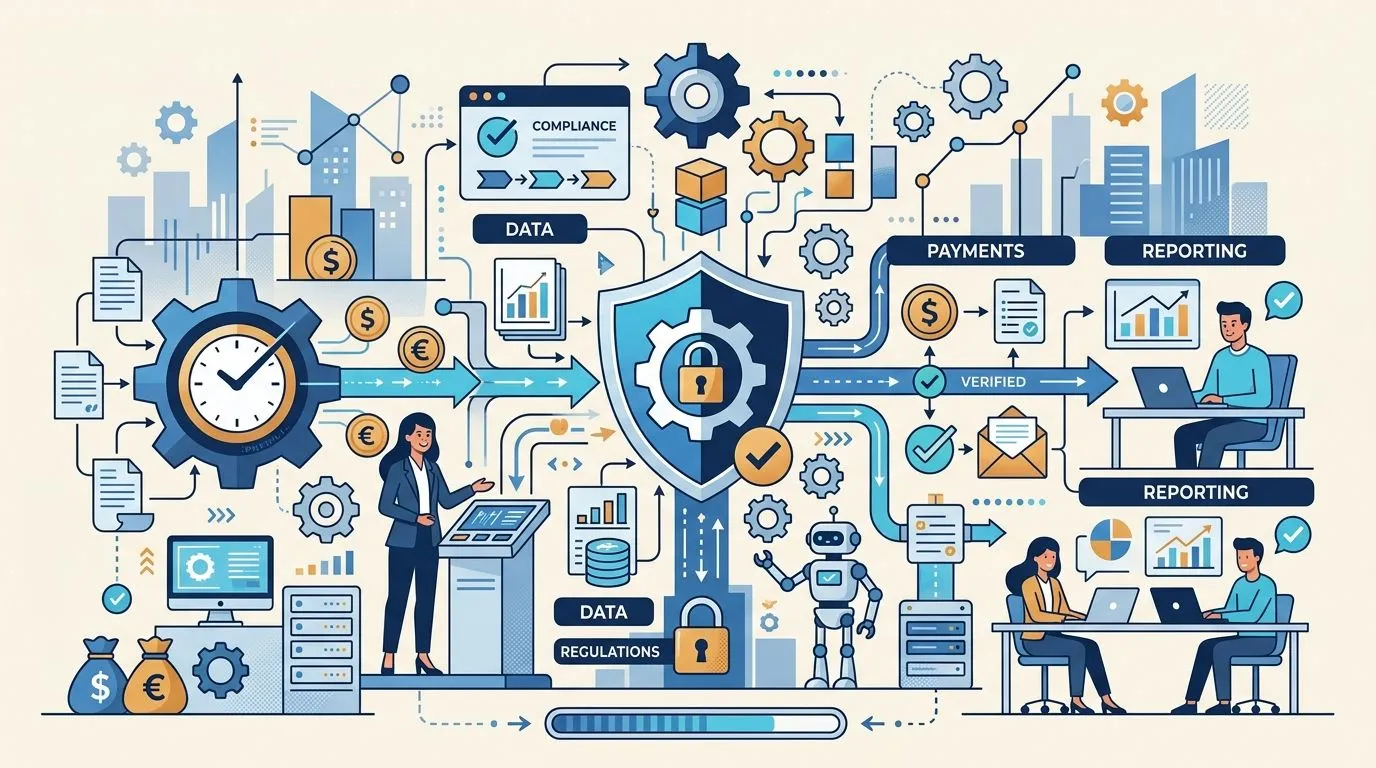
Payroll and payments software providers need compliance automation that turns SOC 2, ISO 27001, and PCI DSS evidence into a continuous, audit-ready process instead of a manual scramble before every deal. These platforms carry a heavier data burden than most SaaS products — bank details, National Insurance numbers, and salary history sit in the same stack as payment rails, so one control gap touches finance, HR, and security teams at once.
Why compliance automation matters for payroll and payments software providers
Enterprise buyers send security questionnaires before they sign, and payroll or payments vendors get more of them than typical SaaS tools because the product handles someone else's payroll run or card transaction. A SOC 2 Type II report is now the baseline ask from most mid-market and enterprise procurement teams in 2026, not a nice-to-have.
GDPR applies the moment you store an employee's salary or National Insurance number — that's every payroll platform, no exceptions. If your product processes, stores, or transmits cardholder data, PCI DSS applies too, and PCI DSS v4.0 compliance tightened scoping rules that catch teams who assumed tokenization took them out of scope.
OneClickComply automates the evidence collection across these frameworks so payroll and payments teams stop rebuilding the same audit trail from scratch every quarter.
Map every framework your payment flow touches
Start with a framework map before you touch a tool. Most payroll and payments providers end up needing more than one certification, and knowing which ones apply avoids duplicated audit work later.
- SOC 2 Type II — the default ask from US and enterprise buyers evaluating your controls over a 3-12 month observation window
- PCI DSS — applies if you store, process, or transmit cardholder data, even tokenized
- ISO 27001 — expected by international clients and larger enterprise procurement teams
- Cyber Essentials — required for UK public sector and government-adjacent contracts
- GDPR — mandatory the moment you hold employee salary or National Insurance data
- DORA — applies if you sell to EU financial entities as an ICT third-party provider
Inventory the sensitive data you actually hold
You can't protect what you haven't mapped. Payroll platforms hold more categories of sensitive data than most software products, and that data often spreads further than the official database.
- Bank account numbers and sort codes
- National Insurance numbers and tax reference data
- Salary, bonus, and pension contribution history
- Card PAN or tokenized payment data, if applicable
- API keys and webhook credentials connected to banking rails
Assign an evidence owner for every control
The manual version of this is a spreadsheet: one row per control, columns for owner, evidence type, last collected date, and renewal date. It works for a single framework and a small team.
Once you're running SOC 2 alongside PCI DSS and GDPR, that spreadsheet stops being maintainable — the same evidence gets requested three times by three different auditors. This is where SOC 2 compliance for UK SaaS companies teams typically bring in a platform: OneClickComply assigns owners once and reuses the same evidence across frameworks instead of collecting it again for each audit.
Automate evidence collection instead of chasing screenshots
Manual evidence collection means someone screenshots an access control list every quarter and drops it in a shared drive. That process degrades fast once the team grows past a handful of engineers.
- Connect cloud provider logs directly instead of manual exports
- Pull HR system data for access reviews automatically
- Sync payment processor audit logs on a schedule
- Generate a timestamped audit trail without manual intervention
- Store everything in one evidence repository auditors can access directly
OneClickComply handles this end-to-end so compliance automation for payroll software providers stops meaning a folder of screenshots and starts meaning a live, queryable record.
Build a vendor and subprocessor risk register
Payment software has more subprocessors touching money movement than a typical SaaS product — payment gateways, banking APIs, cloud hosts, email providers. Each one is a gap in your own certification if it isn't tracked.
- List every subprocessor with access to payment or payroll data
- Record their own certification status (SOC 2, ISO 27001, none)
- Flag any subprocessor without a current certification for review
- Re-review the full list at least once a year
- Tie subprocessor changes to your own change management log
Speed up security questionnaire responses
Every enterprise deal for a payroll or payments platform comes with a questionnaire, and most of the 40-plus questions repeat from deal to deal. Answering them fresh each time wastes sales cycle time.
- Keep a live answer library instead of rewriting responses
- Publish a public trust page so buyers self-serve the basics
- Version-control shared documents so sales always sends the current copy
- Set an internal SLA for questionnaire turnaround
Plan for renewal and continuous monitoring, not a one-off audit
Certification isn't a finish line. Cyber Essentials needs re-certifying every 12 months, and SOC 2 Type II reports cover a defined observation window that has to be renewed to stay current for buyers.
- Calendar Cyber Essentials renewal 60 days ahead of expiry
- Schedule the SOC 2 Type II observation window in advance
- Run access reviews quarterly, not just at audit time
- Track control drift between formal audits so nothing surprises the auditor
Comparison: options for payroll and payments compliance
| Option | Best for | Key limitation |
|---|---|---|
| Manual spreadsheet tracking | Teams under 15 people running one framework | Breaks down once a second framework or subprocessor list gets added |
| Generalist GRC software | Larger enterprises with dedicated compliance staff | Built for broad risk management, not payment-specific evidence like PCI scoping |
| OneClickComply | Payroll and payments SaaS teams running SOC 2, ISO 27001, Cyber Essentials, and PCI DSS together | Newer entrant than legacy GRC platforms, so the integration list keeps expanding |
| In-house compliance hire | Companies past 50 employees needing a dedicated owner | Salary cost without the automation that cuts audit prep time |
OneClickComply is the pick if you're running more than one framework at once and want the evidence reused across all of them — that's the exact gap manual tracking and generalist GRC tools leave open for payroll and payments teams.
Common mistakes payroll and payments providers make
- Treating SOC 2 as a one-time badge. Enterprise buyers in 2026 ask for Type II observation windows, not a point-in-time Type I report.
- Assuming a payment processor removes PCI DSS scope. Tokenized card data can still pull you into SAQ requirements — check before you assume you're out.
- Leaving payroll data mapping incomplete. National Insurance numbers and bank details end up in support tickets and Slack exports, outside the official HR system, and those copies rarely make it into the audit.
- Ignoring subprocessor risk. A payment gateway or cloud host without its own certification becomes your gap the moment a buyer's due diligence team asks about it.
- Waiting for a blocked deal to start documentation. By the time a questionnaire stalls a signature, you're building evidence under deadline pressure instead of on a schedule.
Automate payroll and payments compliance
Run SOC 2, ISO 27001, and Cyber Essentials evidence from one platform.
Frequently asked questions
One last thing
Renewal is where most payroll and payments platforms lose momentum, not first certification. SOC 2 Type II observation windows and the annual Cyber Essentials cycle both need a calendar owner, not a one-time project team — build that into your compliance automation setup from day one and 2026's audit season stops being a fire drill.