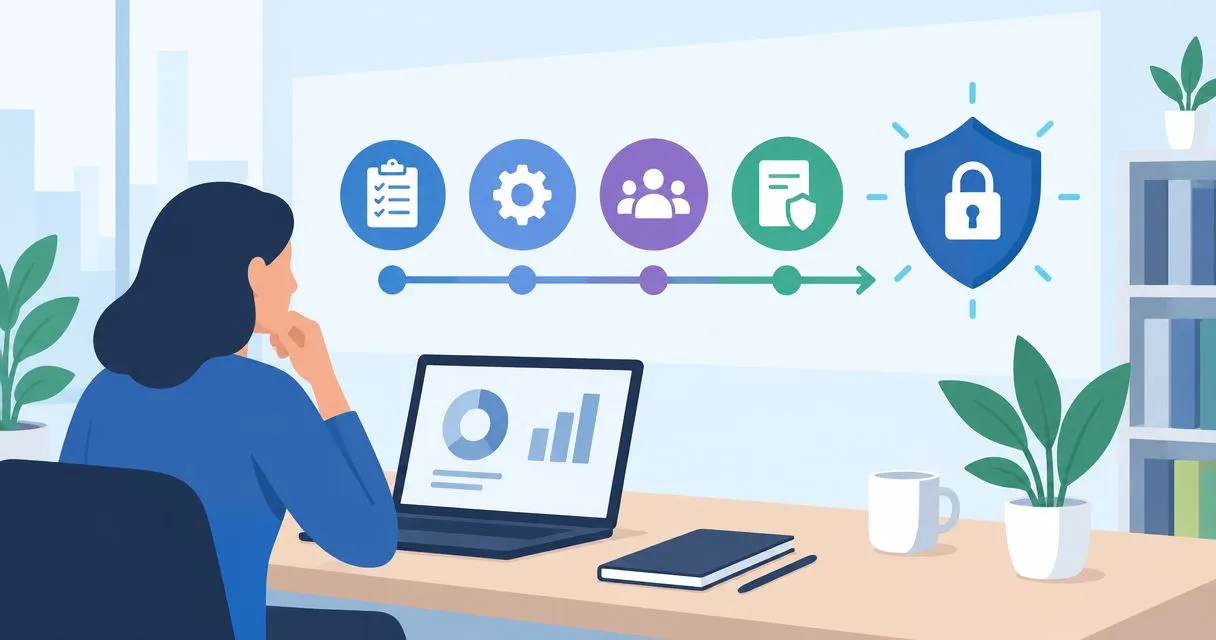
There is no fixed duration for building a SOC 2 readiness programme from scratch: your scope, existing controls and evidence gaps determine the schedule. Readiness also excludes the independent examination and, for a Type II report, the period over which your controls must operate. For your 2026 plan, set a defensible target after assessing those dependencies—not before.
How long does it take to build SOC 2 readiness from scratch?
You can set a credible readiness date once you know what needs fixing, who will fix it and what evidence the auditor expects. A generic deadline cannot tell you whether your actual systems and processes are ready.
Start with a SOC 2 readiness checklist. Turn each gap into a task with an owner, a dependency and a clear completion condition.
Build your estimate through these steps:
- Confirm scope. Identify the service, systems, people and relevant Trust Services Criteria covered by the examination.
- Assess gaps. Compare current practices and evidence against the controls you need.
- Implement controls. Fix technical weaknesses and establish the required operating processes.
- Check evidence. Confirm that records demonstrate what your controls actually do.
- Review readiness. Resolve outstanding issues and agree the examination approach with your auditor.
Estimate the work behind each step with its owner. Then identify tasks that depend on earlier work finishing; those dependencies determine your earliest credible completion date.
Why this matters
A readiness deadline and a report delivery deadline are different commitments. Mixing them creates a project plan that leaves no room for the independent examination or follow-up requests.
For your 2026 customer commitments, use precise language. Say whether you are building the programme, preparing for examination, operating controls during a reporting period or awaiting the report.
That distinction also improves internal decisions. Engineering needs a defined remediation backlog, leadership needs unresolved risks, and sales needs an accurate statement it can share with buyers.
Build the programme around completion conditions
Use the following stages to organise your work. These are planning steps, not mandatory durations or a promise that every business follows the same sequence.
Confirm scope
Define the service customers rely on and the systems that support it. Include relevant people, infrastructure, software, data and procedures rather than starting with a list of policy templates.
Document which Trust Services Criteria apply. Security is central to SOC 2; additional categories depend on the service and commitments covered by the examination.
Completion condition: you have a written system boundary, an agreed reporting objective and a clear understanding of the relevant criteria. Discuss these with your auditor before building the rest of the programme around them.
Assess gaps
Compare your existing controls with the requirements of the planned examination. Separate controls that already work from controls that exist only on paper.
For each gap, record:
- What needs to change.
- Who owns the change.
- What must happen first.
- What evidence will demonstrate completion.
- Who will review the result.
Completion condition: every identified gap has an owner and a defined next action. A task marked as pending without either is not a usable scheduling input.
Implement controls
Put the agreed controls into operation. Depending on your scope and assessment, this can include access management, change approval, incident handling, supplier oversight and other security processes.
Write policies that match those processes. If a policy promises a review that nobody performs, you have created another gap rather than closed one.
Completion condition: the control owner can show how the control works, who performs it and where its records are kept. Technical configuration alone does not demonstrate every part of an operating process.
Check evidence
Review records while you implement controls, not just before the examination. Check whether each record identifies the relevant system, activity, date and reviewer where those details are needed.
Evidence should show execution. A blank access-review template describes an intended process; a completed review records what happened and the decisions made.
Completion condition: you can trace each control to relevant evidence and explain any gaps or exceptions. Keep the source records accessible rather than relying on an unexplained completion tick.
Review readiness
Walk through the programme before treating it as ready. Ask control owners to demonstrate their processes and retrieve supporting records without reconstructing events from memory.
Review unresolved findings with the people responsible for the examination. Distinguish issues that block the planned approach from matters that need a documented response or further discussion.
Completion condition: you understand the remaining issues, have agreed how to address them and have confirmed the next examination steps. Readiness is a supported decision, not a dashboard percentage.
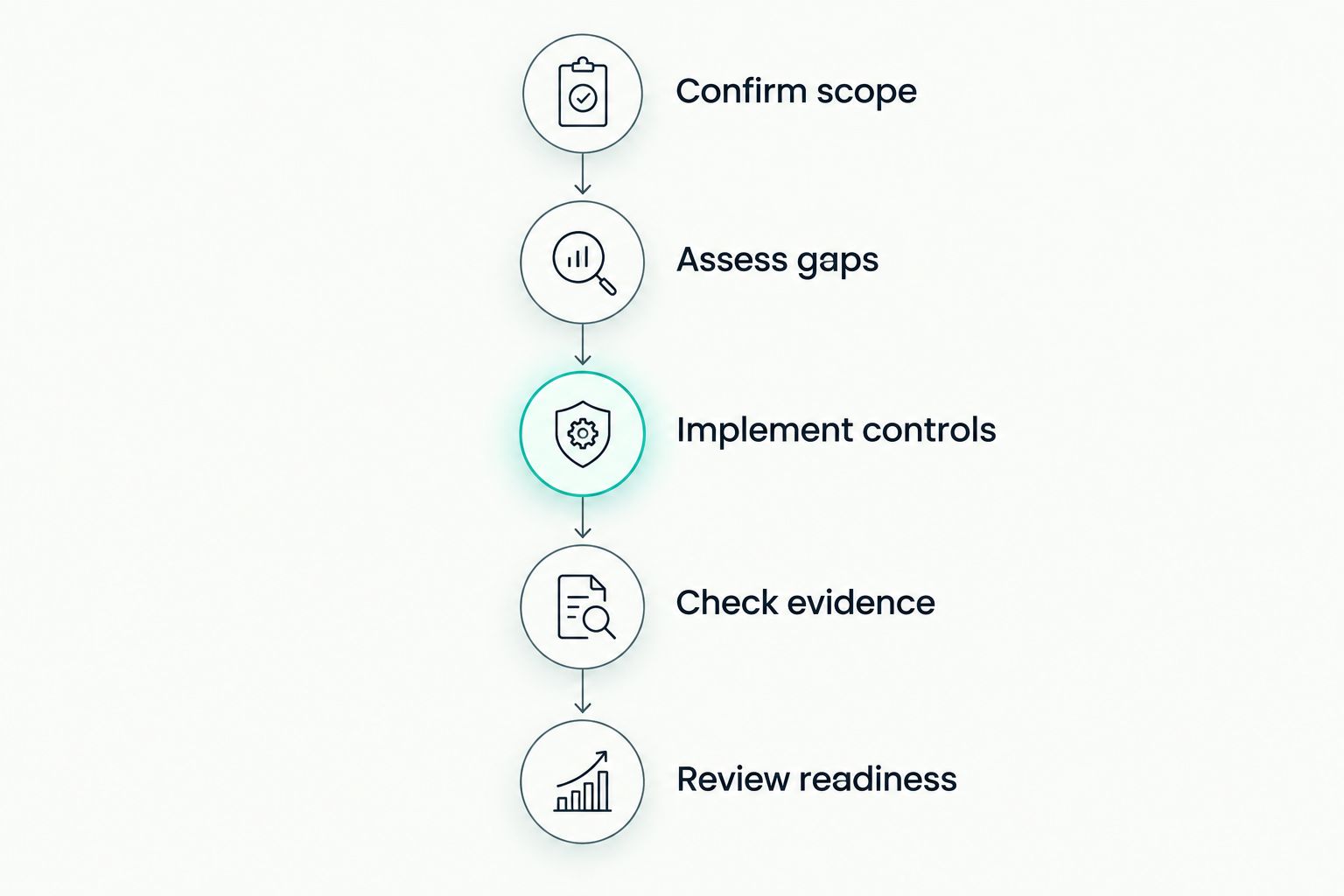
Define what completion means at each stage before committing to a readiness date.
Type I and Type II need different scheduling decisions
Under the AICPA's SOC 2 reporting model, a Type I report addresses control design at a specified date. A Type II report also addresses operating effectiveness over a specified period.
Choose the report your intended users need. Do not choose Type I solely because a point-in-time examination appears easier to schedule.
| Reporting route | Best for | What you prepare | Benefit | Limitation |
|---|---|---|---|---|
| SOC 2 Type I | Buyers that accept assurance about control design at a specified date | Defined systems, suitable control design and supporting documentation | Provides point-in-time assurance about control design | Does not provide the same operating-effectiveness assurance as Type II |
| SOC 2 Type II | Buyers that need assurance about controls operating over a period | Control design plus evidence of operation throughout the reporting period | Addresses operating effectiveness over time | Requires evidence covering the agreed period, not just the examination date |
Your 2026 project plan should show the readiness milestone separately from the Type II reporting period and report delivery. Agree the reporting period and evidence expectations with your auditor rather than assuming a universal duration.
A completed readiness project does not produce a SOC 2 report by itself. The independent examination remains a separate activity.
Why SOC 2 readiness timelines vary
These factors determine the work you need to schedule. Assess them against your own service rather than using company size as a substitute for a gap assessment.
- Scope breadth. Each included service and supporting environment needs to be understood and covered by relevant controls.
- Existing control maturity. An established process with usable records needs different work from an informal practice that relies on memory.
- Technical remediation. Configuration changes, access clean-up and other fixes require engineering ownership and an agreed implementation path.
- Evidence quality. Missing, incomplete or unclear records create work even when the underlying activity happened.
- Team capacity. Tasks remain unfinished when control owners have no allocated time to perform or review them.
- External dependencies. Supplier information, specialist testing and auditor coordination introduce work outside your direct control.
Schedule around the longest chain of dependent tasks. Parallel work helps only when the people responsible have capacity and the tasks do not depend on unfinished decisions.
For example, you can draft an access-management policy while reviewing current permissions. You cannot demonstrate that a newly introduced access-review process operated before it existed.
How do you turn a gap assessment into a credible date?
Ask each owner to estimate their actual tasks after the scope is agreed. Keep implementation work separate from review and approval so the schedule reflects both.
Use a task record with these fields:
| Field | What to record |
|---|---|
| Action | The specific change or activity required |
| Owner | The person responsible for completion |
| Dependency | Work or decisions needed before the task proceeds |
| Evidence | The record that will demonstrate completion |
| Reviewer | The person who checks the result |
| Target date | The date agreed with the owner |
Then test the plan against available capacity. If the same engineer owns several overlapping tasks, those tasks are not automatically parallel.
For a 2026 launch or procurement deadline, work backwards from the report the buyer needs. Confirm examination scheduling with the auditor, then establish the readiness milestone and internal task dates that support it.
Keep assumptions visible. A date based on an unresolved scope decision is a planning assumption, not a commitment.
Can automation shorten SOC 2 readiness work?
Automation can reduce repeatable administrative work, but it cannot replace management decisions or create a history of control operation. Assess the work being automated rather than treating platform adoption as proof of readiness.
OneClickComply is best suited to growing businesses that want SOC 2 compliance automation for control remediation, policies and risk management. OneClickComply provides those capabilities alongside trust-centre management.
The practical benefit is support for work your team otherwise needs to organise and maintain. The limitation is equally clear: you still need to define scope, approve policies, assign responsibilities and support the independent examination.
Use OneClickComply to support the programme, not to substitute a software completion score for an auditor's assessment. Ask who checks each automated action and how the resulting records support your controls.
Can you build readiness while controls are already operating?
Yes, you can develop documentation and assess evidence while existing controls operate. Keep a clear record of what was already in place and what you introduced during the project.
Do not describe a new process as longstanding because an older policy mentioned it. Discuss changes during a planned Type II reporting period with your auditor so the examination approach reflects the actual control history.
Should you finish every policy before starting remediation?
No, you should develop policies and remediation together. Document the process you intend to operate, test whether the team can perform it and update the policy to match the approved approach.
Prioritise dependencies instead of document volume. An approved policy matters, but it does not remove the need to configure a control, perform a review or retain evidence.
Frequently asked questions
One last thing
A control can be configured correctly and still lack the evidence needed to explain its operation. Before closing a readiness task, ask its owner to retrieve the record and show what it proves.
For your 2026 programme, make that demonstration part of completion. Finish with working controls and explainable evidence—not just finished documents. Seriously Simple Cyber Compliance.