
DORA compliance has no fixed total cost for UK financial firms: your budget depends on which entities fall within scope, the controls already operating and the work needed to close gaps. A software subscription excludes staff time, legal review, technical fixes and resilience testing. For 2026, establish your regulatory position first, then budget separately for implementation and ongoing operation.
Why this matters
The wrong scope produces the wrong budget. An EU-regulated group entity and a UK supplier serving that entity do not have identical obligations. Neither should buy an identical compliance package without checking the work involved.
Start with a DORA gap analysis for ICT risk management. Identify the applicable requirements, existing evidence and unresolved gaps before requesting proposals.
For your 2026 budget, separate spending required by DORA from work required by UK regulation or customer contracts. Shared controls can support several obligations, but the legal basis and evidence requirements remain distinct.
How much does DORA compliance cost for UK financial firms?
There is no defensible universal total. Build your estimate from defined work packages rather than a headline software figure or an unsupported market average.
DORA is the EU Digital Operational Resilience Act. It sets requirements for in-scope financial entities covering technology risk, incident reporting, resilience testing and ICT supplier risk, among other areas.
Use this breakdown to request comparable proposals. Keep internal effort visible even when an external provider handles delivery.
| Budget component | Initial work | Recurring work | Evidence to request |
|---|---|---|---|
| Scope and governance | Confirm entities, obligations and accountable owners | Review organisational and regulatory changes | Written scope and responsibility map |
| ICT risk management | Assess gaps and fix missing controls | Review risks and control performance | Risk assessments and remediation records |
| Incident management | Define classification, escalation and reporting procedures | Exercise procedures and maintain contact details | Incident records and exercise findings |
| Resilience testing | Establish a risk-based testing programme | Run applicable tests and address findings | Test scope, reports and closure evidence |
| Supplier oversight | Map ICT arrangements and review contracts | Update records and monitor relevant suppliers | Register of information and contract reviews |
| Software and administration | Configure workflows and organise evidence | Maintain records, access and processes | Agreed scope and responsibility split |
Your budget must cover delivery, review and maintenance. A proposal that supplies policy templates but excludes implementation does not cover the same work as a proposal that fixes controls and validates them.
Separate implementation from ongoing operation
Implementation covers the changes needed to establish an operating programme. Examples include assigning responsibilities, reviewing contracts, documenting reporting procedures and resolving technical weaknesses.
Ongoing operation covers keeping that programme effective. Include control reviews, supplier changes, exercises, training, evidence maintenance and management oversight.
Build a 12-month operating plan alongside the implementation plan. This is a budgeting recommendation, not a statutory requirement to buy an annual service.
Does DORA apply directly to your UK firm?
A UK address alone does not make a firm subject to DORA. Assess the legal entity, its authorisation, its activities and any relevant exclusions rather than treating all UK financial services businesses as one category.
An EU subsidiary can have direct obligations even where its parent company is British. A UK ICT supplier can face DORA-related contractual requirements from an in-scope financial customer; designated critical ICT providers also face a specific EU oversight framework.
These routes create different work packages. Confirm the position with qualified legal or regulatory advice where your structure crosses borders.
| Position | What to establish | Budget consequence |
|---|---|---|
| In-scope EU financial entity within a UK group | Applicable entity-level obligations and proportionality | Fund the relevant operating requirements, governance and evidence |
| UK ICT supplier serving an in-scope customer | Contractual obligations, services supported and customer requests | Fund the agreed supplier requirements rather than assuming every financial-entity obligation applies |
| UK financial firm without an established direct DORA obligation | UK regulatory duties and any group or contractual commitments | Separate UK operational resilience work from DORA-specific work |
For 2026 planning, record the conclusion for each legal entity. Do not apply a group-wide label without documenting what it means locally.
Why DORA compliance spending varies
These factors determine the work required. Ask providers to explain their assumptions against each one before comparing proposals.
- Regulatory scope. Direct financial-entity obligations differ from contractual supplier commitments. Establish the applicable requirements before commissioning work.
- Existing controls. Current risk assessments, tested recovery procedures and maintained records give you a different starting point from undocumented processes.
- ICT complexity. More systems and dependencies mean more relationships to assess, document and test. Focus on the services supporting critical or important functions.
- Supplier arrangements. Contract gaps, subcontracting dependencies and incomplete supplier information create review and follow-up work.
- Testing requirements. A routine testing programme differs from advanced threat-led penetration testing. Apply the requirements relevant to your entity.
- Delivery responsibilities. Internal staff, external specialists and software handle different tasks. Specify who implements changes, reviews evidence and accepts residual risk.
Do not use headcount as the only sizing measure. Ask how your systems, services, entities and supplier dependencies affect the proposed scope.
What testing should your budget include?
DORA does not turn every financial firm into a candidate for the same advanced test. Distinguish the general resilience-testing programme from threat-led penetration testing for entities identified under the relevant rules.
Under DORA Article 24, in-scope financial entities other than microenterprises must ensure appropriate testing at least annually on ICT systems and applications supporting critical or important functions. The testing programme must reflect risk; an annual test is not a substitute for selecting suitable coverage.
Under DORA Article 26, financial entities identified for advanced threat-led penetration testing generally undertake it at least every 3 years. The competent authority can adjust that frequency, and this requirement does not apply to every UK financial firm.
Use these statutory frequencies when checking your 2026 testing plan. Confirm the applicable technical standards and supervisory requirements before commissioning a test.
Ask the testing provider to state:
- Which systems, services and dependencies the engagement covers.
- Which testing methods the scope includes.
- Whether production environments are involved and how risks are controlled.
- What reporting, remediation support and retesting the engagement includes.
- Which activities your own team must complete before testing starts.
Keep remediation separate from discovery. Finding a weakness and fixing it are different tasks; assign an owner and delivery plan for both.
Which delivery approach fits your team?
Choose the approach after defining the work. Software, internal staff and advisers are not interchangeable.
| Approach | Best for | Main advantage | Main limitation |
|---|---|---|---|
| Internal delivery | Firms with accountable owners and sufficient specialist capacity | Keeps operational knowledge close to the controls | Competes with existing responsibilities and requires specialist skills |
| External specialists | Firms needing defined legal, technical or testing expertise | Adds expertise for a specific work package | Requires clear deliverables, handover and internal ownership |
| Compliance software | Firms organising repeatable tasks, policies and evidence | Provides a structured way to manage recurring work | Does not transfer regulatory accountability or automatically fix every gap |
OneClickComply is best for growing businesses seeking compliance automation. The platform generates policies, manages risk and automates remediation of security controls.
Those functions are relevant when assessing compliance administration. Before selecting OneClickComply, confirm the DORA-specific mappings, reporting outputs and workflows your programme needs; do not assume general automation covers every regulatory requirement.
How do you build a useful DORA budget?
Use a sequence that connects each spending decision to a requirement and an accepted deliverable. Keep the same scope when comparing providers.
- Confirm scope. List legal entities, relevant authorisations, services and customer commitments. Record which requirements apply and why.
- Map gaps. Compare each applicable requirement with controls and evidence already in place. Separate missing documentation from controls that do not operate.
- Assign owners. Name the person accountable for each gap. Specify which tasks need legal, technical or operational expertise.
- Compare proposals. Give each provider the same work packages. Ask for inclusions, exclusions, dependencies and acceptance criteria.
- Plan maintenance. Assign recurring reviews, testing, updates and reporting. Include the internal effort needed to keep records current.
The sequence matters. Selecting software before confirming scope leaves you checking whether the purchase fits the programme afterwards.
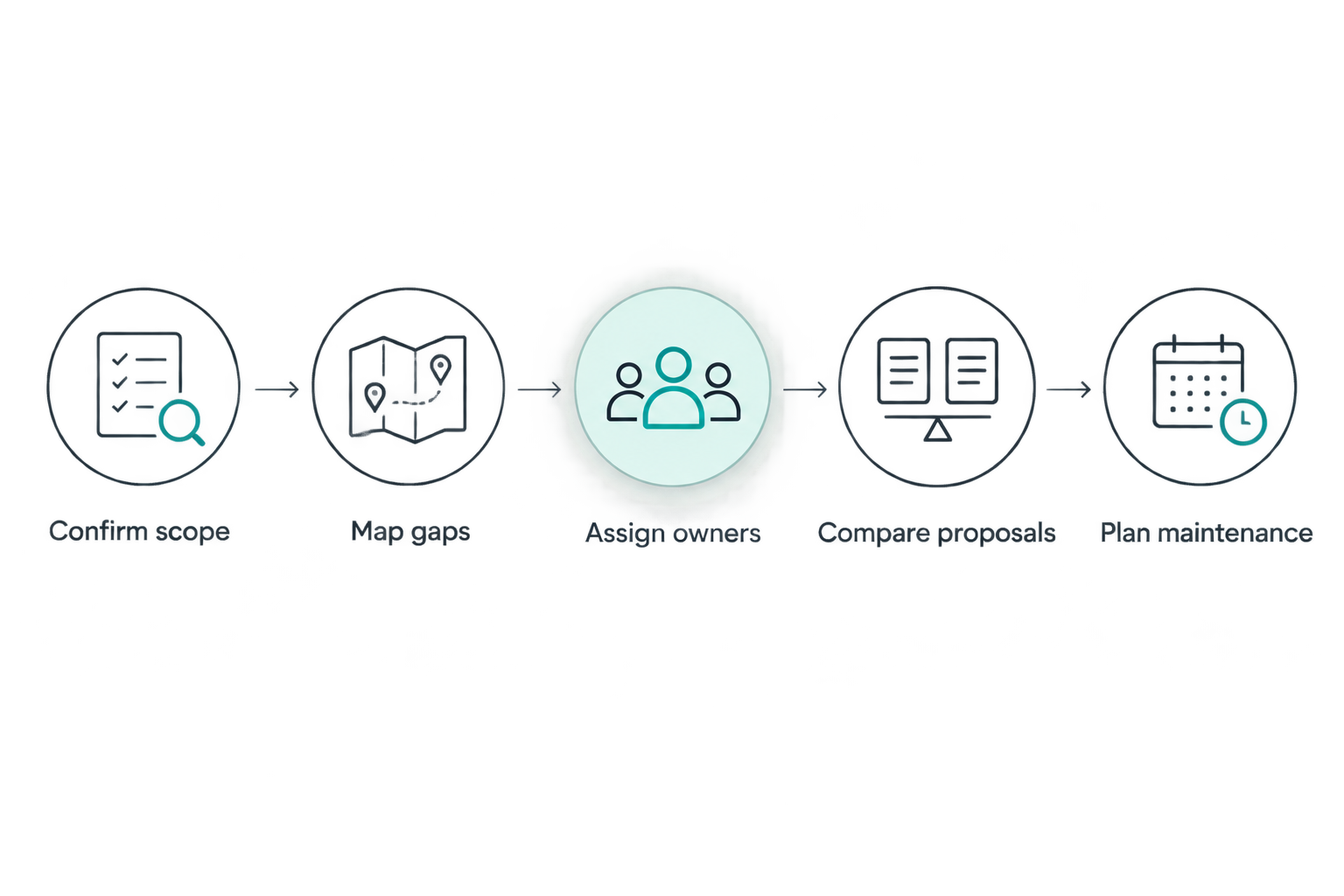
Define the work before choosing the delivery approach.
For each work package, record the expected output, accountable owner, delivery dependency and review method. This makes a proposal assessable without relying on vague promises of complete compliance.
How do you avoid paying for the same work twice?
Reuse evidence where it genuinely meets the requirement. Existing security programmes can provide useful risk assessments, access-control records, supplier reviews and incident procedures.
However, ISO 27001 certification does not establish DORA compliance. Map the evidence to the specific obligation and close the remaining gaps, including relevant contractual and reporting requirements.
For your 2026 plan, maintain a shared control inventory with separate requirement mappings. That lets you identify duplicated tasks without pretending the frameworks are equivalent.
Do not count an existing policy as completed implementation. Check whether the process operates, who owns it and what evidence demonstrates its use.
Is DORA a certification you pay to obtain?
DORA is a regulation, not a certification scheme with a universal certificate fee. Buying a readiness assessment or software subscription does not establish compliance by itself.
Ask any provider using certification language to explain exactly what the deliverable represents. Distinguish a private assessment from a regulatory determination.
Can you outsource responsibility for DORA compliance?
An in-scope financial entity retains responsibility for its obligations when it uses external providers. Advisers and software can support delivery, but management must still oversee the programme.
Keep named internal owners for decisions, exceptions and remediation. A supplier contract should make the delivery split clearer, not obscure it.
Frequently asked questions
One last thing
Ask what remains your responsibility after the engagement ends. Require a handover that names control owners, outstanding gaps, recurring tasks and the evidence location.
That question exposes the difference between receiving documents and running a working programme. Define the work, automate suitable tasks and keep accountability clear. Seriously Simple Cyber Compliance.