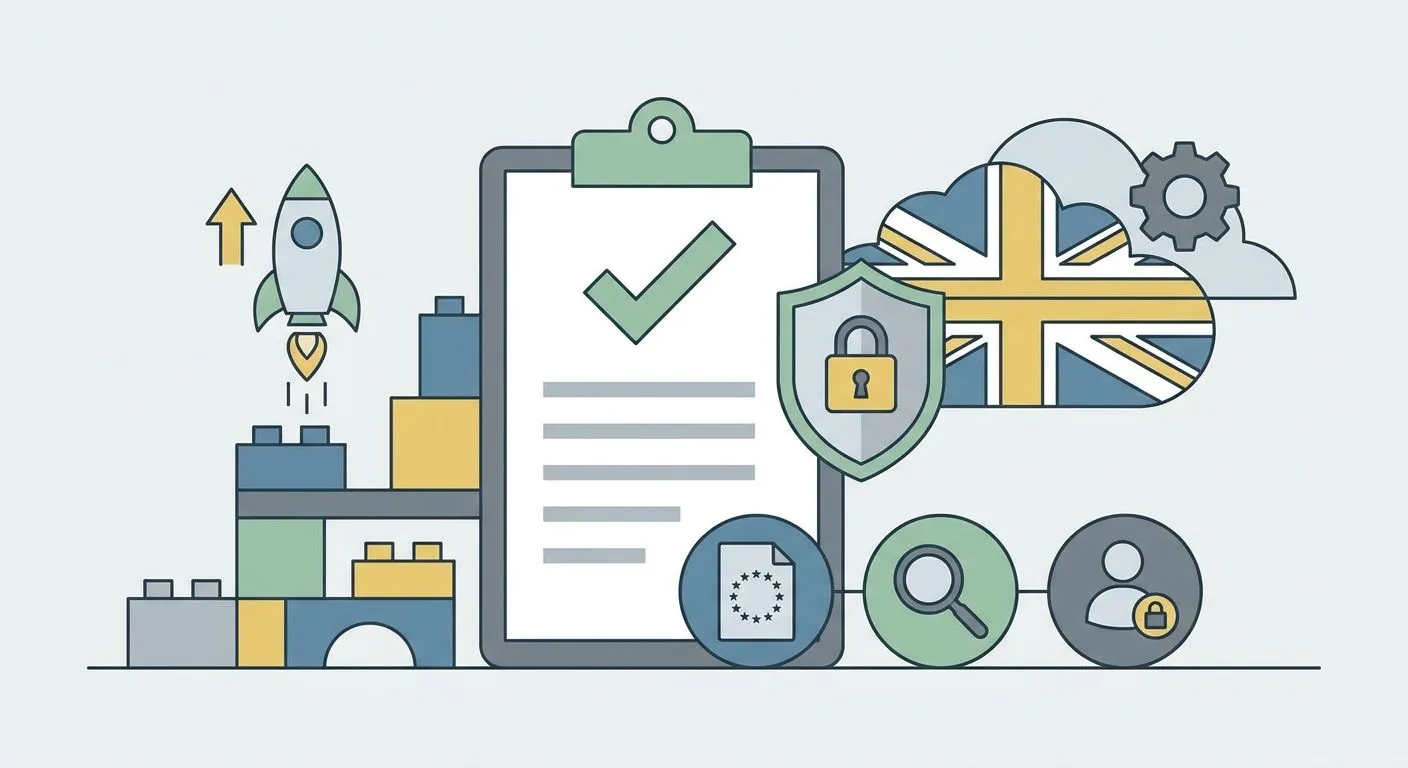
Building a GDPR compliance checklist for a UK startup means mapping every place personal data enters your business, then documenting the lawful basis, retention period, and processing agreement for each one. A generic template gets you through week one; the checklist that survives an ICO inquiry or a customer's security questionnaire has your actual data flows in it, updated as the business changes.
Why this matters
Investors and enterprise customers now ask for GDPR evidence before Cyber Essentials or ISO 27001 even come up. A due diligence request in 2026 typically wants your RoPA, your DPIA log, and proof you can answer a subject access request inside the statutory window.
Most startups treat GDPR as a one-off legal review at incorporation. That's the mistake: the checklist needs to move with the product, the vendor list, and the marketing stack, or it stops matching reality within a quarter.
How to build a GDPR compliance checklist for UK startups
Build the checklist in this order — each step depends on the one before it:
- List every place personal data enters the business. Signup forms, CRM imports, support tickets, payroll, analytics tools — all of it.
- Assign a lawful basis to each data flow. Consent, contract, legitimate interest, or legal obligation — pick one per flow, not one for the whole company.
- Build a record of processing activities. This is the document the ICO and enterprise buyers ask for first.
- Set DPIA triggers. Any new tool that profiles users, tracks location, or processes special category data needs a data protection impact assessment before launch, not after.
- Write the breach response plan. Know who decides whether an incident meets the threshold for reporting a data breach to the ICO within 72 hours.
- Template your data processing agreements. Every vendor touching customer data needs a signed DPA before data flows, not a verbal assurance.
- Set a retention schedule. Decide how long each data category lives and who deletes it when the clock runs out.
- Document the subject access request process. You have one calendar month to respond once a request lands — the process needs to exist before the first request does.
| Checklist item | Who owns it | Review frequency |
|---|---|---|
| Lawful basis register | Founder or ops lead | Quarterly |
| RoPA | Ops/compliance lead | Quarterly |
| DPIA log | Product + compliance | Per new tool/feature |
| Breach response plan | Founder + eng lead | Annually, tested |
| DPA templates | Legal/ops | Per vendor onboarding |
| Retention schedule | Ops | Annually |
| DSAR process | Ops/compliance | Annually |
Verdict: a UK startup with fewer than 20 staff can build a working GDPR checklist in under two weeks using the eight steps above — the failure point isn't the build, it's keeping it current past month three.
Why GDPR requirements vary for UK startups
No two startups need identical checklists. The variation comes from a small set of factors:
- Data category. Special category data (health, biometric, precise location) pushes you into mandatory DPIA territory almost immediately.
- Customer base. B2C startups handling consumer data at volume face more scrutiny than B2B tools processing business contact details.
- Vendor stack size. Every SaaS tool added is another DPA to track and another entry in the RoPA.
- Marketing tooling. A startup running an email marketing automation setup for outbound nurture sequences has to document the lawful basis for every list segment, not just the original signup form — automation tools multiply data flows faster than most founders track them.
- Funding stage. Series A due diligence in 2026 typically asks for a working RoPA and DPIA log; pre-seed investors rarely ask at all.
- International transfers. Any US-based tool in your stack (most analytics and CRM platforms) needs a transfer mechanism documented, usually Standard Contractual Clauses.
Does GDPR apply to a UK startup with no EU customers?
Yes — UK GDPR applies to any UK-incorporated business processing personal data of individuals in the UK, regardless of whether you have EU customers. The EU GDPR only adds a second layer if you're actively targeting or monitoring people in the EU.
How long does it take to become GDPR compliant?
A lean startup can complete the core checklist — lawful basis register, RoPA, DPIA triggers, and breach plan — in one to two weeks with a founder or ops lead driving it. The harder part is maintaining it: reviews need to happen quarterly, not once at setup, or the documentation drifts from what the business actually does.
Do I need a Data Protection Officer at seed stage?
Most seed-stage startups don't meet the mandatory DPO threshold, which kicks in for large-scale monitoring or special category data processing. Founders still benefit from appointing someone accountable for data protection even when a formal DPO isn't legally required.
Spreadsheet-based checklists work until the third vendor gets added and nobody remembers which DPA is signed. That's usually the point where startups move to a platform that keeps the RoPA, DPIA log, and vendor register linked instead of scattered across three tools. OneClickComply automates the evidence collection behind GDPR, Cyber Essentials, and ISO 27001 so the checklist stays current without a dedicated compliance hire.
Automate your GDPR checklist
Keep your RoPA, DPIA log and DPA register current without spreadsheets.
Frequently asked questions
One last thing
The part of the checklist founders skip most in 2026 is the retention schedule — not because it's hard, but because "delete it eventually" feels safe until an auditor asks for the deletion date on a specific data category. Put a number on every retention period now; it's the single fastest fix that makes the rest of the checklist look credible to a reviewer.