
ISO 22301 certification is worth it for a UK SME in 2026 when a customer requires it or independent assurance supports a clear business need. Otherwise, build and exercise your continuity arrangements first: certification adds audit preparation and ongoing maintenance, and it does not guarantee uninterrupted service.
Is ISO 22301 certification worth it for a UK SME in 2026?
Certify when you can name the requirement, the service it covers and the person responsible for maintaining it. If those answers remain unclear, improve continuity first and revisit certification once you have a defined purpose.
ISO 22301 sets requirements for a business continuity management system. Certification provides independent assessment against those requirements within a stated scope; it is not a promise that every incident will end without disruption.
Use this comparison before you commit. The ISO 22301 business continuity certification guide explains the wider programme.
| Route | Best for | Main benefit | Main drawback | Recommendation |
|---|---|---|---|---|
| Certify now | SMEs with an explicit customer requirement and working continuity arrangements | Independent assurance against a recognised standard | Requires audit preparation and continued upkeep | Proceed when the scope matches the requirement |
| Prepare first | SMEs with a clear need but untested recovery arrangements | Directs effort towards practical recovery gaps | Does not provide a certificate for procurement | Exercise the arrangements before seeking certification |
| Defer certification | SMEs without a certificate requirement or a defined assurance need | Keeps attention on proportionate continuity improvements | Cannot satisfy a requirement specifically asking for certification | Keep continuity work; defer the external assessment |
Why this matters
Separate keeping the business running from proving how you manage continuity. You need workable arrangements whether or not you pursue certification.
A certificate serves a different purpose: independent assurance. Treating the certificate as the starting point reverses the work and encourages documents that staff cannot use during an incident.
For your 2026 decision, ask what changes after certification. A named procurement requirement is a concrete answer; a general wish to look more established is not enough on its own.
Certify now: best for a named customer requirement
Certification has a clear commercial purpose when an actual buyer requires ISO 22301 for the service you provide. Get the requirement in writing before treating it as a reason to proceed.
Ask the buyer:
- Is certification mandatory, preferred or an alternative to other evidence?
- Which services and legal entities must the certificate cover?
- Must the certification body hold recognised accreditation?
- When must you provide the certificate?
- What evidence will the buyer accept while certification is in progress?
Check scope carefully. A certificate covering a different service, site or entity does not automatically answer the buyer's requirement.
Proceed when the requirement is explicit and your delivery team can maintain the system. Do not promise a completion date before you understand your gaps and the certification body's assessment process.
The benefit is a defined form of assurance. The limitation is equally clear: meeting a procurement requirement does not guarantee a contract award.
Prepare first: best for untested recovery arrangements
Prepare before certifying if your plans have not been exercised or your service owners disagree about recovery priorities. An audit does not replace the decisions your team needs to make.
Start with a business impact analysis. Identify the activities that support your services, the consequences of disruption over time and the resources needed to resume delivery.
Turn that analysis into usable arrangements:
- Set recovery priorities for the activities in scope.
- Identify staff, technology, premises and supplier dependencies.
- Assign people who can make decisions during disruption.
- Document workarounds and recovery procedures.
- Exercise the procedures and track improvements.
A written plan is an input, not proof that recovery works. Exercises let you check assumptions about access, authority, communications and supplier support.
Prepare first when the recovery process exists mainly on paper. This builds practical evidence, but it will not satisfy a buyer who insists on a certificate by a fixed deadline.
Defer certification: best when assurance has no defined use
Defer external certification when you cannot identify who needs it or what decision it supports. Keep the continuity work.
You can assign responsibilities, assess disruption impacts, test recovery and improve arrangements without claiming certification. Avoid describing an internal programme as independently certified when it has not undergone that assessment.
For a lean SME, a sensible starting recommendation is to examine 1 critical service, assign 1 accountable owner and run 1 documented exercise. These are starting actions, not ISO requirements or evidence that the whole business meets the standard.
Use the exercise findings to decide what to do next. Revisit certification when customer expectations change, your service dependencies expand or independent assurance gains a clear purpose.
Defer the certificate, not continuity planning. The trade-off is that practical evidence alone cannot fulfil an explicit certification requirement.
Why the value of ISO 22301 varies
The value depends on the assurance you need and the work required to sustain it. Compare these factors rather than relying on a generic return-on-investment claim.
- Customer requirements: A mandatory certificate creates a different decision from a questionnaire accepting exercise reports and recovery plans.
- Certification scope: More services, locations and dependencies create more arrangements to assess and maintain.
- Existing readiness: Tested plans and clear ownership give you a different starting point from incomplete documents.
- Operational dependencies: Recovery arrangements must address the people, systems, premises and suppliers needed for your services.
- Internal capacity: Someone must maintain records, coordinate exercises and close actions after the initial assessment.
- Existing management systems: Relevant processes can support the work, but another certificate does not establish ISO 22301 conformity.
Write down how each factor applies to your business. That creates a decision you can explain to leadership without inventing financial returns.
How do you build a defensible business case?
Build your 2026 business case around evidence you already hold. Separate confirmed requirements from hoped-for benefits, and include the continuing work after certification.
1. Confirm demand
Collect relevant contract clauses, tender questions and customer requests. Record exactly what each asks for, including the required scope and any accreditation conditions.
Do not count every sales conversation as demand for certification. A request for a continuity plan is not the same as a requirement for ISO 22301.
2. Define scope
List the services, entities, locations and supporting activities you intend to include. Explain exclusions rather than leaving readers to assume the certificate covers the entire organisation.
Keep the scope commercially useful. Narrowing it solely to simplify assessment defeats the purpose if the customer's service sits outside it.
3. Check readiness
Review your impact analysis, risk assessment, continuity strategies, plans, exercises and improvement records. Identify gaps and assign owners.
Include internal audit and management review in your readiness work. Certification assesses a management system, not just a folder of recovery procedures.
4. Compare commitments
Obtain a written proposal from a certification body for the agreed scope. Ask what the initial assessment, subsequent assessments and handling of findings involve.
Include staff effort, exercises, recovery improvements and any external support in your internal approval. Keep assumptions separate from confirmed commitments.
5. Approve ownership
Name the person responsible for the programme and the service owners responsible for recovery. Agree how leadership will review performance and unresolved actions.
Record the decision, including reasons to defer if that is the right outcome. A defensible decision does not always end in certification.
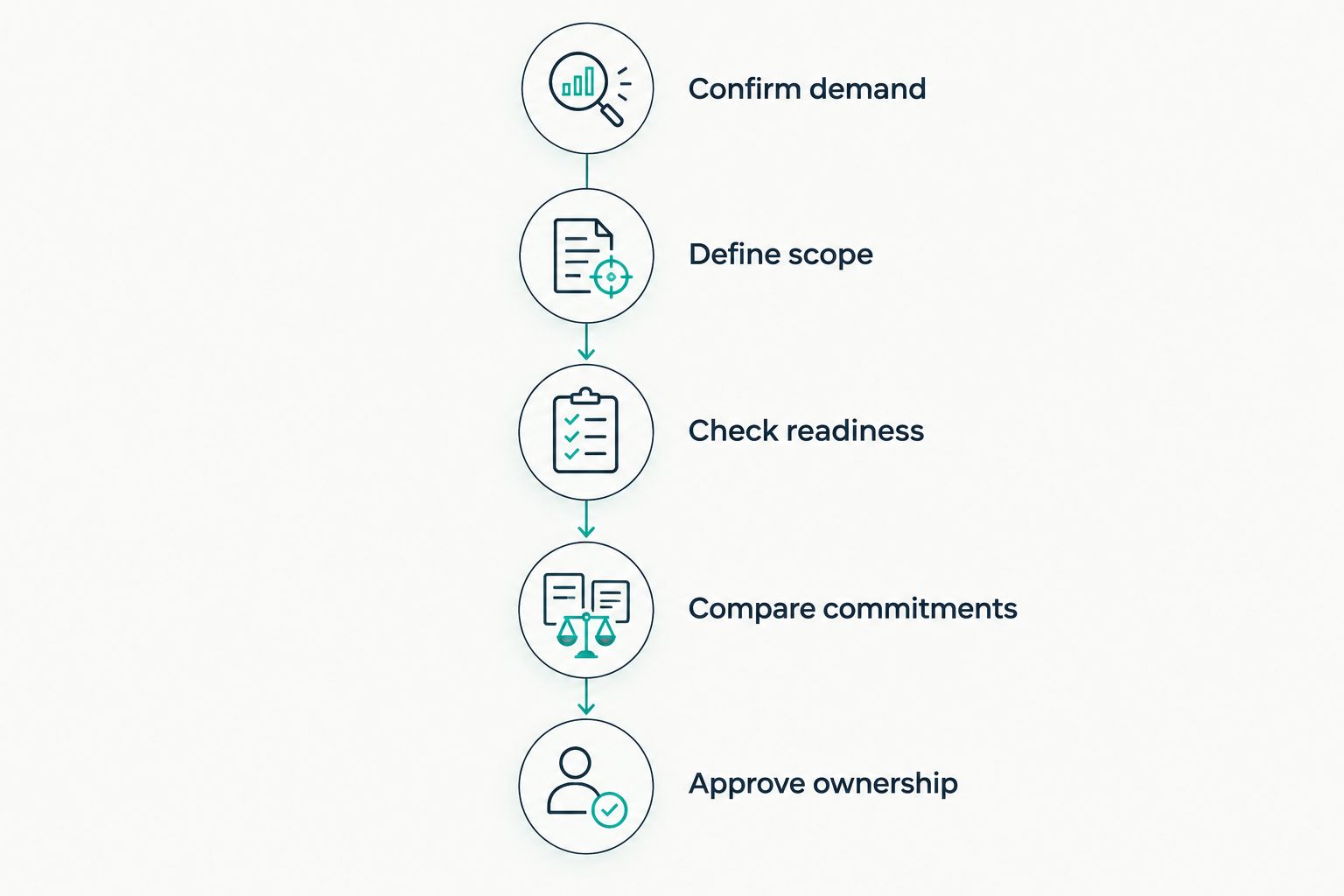
Confirm the requirement before committing to certification.
What evidence should you have before an assessment?
Prepare evidence that your continuity arrangements operate in practice. Documents should explain responsibilities and decisions; records should show what happened when you used or reviewed them.
A practical evidence checklist includes:
- An agreed scope and business continuity policy.
- Business impact analysis and risk assessment records.
- Continuity strategies and supporting resource decisions.
- Current response and recovery procedures.
- Exercise results, lessons and assigned actions.
- Internal audit, management review and corrective action records.
Use ISO 22301 itself to check the full requirements. This checklist is a preparation aid, not a substitute for the standard or a certification body's assessment.
Avoid creating separate versions of the same record for different audiences. Keep ownership and approval clear so staff know which procedures to follow.
Does ISO 27001 cover the same thing as ISO 22301?
ISO 27001 does not replace ISO 22301. ISO 27001 addresses information security management; ISO 22301 addresses continuity of products and services during disruption.
Information security and continuity overlap around subjects such as technology availability and recovery. Business continuity also considers disruption involving people, premises and other operational dependencies.
Reuse relevant records where they genuinely apply. Check the additional requirements rather than assuming an existing information security certificate covers business continuity.
Is ISO 22301 certification mandatory for UK SMEs?
ISO 22301 certification is not a general legal requirement for UK SMEs. A contract, tender or sector-specific obligation needs separate examination; do not treat certification as mandatory without identifying the applicable requirement.
For a 2026 procurement decision, read the exact wording. Ask the buyer to clarify ambiguous references to continuity standards before you commit.
Where does compliance automation fit?
Use automation for repeatable administration, not as a substitute for recovery decisions. Software does not decide which service takes priority or prove that staff can execute a workaround.
OneClickComply is best for growing businesses that want to automate cyber compliance tasks. The platform generates policies, manages risk and auto-remediates security controls; assess your ISO 22301 requirements separately rather than assuming those functions establish business continuity readiness.
Review OneClickComply against a written list of requirements. Confirm the fit before you reorganise your processes around any platform.
Discuss your compliance requirements
Explain your certification goals and confirm which platform functions fit your programme.
Frequently asked questions
One last thing
Ask a service owner to walk through recovery without opening the continuity plan. Then compare that explanation with the approved procedure.
Treat any disagreement as an exercise finding to investigate, not proof of failure. For your 2026 programme, close that gap before adding another document: make the arrangements usable, then prove how you manage them.
Seriously Simple Cyber Compliance.