
ISO 22301 certification has no fixed completion time: your finish date depends on the business continuity arrangements you already operate, the scope you choose and the certification body's assessment. For a 2026 project, plan for implementation, exercises, internal review and external assessment—not just the audit appointments. Agree a readiness-based schedule before you promise a certification date.
How long does ISO 22301 certification take?
ISO 22301 does not prescribe a standard project duration for every organisation. You need enough time to build and operate your business continuity management system, demonstrate that it works and complete the certification process.
Start with the services and activities covered by your proposed certificate. The guide to ISO 22301 business continuity certification for UK SMEs explains that wider context.
Build your schedule around these milestones rather than an unsupported average:
- Agree the scope. Identify the services, sites, teams and dependencies your business continuity arrangements cover.
- Assess impacts and risks. Establish what disruption means for those activities and what recovery they require.
- Implement continuity arrangements. Assign responsibilities, choose workable recovery approaches and document the procedures people need.
- Exercise and evaluate. Test the arrangements, complete an internal audit and conduct management review.
- Complete external assessment. Progress through the certification body's initial audit stages, address findings and await its certification decision.
These milestones are a planning structure, not prescribed time allowances. Ask your certification body to confirm its assessment requirements against your actual scope and readiness.
Why this matters
A tender deadline and an audit booking are different things. Completing an audit does not itself mean that a certificate has been issued.
For your 2026 plan, distinguish three outcomes: the system is ready for assessment, the assessment is complete and certification is granted. Give each outcome an owner and a clear completion condition.
Plan backwards from the evidence your customer needs. If a contract requires a certificate, an implementation plan or an audit booking is not the same deliverable.
What happens before the certification audit?
Preparation is not just writing a business continuity plan. ISO 22301 addresses the management system around continuity: responsibilities, decisions, operating arrangements, evaluation and improvement.
Use the following sequence to identify unfinished work. Overlap tasks where their inputs are ready, but keep the dependencies visible.
Agree the scope
Write a clear statement of what the system covers. Identify the activities and locations included, the boundaries of your organisation and the external services on which those activities depend.
A narrow scope still needs to make operational sense. Excluding a shared team from the wording does not remove its role in recovering an included service.
Assess impacts
A business impact analysis establishes how disruption affects your activities over time. It informs recovery priorities, resource requirements and the timing your continuity arrangements need to meet.
Get input from the people who deliver the work. Use the guide to conducting a business impact analysis for ISO 22301 to organise that work before you finalise recovery plans.
Implement arrangements
Choose continuity approaches that address your assessed requirements. Document who activates them, who makes decisions, how people communicate and what resources recovery needs.
Check the arrangements against reality. A procedure that depends on an unavailable supplier, inaccessible information or an unassigned decision-maker needs correction before assessment.
Exercise and review
Run exercises against clear objectives. Record what happened, evaluate the results and assign improvements rather than treating attendance as proof that the plan works.
Complete your internal audit and management review as part of evaluating the system. Keep evidence of decisions, findings and follow-up actions.
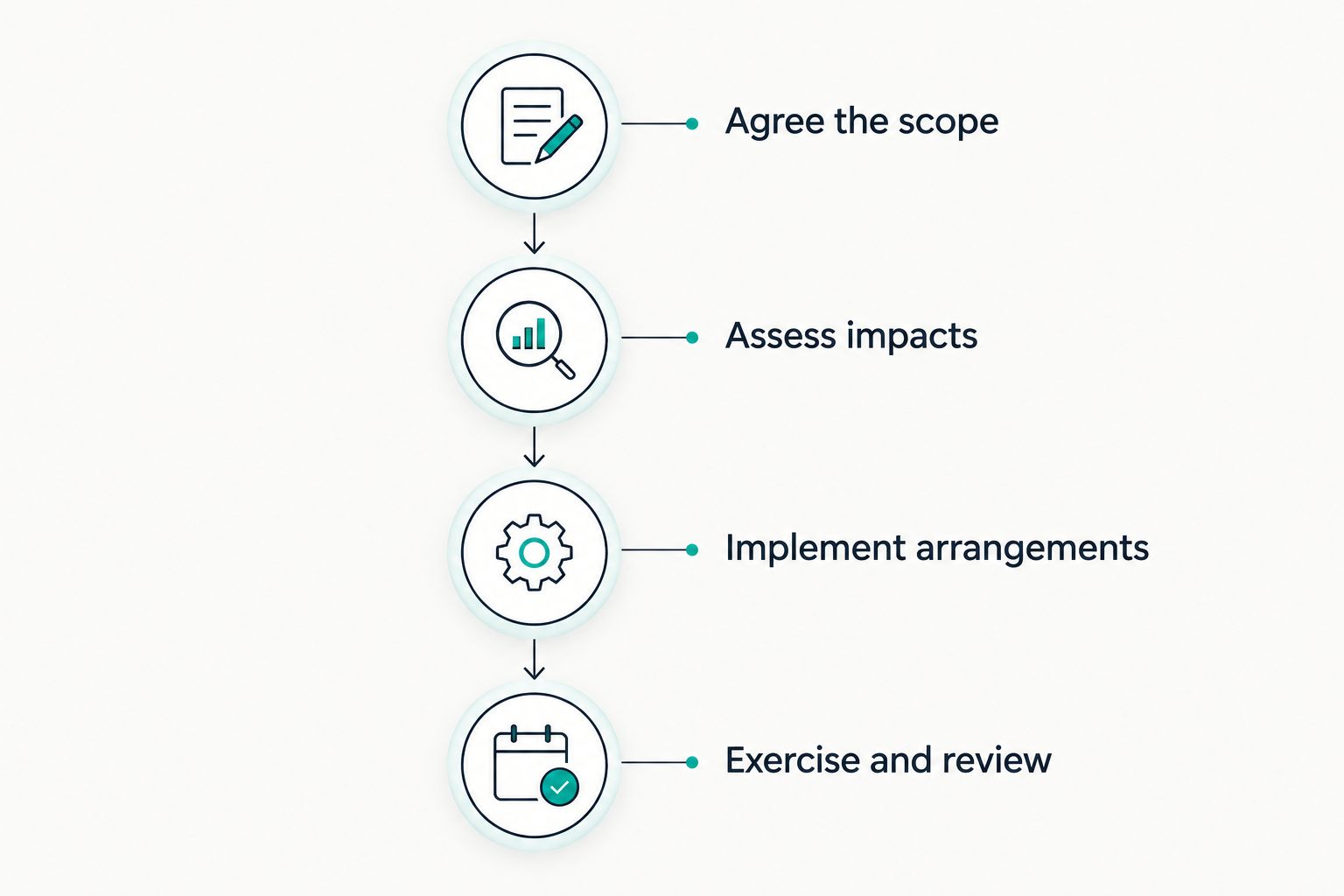
Recovery plans depend on agreed scope and impact analysis; review checks whether the arrangements work.
What happens during external certification?
Initial management system certification normally includes Stage 1 and Stage 2 audits. These serve different purposes; neither should be confused with the preparation project as a whole.
Stage 1 reviews your readiness. The certification body examines relevant information about your system and prepares for the next assessment stage. Discuss concerns raised here before treating the next appointment as unconditional.
Stage 2 evaluates implementation and effectiveness. The auditor examines whether your system meets the applicable requirements and operates in practice. Documents support that assessment, but they do not replace operating evidence.
After assessment, handle any findings through the certification body's process. Certification follows its review and decision; it is not a certificate automatically handed over at the closing meeting.
Before confirming your 2026 deadline, ask the certification body:
- What information do you need to determine audit duration?
- What readiness evidence do you expect before each stage?
- How will findings affect progression or the certification decision?
- What happens between the audit closing meeting and certificate issue?
- Which dates are confirmed, and which remain conditional?
Record those answers in your project plan. Keep internal preparation dates separate from the certification body's commitments.
How does your starting point affect the schedule?
An existing management system gives you material to assess for reuse. Starting from scratch means establishing the routines as well as producing the documents.
Neither starting point proves that your business continuity arrangements meet ISO 22301. Compare the actual evidence, not the number of policies in a folder.
| Starting point | Best for | Useful foundation | Limitation to address |
|---|---|---|---|
| Existing, exercised continuity arrangements | Teams formalising established continuity work | Plans, exercise records and operational experience | Check coverage against the full management system requirements |
| Another established management system | Teams extending existing governance routines | Document control, internal audit and management review processes | Continuity-specific analysis and recovery arrangements still need assessment |
| No formal continuity system | Teams building clear ownership from the outset | Freedom to design processes around current operations | Establish arrangements and demonstrate their use before assessment |
Reuse evidence only when it answers the requirement. An existing risk register helps organise work, but its existence does not establish that disruption impacts and recovery requirements have been analysed.
For a 2026 project, review existing records for current scope, ownership and accuracy. Old documents are inputs to review, not automatic evidence of present readiness.
Why ISO 22301 certification time varies
The main drivers sit inside your implementation work and external assessment process. Check these factors before accepting a proposed finish date:
- Scope and dependencies. Included activities, sites, shared services and suppliers determine what your continuity arrangements must address.
- Existing operating evidence. Approved documents, completed exercises and recorded reviews show different levels of readiness.
- Recovery gaps. An identified recovery requirement still needs a workable approach, assigned resources and supporting procedures.
- Decision-making capacity. Business owners need to validate impacts, approve arrangements and resolve outstanding issues.
- Assessment and findings. Audit scheduling, readiness concerns and corrective action affect progression to the certification decision.
Headcount alone does not explain the work. Review the complexity of the services and dependencies inside your scope instead of assuming that a small organisation has a simple continuity project.
How do you build a realistic certification schedule?
Use completion conditions rather than optimistic calendar labels. Each milestone should name the evidence required, the person responsible and the task that depends on it.
For your 2026 schedule, use this sequence:
- Confirm the business deadline. Establish whether you need a certificate, evidence of progress or a completed assessment.
- Assess the current position. Review continuity arrangements and management system records against the intended scope.
- Map dependent work. Put impact analysis before final recovery decisions, and implementation before exercises that evaluate it.
- Assign accountable owners. Give business decisions to people with authority over the affected services and resources.
- Validate assessment dates. Check the proposed sequence with the certification body and record its conditions.
- Track unresolved findings. Show corrective action and the certification decision as explicit work, not an invisible final step.
Review the schedule when scope or evidence changes. Keep the reason for each change visible so a revised date leads to a decision, not another unexplained delay.
What evidence should you track?
Maintain a working index that connects each milestone to its supporting records. Use it to distinguish unfinished work from completed work that simply needs organising.
Include:
- The agreed scope and continuity objectives.
- Business impact analysis and risk assessment records.
- Approved continuity approaches and procedures.
- Exercise objectives, results and improvement actions.
- Internal audit findings and follow-up records.
- Management review decisions and outstanding actions.
A full folder is not the goal. You need traceable evidence that your system operates and that you act on what it reveals.
Can you shorten ISO 22301 certification preparation?
You can remove avoidable administrative work. You cannot replace business decisions or operating evidence with a promise to finish them later.
Use existing records where they remain relevant. Arrange stakeholder reviews early, keep document ownership clear and resolve conflicting recovery assumptions before they become approved procedures.
Run independent work in parallel. Document control and training preparation can progress alongside analysis, but final recovery procedures need agreed recovery requirements.
Protect time for exercises and follow-up. Finding a weakness during preparation gives you something specific to correct before external assessment.
Where OneClickComply fits
OneClickComply is best for growing businesses automating cyber compliance administration. Its compliance automation platform supports activities including policy generation, security control remediation and risk management for frameworks such as ISO 27001, Cyber Essentials and SOC 2.
That role has a clear boundary. OneClickComply's described cyber compliance capabilities are not evidence of ISO 22301 coverage or a guaranteed certification timeline.
If you assess OneClickComply for a wider compliance programme, check the fit against your actual requirements. Business owners still need to approve continuity priorities, validate recovery arrangements and act on exercise results.
Frequently asked questions
One last thing
Ask the person promising a completion date to define what complete means. A finished policy pack, an audit closing meeting and an issued certificate are different milestones.
Put the required outcome beside your deadline. Then manage the evidence and decisions needed to reach it. Seriously Simple Cyber Compliance.