No. SOC 2 certification is not a general legal requirement for UK SaaS companies in 2026, but a customer contract or procurement process can require a SOC 2 report. You must still meet applicable data protection and security obligations, and SOC 2 does not replace them.
Is SOC 2 certification mandatory for UK SaaS companies?
SOC 2 is voluntary as a general legal matter, but it can become a contractual requirement. Separate what legislation requires from what your customer requires before you commit to an audit.
| Situation | Is SOC 2 required? | Your next move |
|---|---|---|
| You operate a UK SaaS business | No general legal requirement solely because you provide SaaS | Identify the laws and security duties that apply to your service |
| A prospective customer requests a report | A procurement condition, not automatically a legal obligation | Ask whether the report is essential or alternative evidence is accepted |
| Your signed contract requires a report | A contractual obligation under the agreed terms | Check scope, report type, delivery date and consequences |
| You process personal data | Data protection duties apply independently | Assess your UK GDPR obligations rather than treating SOC 2 as a substitute |
For the operational work behind the report, use the SOC 2 compliance for UK SaaS companies guide. First, establish whether you actually need that report to serve your intended customers.
Why this matters
The wrong starting question creates the wrong programme. Asking whether every SaaS company needs SOC 2 misses the decision that matters: whether your customers need independent assurance about your service.
For your 2026 compliance plan, separate legal duties, signed commitments and buyer preferences. Each needs an owner, but they do not all require the same evidence.
A report can satisfy a purchasing condition. It cannot make every part of your business legally compliant or remove your responsibility to operate secure systems.
Is SOC 2 actually a certification?
SOC 2 is an independent assurance report, not a certification. People use the phrase SOC 2 certification in sales conversations, but the distinction matters when you describe your status.
The American Institute of Certified Public Accountants, or AICPA, sets the SOC 2 reporting framework. A qualified independent CPA firm examines the service organisation’s controls against the applicable Trust Services Criteria.
Those criteria cover 5 categories: security, availability, processing integrity, confidentiality and privacy. Security is included in a SOC 2 examination; the other categories depend on the scope of the engagement.
Your report describes a defined system. It does not automatically cover every product, subsidiary or service you sell.
Use precise language in questionnaires:
- Say that you have a SOC 2 Type I or Type II report when that is true.
- Identify the service and period the report covers.
- Do not describe preparation work as a completed examination.
- Do not present an auditor’s report as a guarantee against incidents.
SOC 2 Type I: controls at a specified date
A SOC 2 Type I report addresses the description of your system and the suitability of the design of its controls at a specified date. It does not establish that those controls operated effectively throughout a period.
Best for: a buyer that explicitly accepts point-in-time assurance. Confirm that acceptance before choosing this route.
The benefit is a defined assessment of control design. The limitation is equally clear: Type I does not provide the operating-effectiveness evidence of Type II.
A Type I report is not a compulsory stepping stone to Type II. Choose it because it meets an agreed requirement, not because the numbering suggests a mandatory sequence.
SOC 2 Type II: controls over a specified period
A SOC 2 Type II report also addresses whether controls operated effectively over a specified period. Your evidence must support what happened during that period, not just what your policies say should happen.
Best for: a buyer that requires evidence of ongoing control operation. A Type I report does not satisfy an explicit Type II requirement unless the buyer agrees otherwise.
| Report | Evidence focus | Best for | Main limitation |
|---|---|---|---|
| Type I | Control design at a specified date | A buyer accepting point-in-time assurance | Does not assess operating effectiveness over a period |
| Type II | Control design and operation over a specified period | A buyer requiring ongoing operating evidence | Requires records across the examination period |
For a 2026 procurement deadline, distinguish the reporting period from the report delivery date. Your customer needs to know when the finished report will be available, not merely when preparation begins.
Why SOC 2 requirements vary
There is no universal SOC 2 requirement attached to the SaaS business model. Your actual requirement depends on the service, the buyer and the terms you accept.
Check these factors:
- Contract wording. A signed obligation differs from a questionnaire asking whether a report exists.
- Report type. A request for Type II is more specific than a general request for SOC 2.
- System scope. The report must address the service the customer intends to use.
- Relevant criteria. A buyer’s assurance needs determine whether categories beyond security matter.
- Timing. A condition before onboarding differs from a commitment after contract signature.
- Alternative evidence. The buyer decides whether other assurance satisfies its purchasing requirements.
Ask the buyer’s security or procurement team to confirm the requirement in writing. A salesperson’s interpretation is not a substitute for the terms that govern approval.
Does UK GDPR require SOC 2?
UK GDPR does not require a SOC 2 report. It requires appropriate measures to protect personal data, alongside other obligations that depend on your role and processing activities.
Article 32 addresses security of processing. It requires a risk-based approach to technical and organisational measures rather than prescribing SOC 2 as the universal route.
A SOC 2 report can contribute evidence about relevant controls. It does not, by itself, establish lawful processing, valid international transfers or compliant responses to individuals’ rights requests.
Keep these workstreams connected but distinct. Your privacy obligations continue even when an auditor has examined your security controls.
If a customer says that GDPR makes SOC 2 compulsory, ask which legal provision or contractual clause they mean. That question separates a legal duty from the customer’s chosen assurance process without dismissing either.
Can a customer make SOC 2 mandatory?
A customer can make SOC 2 a condition of doing business with you. Whether you must provide it depends on the requirement and the commitments you accept.
Before signing, identify what the clause actually requires. A promise to begin readiness work is different from a promise to deliver a completed Type II report by a fixed date.
Check whether the contract defines:
- The service and legal entity covered.
- The required report type and criteria.
- The deadline for delivery.
- How subsequent reports must be supplied.
- Who can access the report and under what confidentiality terms.
- What happens if the report contains exceptions or arrives late.
Do not promise an unqualified outcome from an independent examination. You control your preparation and remediation work; the auditor controls the audit opinion.
For your 2026 sales pipeline, record these obligations beside the relevant opportunities. Keep confirmed requirements separate from assumptions about what buyers prefer.
How do you decide whether to start SOC 2 now?
Start with a documented customer requirement, then build the programme backwards from it. A general desire to appear enterprise-ready is not a sufficiently clear audit scope.
Confirm demand
Ask current prospects whether SOC 2 is a firm approval condition. Record the required report type and whether they accept alternatives while you prepare.
Define scope
Identify the product, infrastructure, people and processes that support the service under examination. Agree the system boundary with your auditor before building evidence around it.
Check readiness
Compare your existing controls with the proposed examination requirements. Assign owners to gaps in access management, change approval, incident handling and other relevant processes.
Agree timing
Work with your auditor to distinguish remediation, the examination period and report preparation. The SOC 2 compliance timeline must account for operating evidence, not just the date you finish writing policies.
Keep evidence
Retain records that show controls operated as described. Evidence should identify the action, the responsible person and the relevant date.
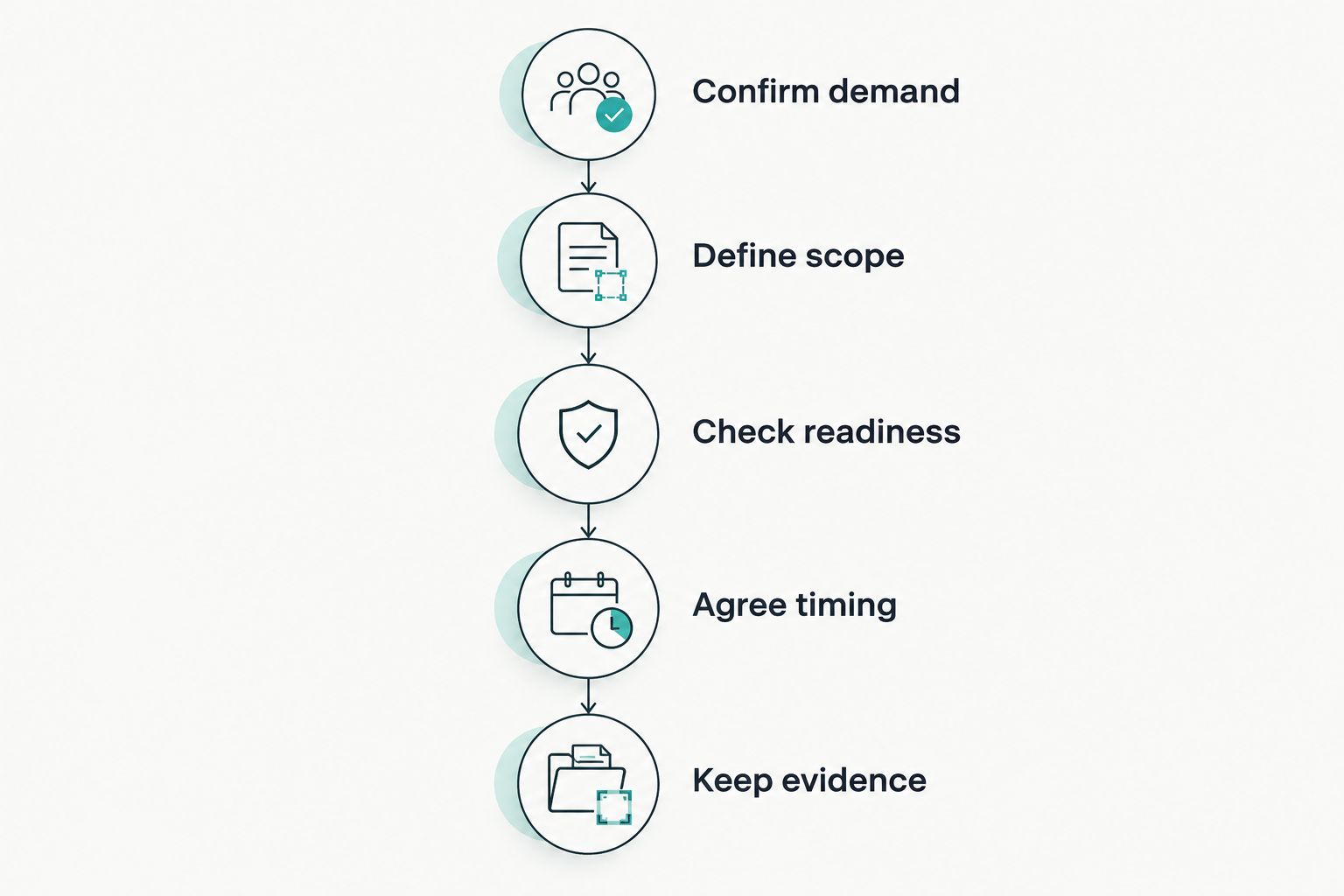
Confirm what the customer requires before setting your scope and schedule.
Keep your sales commitments aligned with that plan. If the buyer needs a completed report before onboarding, a readiness checklist alone does not fulfil the requirement.
What can you provide before your report is ready?
Ask the customer what evidence it will accept during its review. Do not assume that a different certificate or a completed questionnaire automatically replaces SOC 2.
Depending on what you actually have, the discussion can cover:
- A documented description of your security controls.
- Relevant independent testing and remediation records.
- Existing certifications, with their scope clearly stated.
- Contractual security commitments.
- A readiness plan with accountable owners.
Share sensitive material through an agreed review process. A report or testing document can contain details that should not appear on a public sales page.
The advantage of interim evidence is that it supports a specific purchasing discussion. Its limitation is buyer acceptance: only the customer can confirm whether it meets that customer’s requirements.
Where compliance automation fits
OneClickComply is best suited to growing businesses that want software to automate SOC 2 preparation and manage ongoing compliance work. The platform supports control remediation, policy generation, risk management and trust centres.
The benefit is support for that operational work. The boundary is the independent examination: OneClickComply does not replace the auditor or turn a preparation programme into an issued report.
Use OneClickComply for compliance automation where those tasks match your needs. Keep responsibility for scope decisions, control ownership and customer commitments with your team.
Automation also needs oversight. Review generated policies against how your business actually operates, and check that remediation changes fit your environment before treating them as complete.
Frequently asked questions
One last thing
A report that excludes the service your customer buys does not answer that customer’s assurance question. Check the system description before treating any SOC 2 report as sufficient evidence.
Make your 2026 decision around the buyer’s actual requirement, the correct scope and commitments you can meet. Seriously Simple Cyber Compliance.