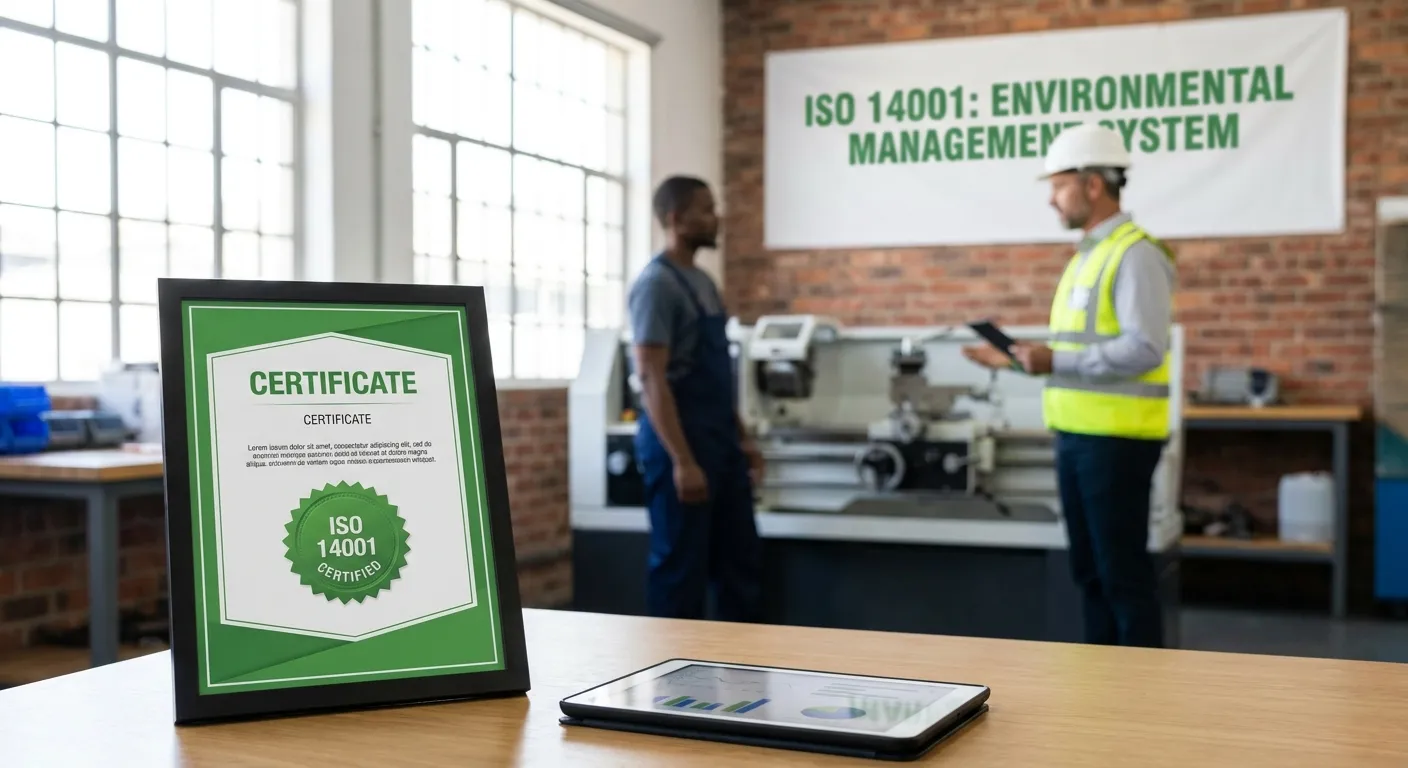
Manufacturing SMEs chasing a customer tender or a supply chain requirement usually hit ISO 14001 first — the environmental management system standard that proves you control waste, emissions, and resource use. This guide breaks down what UK manufacturers actually need to evaluate before booking an audit in 2026.
Why this matters
A manufacturing SME without ISO 14001 loses tenders it never even sees rejected — procurement teams filter on the certificate before shortlisting. If you already hold ISO 9001 for manufacturing and engineering firms, your quality management system already covers half the documentation an environmental auditor asks for.
OneClickComply automates cyber compliance certifications like ISO 27001, Cyber Essentials, and SOC 2 — not ISO 14001 itself, which sits under a different accreditation scheme entirely. But most manufacturers pursuing 14001 for one customer's tender discover within a year that the same customer also demands Cyber Essentials or ISO 27001 for supply chain security. That's where a compliance automation platform earns its keep.
Who this is for
This guide is for manufacturing SMEs with 10 to 250 staff, one or two production sites, and a live customer requirement (tender, contract renewal, or supply chain audit) forcing the ISO 14001 question in 2026. If you're pursuing certification purely for internal environmental strategy with no external deadline, the buying pressure below is lighter — but the criteria still apply.
What to look for in ISO 14001 certification for a manufacturing SME
UKAS accreditation status
Check the certification body carries UKAS accreditation (or an equivalent national accreditation body) for the ISO 14001 scope specifically. Procurement teams running supplier due diligence check for the accreditation logo, not just the ISO number on your wall certificate.
Manufacturing sector experience
An auditor who has never assessed a production floor will miss real environmental aspects — solvent storage, effluent discharge, energy metering by shift. Ask for named auditor CVs with manufacturing sector history before you sign.
Multi-site audit scope
If you run more than one production site, ask how the certification body samples sites across the three-year cycle rather than auditing every location every year. This changes your day-rate cost significantly.
Integration with your existing management system
If you already run ISO 9001 or are still choosing a framework, read how to choose the right compliance framework for your business before booking separate audits — an integrated management system audit window saves real money.
Transparent cost structure
Get a written day-rate breakdown covering Stage 1 (documentation review), Stage 2 (implementation audit), travel for multi-site visits, and annual surveillance audit fees for years two and three of the three-year cycle.
Top picks: certification routes for manufacturing SMEs
UKAS-accredited certification body — the safe pick. Full Stage 1 and Stage 2 audit plus annual surveillance across a three-year cycle. A single-site SME typically runs 3-5 audit days total. Buy — this is the only route that survives a customer's supplier audit in 2026.
Integrated ISO 9001 + ISO 14001 audit — the efficient pick. If your existing ISO 9001 certifier also holds 14001 accreditation, ask them to combine the audit window. This can cut total assessment days by roughly a third versus two separate engagements. Consider — confirm your certifier holds both scopes before committing.
Non-UKAS "certification mark" providers — the shortcut. Some providers issue a certificate in a week with no site visit. It looks identical on a wall but carries no accreditation logo. Skip — every serious procurement team checks for this, and the certificate fails supplier due diligence.
Gap analysis before Stage 1 — the prep pick. Running an environmental aspects register review before booking Stage 1 catches missing documentation early and reduces failed findings at the real audit. Consider, especially for first-time certifying SMEs.
Single evidence library across frameworks — the scale pick. SMEs juggling ISO 14001 alongside Cyber Essentials or ISO 27001 for the same customer relationship save real time when evidence collection is centralised rather than rebuilt per framework. Read how to automate evidence collection for audits for the mechanics. Buy if you're holding more than one certification simultaneously.
What to avoid
- Flat-fee quotes regardless of site count. A genuine environmental management system audit scales with process complexity — a single flat number regardless of your site count or headcount is a red flag.
- Skipping the environmental aspects register. Auditors fail SMEs that haven't identified the real environmental aspects tied to their actual processes — waste streams, emissions, energy use by shift, not a generic template copied from another sector.
- Certifiers with no manufacturing references. Ask for two manufacturing sector references before you sign a three-year contract with any certification body.
Holding more than one certification?
See how compliance automation handles evidence collection across frameworks.
Verdict comparison table
| Route | Cost signal | Audit scope | Best for | Verdict |
|---|---|---|---|---|
| UKAS-accredited certifier | Higher day rate | Stage 1 + Stage 2 + annual surveillance | Tender-dependent SMEs | Buy |
| Integrated ISO 9001 + 14001 audit | Shared day rate | Combined audit window | Existing ISO 9001 holders | Consider |
| Non-UKAS certification mark | Lowest cost | Minimal or no site audit | Nobody bidding on contracts | Skip |
| Gap analysis first | Added upfront cost | Pre-audit documentation review | First-time certifying SMEs | Consider |
| Single evidence library across frameworks | Subscription cost | Continuous evidence, not a one-off audit | SMEs holding 14001 plus cyber frameworks | Buy |
Frequently asked questions
One last thing
Most manufacturing SMEs that pursue ISO 14001 for a single customer tender end up needing Cyber Essentials or ISO 27001 within 12 months — the same customer's supply chain security team asks for it once the environmental audit is done. OneClickComply handles that side of compliance automation so the second certification doesn't mean rebuilding your evidence process from scratch.