Public sector suppliers’ ISO 27001 software is a system for managing information security requirements, evidence and audit preparation so you can demonstrate compliance when bidding for and delivering public contracts. Your starting point is the buyer’s requirements and the service you deliver—not a generic certification checklist.
Why ISO 27001 software matters for public sector suppliers
Your certificate scope must match the service you sell. A certificate covering an unrelated business activity does not establish that the systems delivering a public contract sit inside your certified information security management system.
ISO 27001 sets requirements for that management system, often shortened to ISMS. It connects your security risks, responsibilities, controls and improvement work. Software supports those activities; an independent certification body assesses the management system for certification.
Public sector bids bring a separate task: answering the specific questions in the procurement documents. Keep certificate requirements, security questionnaires and contractual commitments distinct, even when the same evidence supports several answers.
For your 2026 procurement pipeline, record what each opportunity actually asks for. Do not assume that every authority requires ISO 27001, that every certificate scope is acceptable, or that certification replaces all other security checks.
Start with an ISO 27001 gap analysis before certification. Use the findings to separate missing security practices from missing documentation. Buying software cannot resolve that distinction for you.
Build a programme around the contracts you deliver
Work through the process in this order: Scope, Risks, Evidence, Audit, Review. Assign responsibility before you automate tasks, and retain a clear connection between each buyer requirement and the evidence behind your answer.
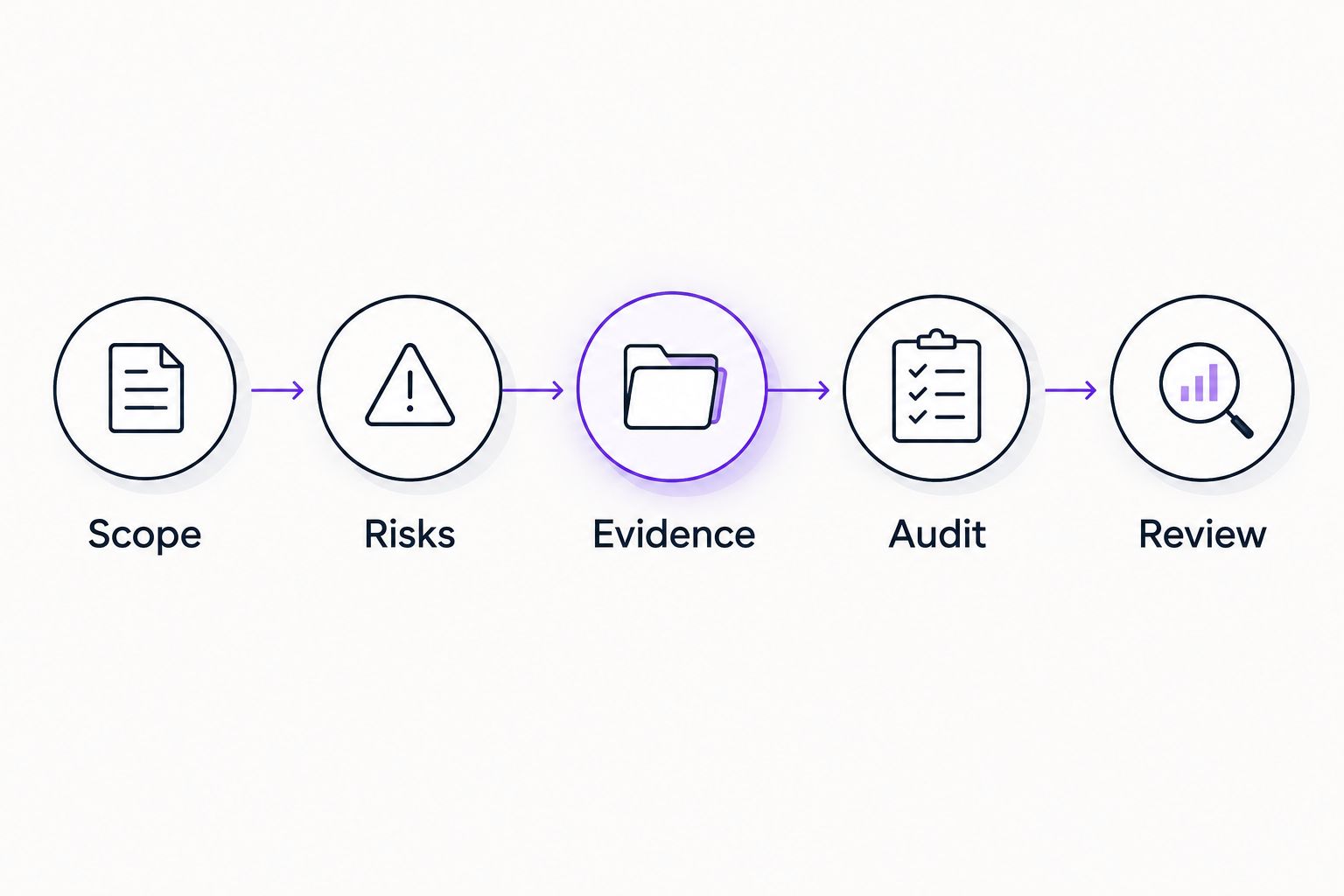
Define the scope before you organise evidence or prepare for an audit.
Define the service and certificate boundary
Get a clear boundary around the work you deliver. Start manually with a service description, a system inventory and a diagram showing where contract information moves. Include the people and suppliers involved, not just the application your buyer sees.
Explain shared services explicitly. A central IT team, support desk or cloud environment can affect the contracted service even when it sits outside the delivery team’s organisation chart.
For each 2026 bid, compare the requested certification scope with your current or planned scope. Ask the buyer to clarify ambiguous wording through the procurement’s formal clarification process; do not silently interpret a requirement in your favour.
- Describe the contracted service and the information it handles.
- List the legal entities, locations and teams involved.
- Identify hosting, support and subcontracting dependencies.
- Record exclusions and the reasons behind them.
- Assign 1 named owner to approve the scope statement.
Translate procurement documents into actions
Make the buyer’s requirements usable. A spreadsheet is enough to begin: record the requirement, its source, your current position and the person responsible for the response.
Separate a requirement to hold certification from a request to describe your security arrangements. Also distinguish requirements at bid submission from obligations that apply during delivery. The procurement documents determine those conditions.
Keep ISO 27001 and Cyber Essentials as separate entries when the buyer asks for both. They address different assurance needs; do not describe one as a substitute for the other without explicit acceptance from the buyer.
- Copy the requirement wording from the procurement documents.
- Record whether it concerns certification, evidence or delivery.
- Capture the relevant submission or contractual deadline.
- Name the person responsible for checking the answer.
- Log clarification responses alongside the original requirement.
Choose software against your actual workflow
Prove the workflow before buying a platform. Using your spreadsheet and document folders, trace a buyer question to its underlying requirement, responsible person and supporting record. That manual exercise gives you a practical demonstration script.
OneClickComply suits growing public sector suppliers seeking automated ISO 27001 compliance management. OneClickComply provides software for managing cyber security compliance end-to-end, including ISO 27001. Use automation for repeatable compliance work—not as a substitute for deciding scope, accepting risks or operating security controls.
For a 2026 shortlist, request 2 workflow walkthroughs: one covering an audit request and one covering a public sector questionnaire. Ask each vendor to show the exact functions you need rather than accepting a general presentation.
- Demonstrate how a requirement connects to supporting evidence.
- Check how responsibilities and approvals are recorded.
- Examine document history and evidence export options.
- Review access restrictions for sensitive buyer information.
- Confirm which tasks remain manual and who performs them.
Assess risks and select relevant controls
Build your risk assessment around the contracted service. Start with a simple register describing what could go wrong, the information affected, existing safeguards and the action you will take.
Assess real situations: excessive access to buyer information, a subcontractor losing availability, or contract data remaining accessible after delivery ends. Use your chosen risk assessment method consistently so decisions remain explainable.
Document the selected controls in the Statement of Applicability. This record explains which Annex A controls apply, the justification for their inclusion or exclusion, and their implementation status. A template helps organise the work; it does not make those decisions.
- Describe each risk in terms of the service and affected information.
- Identify existing safeguards before adding new actions.
- Assign a responsible person for each treatment action.
- Record acceptance decisions and their approval.
- Keep control choices consistent with the risk assessment.
Collect evidence from operating processes
Show that your controls operate. Begin manually by gathering records from the people who run access management, staff onboarding, supplier reviews and incident handling. Policies explain intent; operating records demonstrate activity.
Give each evidence item 3 identifying fields: owner, capture date and scope. These are recommended organising fields, not an ISO-prescribed template. They help you distinguish current records for the contracted service from unrelated or superseded files.
Use software to manage repeatable collection work where its demonstrated functions fit your systems. Do not assume every technical check can be automated, or that a collected record proves the underlying control is effective.
- Gather access approvals, review records and removal records.
- Retain evidence of staff training and policy acknowledgement.
- Record supplier assessments and outstanding actions.
- Keep incident records and follow-up decisions together.
- Restrict access to evidence containing sensitive information.
Prepare for independent assessment
Check the management system before presenting it for certification. Start with an internal audit plan that tests the agreed scope, relevant requirements and operating evidence. Ensure the audit is objective and impartial.
Complete management review and address findings through corrective action. Closing a task is not enough: retain the explanation of the problem, the action taken and the evidence that the action worked.
A certification body conducts the external certification assessment. Software supports preparation and record management; it does not issue an accredited ISO 27001 certificate simply because a dashboard shows tasks as complete.
- Set an internal audit scope and record the audit criteria.
- Sample operating evidence rather than checking policies alone.
- Record findings and the actions needed to resolve them.
- Retain management review decisions and responsibilities.
- Agree external assessment arrangements with the certification body.
Maintain evidence through contract delivery
Keep compliance connected to delivery after the bid is submitted. Start with a calendar for reviews, audit activity and contract reporting. Update it when systems, suppliers or responsibilities change.
For contracts delivered in 2026, check security commitments against what your teams actually operate. A bid answer should not become a forgotten promise once the delivery team takes over.
Give the delivery team access to the approved commitments and supporting records. Keep a controlled history so you can explain both the current position and the basis of an earlier response.
- Review scope when the contracted service changes.
- Reassess risks when suppliers or systems change.
- Track corrective actions through to verified completion.
- Refresh buyer-facing evidence before reusing it.
- Hand security commitments from the bid team to delivery owners.
Compare your compliance management options
Choose the approach your team can operate and explain. A manual process gives you direct control but requires disciplined coordination. Automation supports repeatable work; specialist advice supports decisions that need experience.
These are different ways to manage the programme, not interchangeable forms of certification. None removes the need for an independent certification assessment or accountable people inside your business.
| Option | Best for | Practical advantage | Key limitation |
|---|---|---|---|
| Spreadsheet and controlled document folders | Suppliers starting with a clearly bounded service | You can define requirements and responsibilities directly | Your team must maintain links, versions and reminders manually |
| OneClickComply ISO 27001 compliance software | Growing suppliers seeking automated compliance management | Supports end-to-end management of cyber security compliance | Your business still owns scope, risk decisions and control operation |
| Consultant-supported implementation | Suppliers needing help with scope, risk assessment or audit preparation | Adds specialist support to management system design | You must retain internal ownership and maintain the system after the engagement |
| Combined software and specialist support | Suppliers needing repeatable administration and help with difficult decisions | Separates workflow management from specialist judgement | Responsibilities between your team, adviser and software provider need clear boundaries |
Before selecting OneClickComply or another approach, use a representative procurement question as your acceptance test. Ask your team to produce a supported answer, identify who approves it and explain what changes when the service changes.
Include security due diligence on the compliance platform itself. Ask about data handling, access management, export arrangements and contractual responsibilities before placing sensitive records inside it.
Common mistakes public sector suppliers make
Certifying a boundary that misses the contracted service
A certificate can be genuine while its scope does not cover the work described in your bid. Compare the scope wording with the service, supporting systems and delivery arrangements before presenting it as relevant assurance.
Fix: get delivery and security owners to approve the connection between the certificate scope and the proposed service.
Treating certification as a universal procurement answer
ISO 27001 does not answer every question about a contract. Buyers can ask separately about technical safeguards, incident arrangements, data handling and other certifications.
Fix: respond to each requirement on its own terms. Use the certificate where it answers the question, then provide the additional evidence requested.
Reusing bid answers without checking the evidence
An earlier answer can describe a retired system, an old subcontractor or a process that has changed. Copying it into a new submission preserves the wording, not its accuracy.
Fix: require a responsible person to confirm the answer against current scope and operating records before submission.
Uploading sensitive records without controlling access
Security evidence can contain staff details, infrastructure information or confidential buyer material. A shared evidence folder should not become a broadly accessible collection of sensitive records.
Fix: limit access, redact unnecessary detail and check permitted disclosure before sharing evidence externally.
Promising controls that delivery teams do not operate
A bid team can describe a planned safeguard as though it already exists. That creates a mismatch between the proposal and the service delivered.
Fix: distinguish implemented controls from planned actions. Have delivery owners approve security commitments before the bid leaves your business.
Frequently asked questions
One last thing
Test the answer, not the dashboard. Choose a security question from your next bid and ask someone outside the compliance team to trace the response back to an approved, relevant record.
If they cannot explain that connection, fix the process before adding more tasks or templates. Aim for evidence your bid team can defend and your delivery team can maintain. Seriously Simple Cyber Compliance.