
ISO 27001 for universities is a framework for managing information security across teaching, research and administration, with the aim of protecting information and demonstrating accountable security decisions. This 2026 guide explains how to define your scope, choose supporting software and prepare evidence without treating every faculty, laboratory and shared service as identical.
Why ISO 27001 matters for universities
Your scope must reflect how the university actually operates. A central IT policy does not establish who approves access to a research dataset or who manages a faculty-owned application.
Start your 2026 programme with an ISO 27001 gap analysis. Compare documented responsibilities with working practices before choosing software or booking a certification audit.
Build your assessment around the services you operate: student administration, research environments, collaboration tools and outsourced platforms. Identify the information each service holds, the people responsible and the consequences of losing confidentiality, accuracy or access.
ISO 27001 gives you a management structure for those decisions. It does not replace UK GDPR obligations, research agreements or the security terms in supplier contracts.
The practical outcome is traceability. You should be able to explain why a control exists, who operates it and what evidence shows that it works.
How to implement ISO 27001 for universities
Define your certification boundary
Write a plain-English scope statement before building a control checklist. Name the services, locations, teams and information covered, then explain their dependencies on activities outside the boundary.
For an initial workshop, test 3 service boundaries: central administration, a research environment and a shared technology service. These are planning examples, not mandatory certification units.
A narrow scope still needs clear interfaces. If a research service relies on central identity management, record that dependency even when the central team sits outside the proposed organisational boundary.
Do not describe a department-level certificate as university-wide certification. Your published claims must match the certified scope.
- List the services and information included.
- Identify campuses, facilities and remote access arrangements.
- Record shared identity, network and hosting dependencies.
- Explain exclusions and their justification.
- Obtain approval from the accountable university leader.
Assign decisions to named owners
Give each risk and control an accountable owner. Start with a spreadsheet and a responsibility map; software should organise those decisions, not make them on the university's behalf.
Distinguish the person operating a control from the person accepting the remaining risk. A systems administrator can implement access restrictions without having authority to accept a research programme's exposure.
For your 2026 plan, map responsibilities across central IT, faculty operations, research leadership, procurement and information governance. Include deputies so approvals do not stop when a principal investigator or service owner is unavailable.
Resolve disputed ownership before collecting evidence. Otherwise, a dashboard records unresolved responsibility rather than progress.
- Name the executive sponsor for the programme.
- Assign service owners for in-scope systems.
- Identify who approves risk treatment and acceptance.
- Record who operates and reviews each control.
- Agree escalation routes for overdue decisions.
Assess risks before selecting automation
Build a risk register using your existing documents and interviews. Describe a real scenario, its effect on university activity, current safeguards and the action needed.
For example, assess access to a research workspace after a visiting collaborator leaves. Record who removes access, how the departure becomes known and how you confirm completion.
OneClickComply ISO 27001 software is best for teams seeking policy generation, risk management and automated security control remediation. Those functions support implementation, but your university still owns scope, risk acceptance and approval decisions.
Start manually, then test whether automation removes repeated work from the risks you have identified. Do not buy against an imagined future process while leaving today's ownership gaps unresolved.
- Describe risks in terms of teaching, research or service impact.
- Apply consistent likelihood and impact criteria.
- Record existing safeguards and their evidence.
- Assign treatment actions to named owners.
- Obtain explicit acceptance of remaining risks.
Build evidence around working controls
Use a controlled folder structure and an evidence index before adding specialist software. Collect records from the systems and processes that operate the control, rather than writing a separate narrative for every audit request.
Define 4 evidence fields for each indexed record: Source, Owner, Review date and Control link. These are recommended indexing fields, not a prescribed ISO template.
For your 2026 evidence library, distinguish policy approval from operational proof. An access policy states the rule; a completed access review shows that somebody checked permissions and resolved exceptions.
Keep sensitive research and student information out of broadly accessible evidence folders. Use redacted records where they demonstrate the control without exposing unnecessary personal or confidential information.
- Source: identify where the record originated.
- Owner: name the person responsible for its accuracy.
- Review date: record when the evidence was checked.
- Control link: connect the record to the relevant safeguard.
- Restrict access according to the evidence's sensitivity.
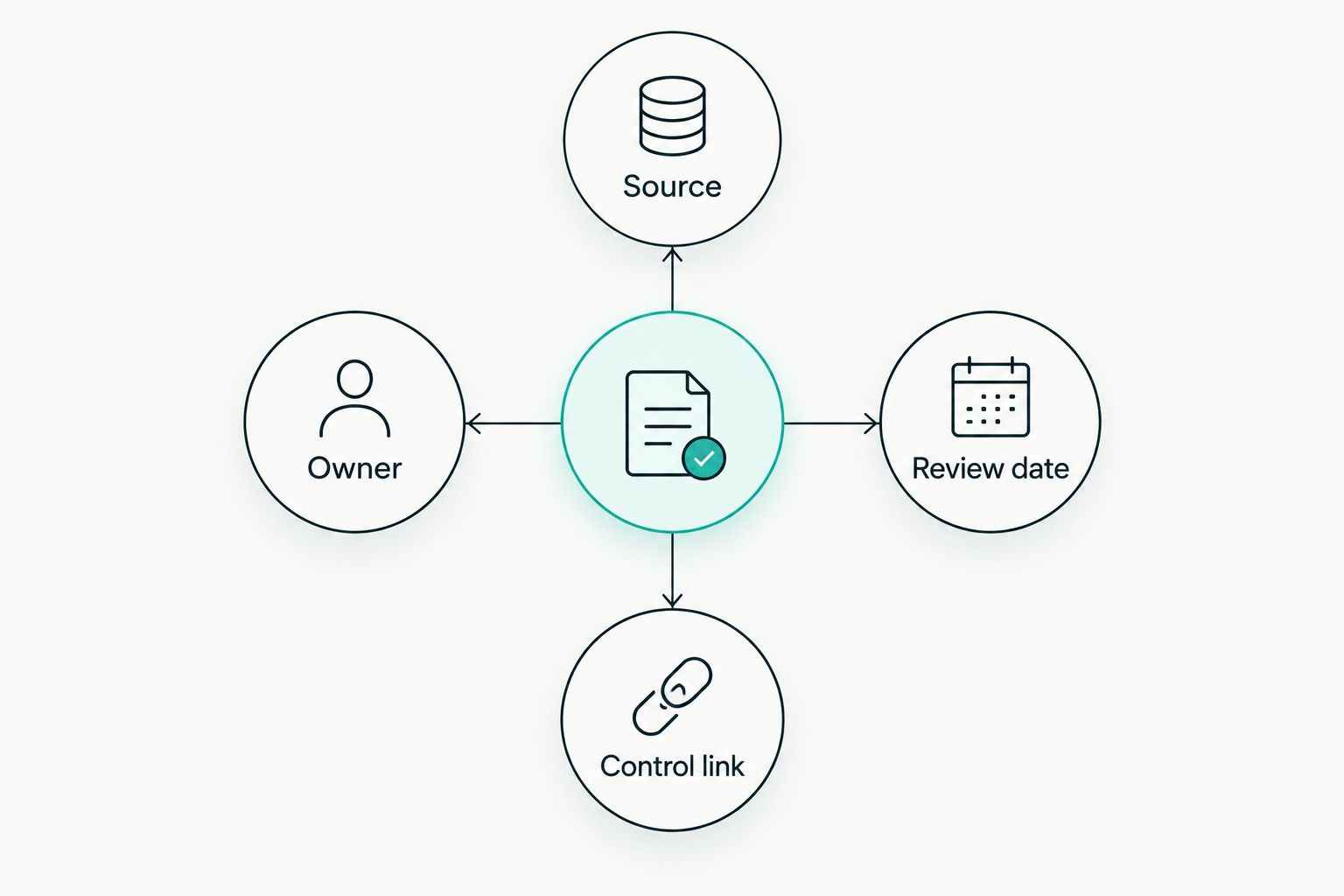
Evidence needs a source, an owner, a review date and a clear connection to the control.
Test software against university workflows
Run the same demonstration scenarios with every shortlisted approach. First, walk through them using your existing spreadsheet and document folders so you know which tasks need improvement.
Use 2 demonstration scenarios: removing a departing collaborator's access and approving a research supplier that will handle confidential information. Ask the supplier to show the complete record, including ownership, exceptions and evidence export.
Separate demonstrated functions from promises. Confirm integration coverage, permissions, change approvals and data handling during procurement; a feature name does not prove suitability for a particular university system.
Automated remediation also needs boundaries. Ask how a proposed change is reviewed, tested and reversed when it affects teaching or research services.
- Follow each scenario from request to closure.
- Test faculty-level and central-team permissions.
- Inspect approval records and exception handling.
- Export evidence in a form your team can review.
- Check how unsupported systems remain in the process.
- Document which remediation actions need human approval.
Prepare policies that match academic work
Draft policies from current practice, then close the gaps between the written rule and the operating process. Use your existing document tools first and retain a clear approval history.
Address visiting researchers, temporary staff, student workers and external collaborators where they fall within scope. A policy written only for permanent employees leaves important access decisions unexplained.
Policy generation can accelerate drafting, but an accountable person must check every document. Remove instructions that assume systems, teams or approval routes your university does not use.
Explain how approved exceptions work. Research equipment or specialist software needs an assessed treatment plan, not an undocumented exemption or a generic instruction that nobody can follow.
- Define information ownership and classification rules.
- Describe access approval and removal responsibilities.
- Set expectations for personal devices and remote access.
- Record supplier and research collaboration requirements.
- Explain incident reporting in plain language.
- Approve exceptions with owners and review dates.
Audit the management system and close findings
Start with an internal audit plan that covers the agreed scope and management requirements. Use a document checklist and interviews, then examine records that show whether controls operate in practice.
For your 2026 readiness review, test a sample of completed activities rather than accepting a dashboard status alone. Follow an access review, a supplier decision and an incident exercise through their supporting records.
Keep roles distinct when assessing cyber security audit firms: technical security testing, internal management-system auditing and certification auditing answer different questions. Define the deliverable you need before assessing a provider's suitability.
Ensure internal auditors are objective and impartial. Present findings and unresolved risks to management, record decisions and verify that corrective actions address the cause rather than just the visible error.
- Check audit coverage against the certification scope.
- Interview central and faculty control owners.
- Trace evidence back to the operating process.
- Record findings with owners and completion criteria.
- Hold a management review with documented decisions.
- Verify corrective actions before marking findings closed.
Compare implementation options for your university
Choose the option that fits your operating model, not the longest feature list. For 2026 procurement, assess what your team can maintain after the initial audit, including responsibility changes and new research services.
The options below describe different ways to organise the work. They do not remove the need for university leadership, risk decisions or independent certification assessment.
| Option | Best for | Practical advantage | Key limitation |
|---|---|---|---|
| Spreadsheets and controlled document folders | A tightly defined scope with clear ownership | You can build a process around existing working methods | Your team must maintain links, versions and follow-up manually |
| OneClickComply | Teams seeking policy generation, risk management and automated control remediation | Brings those compliance activities into an automation platform | University-system coverage and approval controls need evaluation; software cannot accept institutional risk |
| Consultant-led implementation | Teams needing specialist help with scope and management-system design | Adds external judgement to a defined implementation project | Internal owners still need to maintain the system after the engagement |
| Existing enterprise governance platform | Universities already using a shared governance system | Keeps information security work within an established governance process | Check whether the configured workflows support your ISO 27001 evidence and audit needs |
Avoid evaluating these routes in isolation. You can retain institutional governance processes while using software for specific repeatable tasks, provided responsibilities and records remain clear.
Write acceptance criteria before the demonstration. Ask each provider to show how your university retrieves evidence, records an exception and transfers ownership when a researcher or service manager leaves.
Discuss your university compliance scope
Explain your services, ownership model and evidence requirements before choosing an automation approach.
Common mistakes universities make
Treating central IT as the entire university
A central IT programme does not automatically cover faculty-managed systems, research partnerships or outsourced services. State the boundary precisely and record every dependency that affects information security within it.
Confusing research autonomy with risk acceptance
Academic discretion does not identify who can accept an information security risk. Assign that authority explicitly and retain the decision, including conditions and review arrangements.
Uploading sensitive data as audit evidence
An audit request is not a reason to copy complete student records or unpublished research into a shared folder. Provide the minimum evidence needed and control who can access it.
Approving generated policies without checking practice
A polished policy can describe controls that do not exist. Ask the operating team to demonstrate each important requirement before approval, then assign actions for any gaps.
Treating certification as the end of the programme
Your management system needs maintenance as services, suppliers and research projects change. Keep risk reviews, internal audits and corrective actions within normal governance rather than restarting them before each external assessment.
Frequently asked questions
One last thing
Test what happens when the owner leaves, not just when a control fails. Ask someone unfamiliar with the service to find its risk decision, latest evidence and next review action without help from the original owner.
Make that handover test part of your 2026 programme. If the record cannot explain the decision, improve the process before adding more automation.
Seriously Simple Cyber Compliance.