
Choose OneClickComply if you need compliance automation to manage controls, generate policies and maintain readiness; choose Amtivo if you need independent management system assessment and certification. In 2026, the useful comparison is software that helps you do the work versus a certification provider that assesses the result—not two interchangeable products.
Why this matters
Buying certification does not remove the work of running your security programme. Buying software does not turn a readiness dashboard into an independently issued certificate.
That distinction matters when a customer asks for ISO 27001. You need to understand whether the immediate blocker is unfinished internal work or the absence of an external assessment.
Start with the deliverable your customer expects. Then assign the work, choose the right support and keep preparation separate from the certification decision.
At a glance
| Dimension | OneClickComply | Amtivo |
|---|---|---|
| Best for | Growing businesses that need compliance automation | Organisations seeking independent management system certification |
| Standout feature | Automatic remediation of security controls | Management system assessment and certification |
| Policies and risk | Policy generation and risk management | External assessment of the management system |
| Formal assessment | Supports preparation and ongoing compliance work | Certification assessment route |
| Certification decision | Platform functionality is not an independent certification decision | Certification is the relevant service |
| Scope | Define the systems, people and processes you need to manage | Define the organisation and activities to be assessed |
| Internal ownership | Your business still owns controls and decisions | Your business still owns its management system |
| Pricing model to evaluate | Platform access, service scope and contract terms | Assessment scope, certification cycle and contract terms |
The table separates purpose from purchasing terms. Use it to decide which conversation you need first, rather than treating every row as a software feature contest.
Best fit: choose automation for unfinished compliance work
OneClickComply compliance automation is best for growing businesses that need to manage the work behind certification. Its stated functions include automatic control remediation, policy generation, risk management and trust centres.
That makes the platform relevant when your problem is operational. You need to address security controls, document how your business works and keep responsibilities clear as the business changes.
Amtivo is the better fit when you are buying an independent certification service. That is a different outcome from choosing where your team manages its compliance work.
Use these profiles to identify your next step:
- Best for a founder building a programme: prioritise internal readiness and assign control owners.
- Best for a security lead with an established programme: establish the assessment scope and certification route.
- Best for a business doing both in 2026: separate the preparation brief from the certification brief.
Neither purchase removes your responsibility to operate the controls. Select support for the work you actually need completed.
Standout feature: automation addresses control work directly
Automatic remediation is the platform's clearest distinction in this comparison. It addresses security control work rather than only recording that work needs attention.
The useful buying question is not whether automation exists. Ask which controls it can remediate in your environment, what permissions it needs and how you approve changes.
Request a demonstration built around a real control your business manages. Follow the change from identification through action to the record your team retains.
- Identify the control and its owner.
- Confirm what action the platform performs.
- Check where human approval remains necessary.
- Review the record of the completed change.
Automation wins when the blocker is completing repeatable control work. Do not buy a certification assessment expecting it to perform the same operational function.
The limitation is equally important. A completed automated action does not prove that your entire management system meets ISO 27001 requirements; the wider programme still needs review.
Policies and risk: the platform helps create and manage the work
Policy generation and risk management are explicit platform functions. They address tasks your organisation needs to maintain, not just documents you produce for an assessment.
Generated policies still need to describe your business accurately. Review responsibilities, working practices and approval requirements before adopting them.
For risk management, test the workflow against a risk you already understand. Check how you record the issue, assign responsibility, choose treatment and review the decision.
Your acceptance criteria should be practical:
- The policy describes what staff actually do.
- A named person approves the document.
- Each risk has an accountable owner.
- Treatment decisions have a recorded rationale.
- Reviews reflect changes in your business.
Policy generation helps with drafting; your organisation remains responsible for accuracy and adoption. That is the main limit to a hands-off buying expectation.
External assessment serves a different purpose. It examines whether the management system meets the applicable requirements; it is not a substitute for your internal policy and risk process.
Formal assessment: Amtivo fits the certification brief
Amtivo is the relevant choice when your requirement is independent management system certification assessment. Keep that brief separate from the software you use to prepare.
For ISO 27001, initial certification involves 2 audit stages. Stage 1 reviews readiness and key management system information; Stage 2 evaluates implementation and conformity.
Those stages explain why a preparation platform and a certification provider are not direct replacements. Your team builds and operates the system, while the certification process assesses it.
Before appointing a provider in 2026, ask for written confirmation of:
- The contracting certification body.
- The standard and certification scope.
- The accreditation applicable to that service.
- The assessment process and responsibilities.
- How findings and corrective actions are handled.
Do not treat a group name as proof that every service has the same accreditation. Check the specific body and scope against your customer's requirements.
The trade-off is clear: certification assessment addresses external assurance, but it does not remove the internal work needed to establish and maintain your programme.
Certification decision: independent assessment wins over a dashboard
A platform's completion status and an independent certification decision answer different questions. The first describes activity within the software; the second follows the certification body's assessment process.
Choose Amtivo for the certification service, not as a replacement for internal control management. Ask exactly which entity will issue the certificate and what scope it will cover.
ISO management system certification normally follows a 3-year certification cycle, with surveillance during that cycle. Your programme therefore needs to remain operational after the initial assessment.
That ongoing obligation changes the purchase decision. Preparation is not a project you finish and abandon once a certificate arrives.
For your 2026 plan, separate these outputs:
- Internal readiness: controls, policies, risk decisions and operating records.
- External assessment: review against the certification requirements.
- Certification decision: the independent outcome of that process.
- Ongoing maintenance: continued operation and review of the management system.
No software status should be presented to a customer as an independently issued certificate. Equally, a certificate should not replace your internal view of unresolved control work.
Scope is a tie: both routes need a clear boundary
Neither route fixes an unclear scope. Define what your programme covers before you compare proposals or configure a platform.
For a growing SaaS business, that means describing the service, the people who operate it, the systems involved and the organisational boundaries. Use the same description in your internal plan and your certification discussions.
A useful sequence is:
- Define scope: document the business activities and boundaries.
- Assign owners: name the people responsible for decisions and controls.
- Prove operation: retain records showing how the programme works.
- Independent assessment: submit the defined management system for external review.
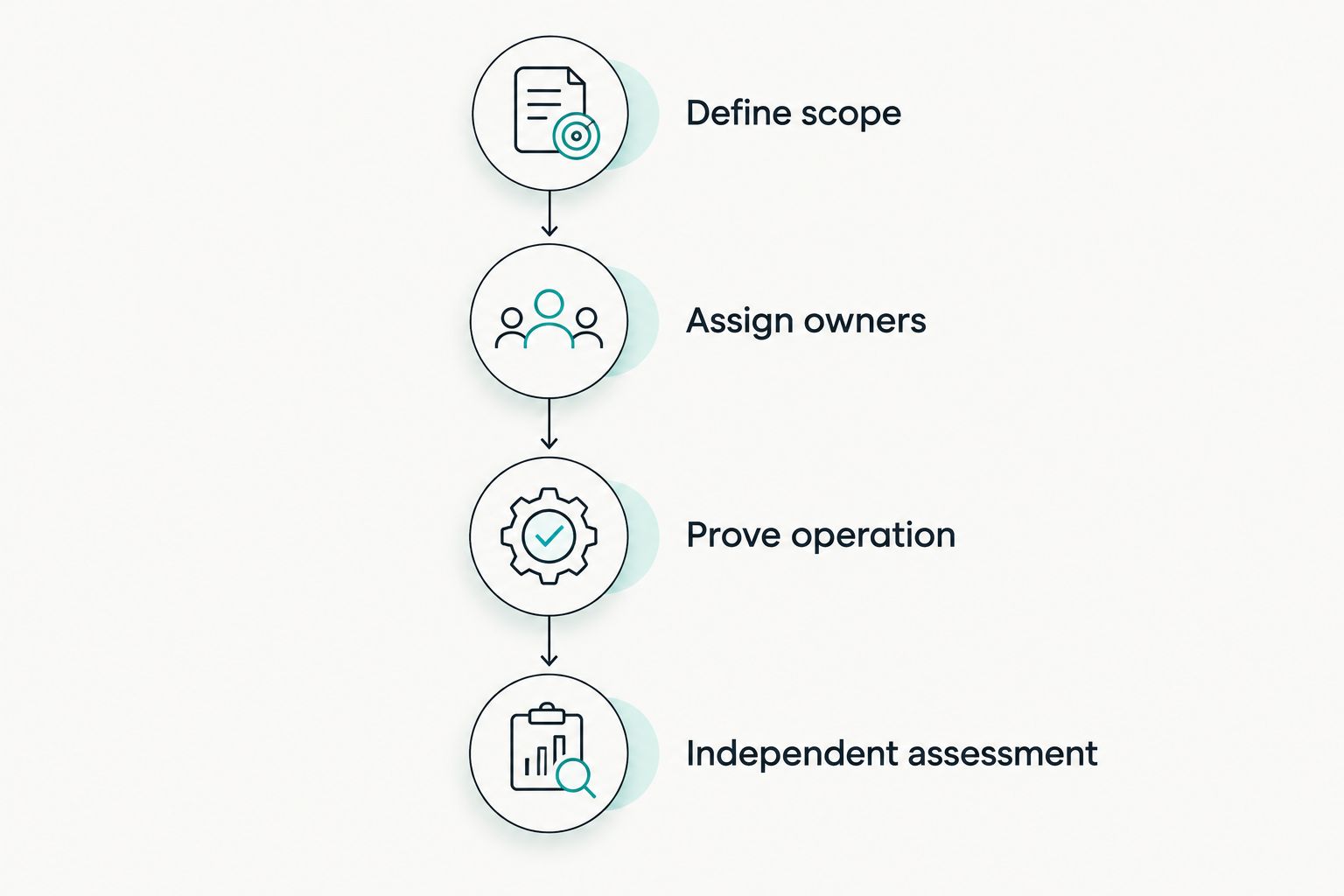
Define the work and its owners before submitting the management system for assessment.
Keep the boundary consistent across documents and conversations. If a customer expects coverage of a particular service, resolve that requirement before you agree the assessment scope.
Scope is a shared prerequisite, not a feature winner. A clear boundary makes both the operational work and the external assessment easier to specify.
Ownership is a tie: your business remains accountable
Neither a software platform nor a certification provider becomes the owner of your business decisions. You still need people who approve policies, accept risks and ensure controls operate.
Automation changes how tasks get completed. Independent assessment changes how conformity is evaluated. Neither removes management responsibility.
Before you buy, identify who handles:
- Security control changes and approvals.
- Policy approval and staff communication.
- Risk acceptance and treatment decisions.
- Internal review and corrective actions.
- Communication with the certification body.
Give each responsibility a named owner rather than assigning everything to a generic compliance inbox. That makes handovers and unresolved decisions visible.
Internal ownership is a tie because both routes require it. The practical winner is the arrangement your team can operate consistently, with clear responsibilities and records.
Pricing: compare platform scope with certification scope
For a 2026 budget, evaluate the charging basis and contractual scope separately. Platform access and certification assessment are different purchases, so a headline comparison alone does not explain what you receive.
For the platform, review the current pricing and confirm the applicable contract terms. Ask what functions and support the agreement covers, and which work remains with your team.
For certification, request a proposal tied to your organisation and assessment scope. Establish what the agreement covers across initial assessment, surveillance and recertification.
Use the same purchasing checklist for both:
- What deliverables does the agreement include?
- What creates a change in scope?
- Which activities need a separate agreement?
- What are the renewal and termination terms?
- Who performs each part of the work?
Predictability comes from a clearly bounded agreement. Flexibility comes from understanding how that agreement handles changes as your business grows.
Compare complete responsibilities, not just the apparent entry point. Treat internal preparation, platform support and independent certification as separate budget lines, even when you coordinate them within one programme.
Final verdict: buy for the job you need done
Choose OneClickComply if you own a growing team's compliance work
Best for: a founder or security lead who needs compliance automation. Choose the platform when your immediate priorities are remediating controls, generating policies and managing risk and trust centres.
Keep the limitation explicit: platform functionality is not the independent certification decision. Plan the external assessment alongside the internal programme.
Choose Amtivo if you are procuring certification assessment
Best for: a compliance lead with an established management system who needs an independent certification route. Choose Amtivo when the next deliverable is certification assessment rather than software to manage preparation.
Keep the limitation explicit here too: appointing a certification provider does not establish or operate your controls for you. Confirm the specific certification body, scope and accreditation before signing.
| Dimension | Winner |
|---|---|
| Best for | Split: operational preparation versus certification |
| Standout feature | Automation for control work; Amtivo for certification |
| Policies and risk | The platform for generation and management |
| Formal assessment | Amtivo |
| Certification decision | Amtivo |
| Scope | Tie: define the boundary first |
| Internal ownership | Tie: your business remains responsible |
| Pricing model | Match the agreement to the required deliverables |
Frequently asked questions
One last thing
Ask your customer what they need to see before you purchase anything: an ISO 27001 certificate, a SOC 2 report or evidence of specific controls. Those are different deliverables, and the answer determines your next move.
Write that requirement at the top of your buying brief. Keep the work simple without confusing preparation with assurance. Seriously Simple Cyber Compliance.