
Choose OneClickComply if you need compliance automation for security controls and certification preparation; choose LegalVision if you need business legal advice and contract support. In 2026, the decision is about the work you need done: managing security compliance or getting legal judgement.
Why this matters
A customer can ask for a security certificate and changes to a contract in the same procurement process. Those requests create different jobs. Treating them as one compliance purchase leaves part of the work unresolved.
A platform helps you manage controls, policies and risk. A lawyer advises on legal obligations and contractual wording. Your business still needs someone to approve decisions and make sure the work reflects how you operate.
OneClickComply is best for growing businesses that need compliance automation, rather than business legal advice. That is the useful dividing line for this comparison—not which provider has the broadest interpretation of compliance.
At a glance
| Dimension | OneClickComply | LegalVision |
|---|---|---|
| Best for | Growing businesses managing security compliance | Businesses seeking legal advice and contract support |
| Security controls | Auto-remediating security controls | Legal advice rather than technical control remediation |
| Legal advice | A compliance automation platform, not a substitute for legal counsel | Business legal services |
| Policies and documents | Generating compliance policies | Legal advice on documents and contractual wording |
| Certification decisions | Supports preparation and ongoing compliance work | Legal services are separate from certification decisions |
| Standout feature | Combines control remediation, policies, risk and trust centres | Access to business legal advice |
| Internal responsibility | Your team approves policies and owns risk decisions | Your team gives instructions and makes business decisions |
| Pricing model | Evaluate the platform agreement against your required scope | Evaluate membership terms against your required legal work |
Choose by deliverable, not by the word compliance
Start your 2026 buying brief with the outcome you must produce. Name the document, control or decision that is blocking progress. That makes the supplier category much easier to choose.
A security programme needs working controls and evidence that those controls operate. A legal matter needs advice that addresses your circumstances. Neither outcome becomes interchangeable because both sit under a compliance budget.
Use these examples to separate the work:
- Security requirement: prepare for ISO 27001, Cyber Essentials or SOC 2.
- Operational requirement: generate policies, manage risks or organise a trust centre.
- Legal requirement: understand a contract, negotiate wording or obtain business legal advice.
- Mixed requirement: meet a customer's security requirements and agree the related contract.
For a mixed requirement, write separate acceptance criteria. The security owner should describe the operational result. The person instructing the lawyer should describe the legal question.
The winner for fit is the provider whose output matches the blocker. Do not ask a legal engagement to act as a security platform, or a security platform to act as your solicitor.
OneClickComply wins for automated security-control work
The compliance automation platform auto-remediates security controls, generates policies, and manages risk and trust centres. Those functions match the recurring work behind a security compliance programme.
The practical advantage is the type of work the platform handles. You are buying a way to act on controls and manage compliance activity, rather than commissioning advice about a legal question.
LegalVision is the wrong category for a brief centred on technical control remediation. Legal advice can address obligations, but a legal opinion is not proof that a security setting has changed.
Before choosing software, test the exact work you need it to handle:
- Name the control you want to remediate.
- Ask what action the platform performs.
- Establish what your team must approve or complete.
- Check how you will demonstrate that the action worked.
The limitation is scope. Do not assume that automation covers every system, control or exception in your business. Require a demonstration of your relevant workflow before you commit.
LegalVision wins when you need business legal advice
Choose LegalVision when the deliverable is legal advice or support with a business contract. That is a different requirement from generating a security policy or managing a risk register.
For example, a customer agreement can raise questions about liability, confidentiality or the promises your business is being asked to make. You need legal judgement on that wording, alongside an accurate account of your security practices.
A compliance platform does not turn operational records into legal advice. Equally, a lawyer's review does not establish that your technical controls work as described.
Give the legal adviser a focused brief:
- Identify the contract or legal question.
- Explain the commercial outcome you want.
- Describe the operational commitments involved.
- Confirm the jurisdiction relevant to the advice.
LegalVision wins for legal judgement; it is not a replacement for operating security controls. Confirm that the proposed engagement covers your particular matter before treating it as resolved.
Policy generation and legal review solve different document problems
A generated policy gives you a document to review against your actual practices. Legal review addresses the legal implications of wording or obligations. Choose according to the document's purpose, not its file format.
A security policy should describe what your business does, who owns the work and how exceptions are handled. Approving text that does not reflect your operations creates a gap between the document and reality.
A contract creates a separate question: what are you agreeing to do? A technically accurate description still needs careful treatment when it becomes a promise to a customer.
Use this division of responsibility:
- Policy generation: produce the compliance document.
- Operational review: check that the document matches your practices.
- Legal review: assess legal wording and obligations where needed.
This is a split verdict. Automation fits policy production; legal services fit legal interpretation. Neither removes the need for an accountable person inside your business to approve the result.
Neither provider replaces an independent assurance decision
For a 2026 certification project, distinguish preparation from assessment. Software can support your programme. Legal advisers can address legal questions. Neither purchase, by itself, establishes that you have passed an independent assessment.
ISO 27001 certification concerns an information security management system. SOC 2 is an attestation report, not an ISO-style certificate. Use the correct deliverable when you brief suppliers and respond to customers.
A buyer asking for a report, certificate or particular scope needs that specific evidence. A platform subscription, policy document or legal engagement is not an equivalent substitute.
Before starting, establish:
- Which framework or assurance outcome the customer requires.
- Which business activities and systems fall within scope.
- Who will conduct any required independent assessment.
- What preparation remains your team's responsibility.
This dimension is a tie: neither provider replaces the relevant assessor or auditor. Keep the preparation brief separate from the independent decision so that responsibilities remain clear.
The platform wins for managing risk and trust-centre work
Risk management and trust centres belong to the compliance automation platform's stated scope. They fit a business that needs to manage security information alongside its policies and control work.
That is useful when your problem is operational organisation: identifying risks, recording decisions and presenting security information. Legal advice serves a different purpose, such as reviewing what a disclosure means or what a contract requires.
A trust centre also needs careful ownership. Decide what information you are prepared to share and keep statements consistent with your actual practices.
Ask for a demonstration built around your intended use:
- Show how you would record a relevant security risk.
- Identify the person responsible for the decision.
- Explain what information belongs in the trust centre.
- Check the review process before information is published.
The platform wins for this operational brief. Do not assume that managing information also settles every legal question about sharing it. Bring a legal adviser into a specific disclosure question when that is the work required.
Both routes still need an accountable internal owner
Neither software nor external advice takes over your management decisions. You need someone who can approve policies, provide accurate instructions and accept or reject business risks.
For software, that owner checks whether the workflow matches your systems and whether the resulting records are accurate. For legal services, the owner supplies the facts and decides how to act on the advice.
Keep these responsibilities visible:
- Security owner: confirms how controls operate.
- Business owner: approves priorities and accepts business decisions.
- Legal adviser: addresses the legal questions in the engagement.
- Independent assessor: makes the relevant assessment decision.
This is an honest tie. Both routes need your input, even though they ask for different kinds of input. Assign ownership before purchase rather than discovering an approval gap during delivery.
Pricing: compare the agreement with the work you need
For your 2026 purchase, compare the scope of the platform agreement with the scope of the legal engagement. A software agreement and a legal membership do not buy the same output.
For the platform, establish which frameworks, functions and support are included in your proposed agreement. Ask what implementation work remains with your team and how changes to your requirements affect the arrangement.
For LegalVision, examine the membership terms against the legal matters you expect to instruct. Confirm the work covered, exclusions, engagement conditions and how matters outside the agreed scope are handled.
A recurring agreement helps planning only when the included work matches your needs. Flexibility matters when your requirements change, but scope still needs to be explicit.
Review both proposals against the same questions:
- What specific output does the agreement cover?
- What work remains with your team?
- Which external services require separate arrangements?
- What happens when the scope changes?
- What are the renewal and termination terms?
There is no pricing-model winner without a matched brief. Use the contact page to explain your required compliance outcome and request the relevant scope.
Test the fit with 3 tasks before you commit
Use 3 tasks to turn this comparison into a buying decision. These are evaluation steps, not claims about either provider's delivery speed or performance.
Control task
Select 1 control relevant to your programme. Ask the platform provider to explain the action, the approval needed and the result you can inspect.
Do not accept a generic presentation in place of your workflow. Your aim is to understand where automation ends and your team's work begins.
Document task
Select 1 document that your business needs. Decide whether the job is policy generation, operational checking or legal advice before assigning it.
A policy and a contract can mention the same subject while requiring different expertise. State the intended use and the person who will approve the result.
Ownership task
Name the internal owner for each outstanding decision. Then ask each supplier what information that person must provide and which approvals remain with them.
If you cannot identify an owner, resolve that gap before purchase. External support needs a clear route to decisions inside your business.
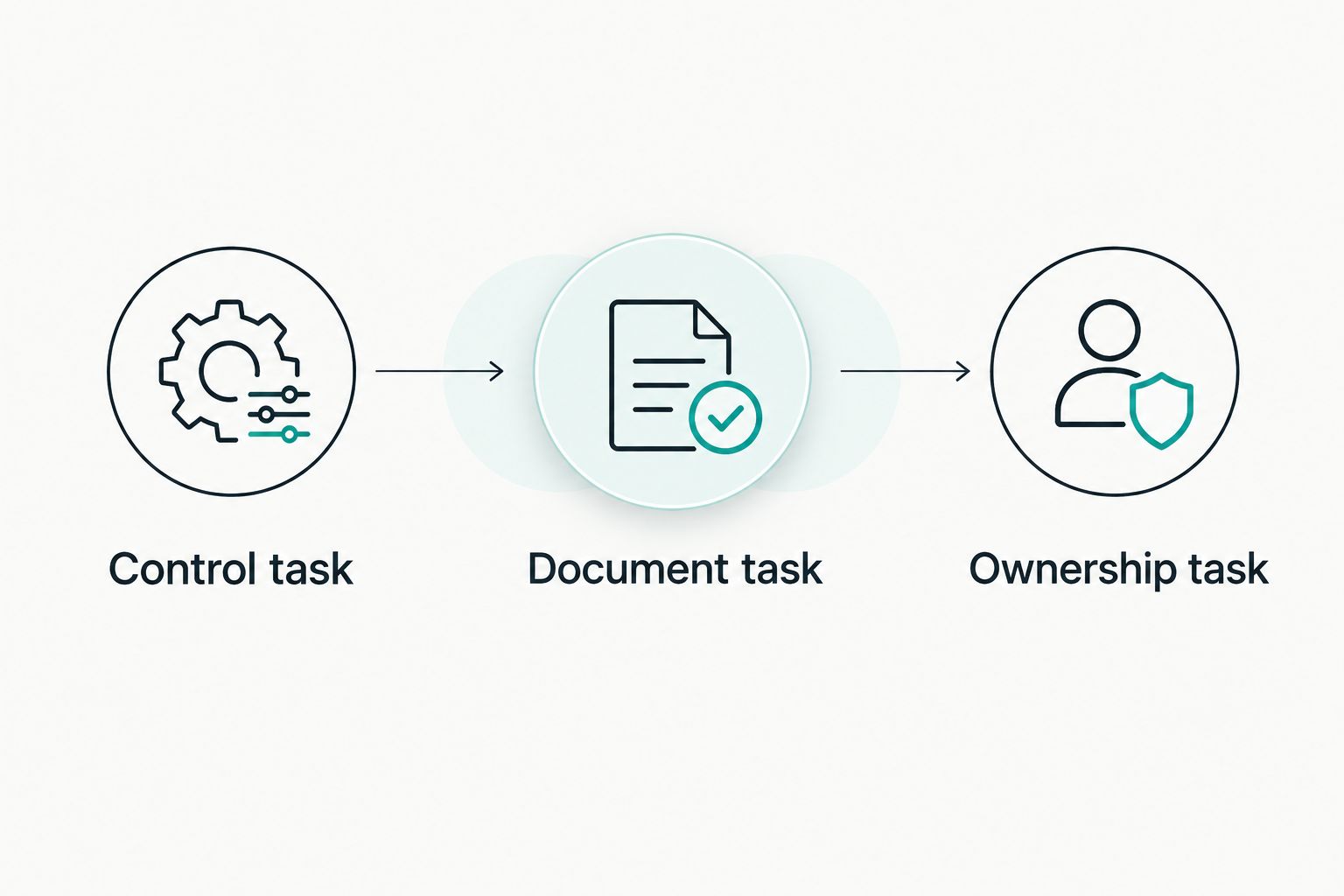
Test the required work before comparing supplier agreements.
Final verdict for 2026
Choose OneClickComply if you lead a security compliance programme
Best for: a founder, operations lead or security lead who needs compliance automation. Choose this route when your priorities are auto-remediating security controls, generating policies, managing risk and maintaining a trust centre.
Keep legal advice separate where the question requires it. Automation supports the programme; your team still owns approvals and management decisions.
Choose LegalVision if you need business legal support
Best for: a founder or business lead whose immediate blocker is a legal question or contract. Choose this route when you need advice on legal wording and business obligations rather than technical control work.
Confirm the engagement's scope. Keep certification preparation and security operations with the people and systems responsible for them.
| Dimension | Winner |
|---|---|
| Best fit | Match the provider to the required deliverable |
| Security controls | Compliance automation platform |
| Legal advice | LegalVision |
| Policies and documents | Split: generation versus legal review |
| Certification decisions | Tie: neither replaces independent assessment |
| Risk and trust-centre work | Compliance automation platform |
| Internal responsibility | Tie: both need an accountable owner |
| Pricing model | Decide against the agreed scope |
Frequently asked questions
One last thing
Take a sentence from your next customer request and identify the deliverable. A request for a certificate needs assurance evidence. A request to amend liability wording needs legal judgement.
If the request contains both, split the work before choosing a supplier. That is the practical route to Seriously Simple Cyber Compliance.