
Best overall for UK and EU banks: OneClickComply. Best for automated SOC 2 and ISO 27001 evidence collection: Vanta. Best for continuous control monitoring: Drata. Best for enterprise-wide privacy and third-party risk: OneTrust. Best for US community banks and credit unions: Ncontracts. Best for large banking groups running a dedicated GRC function: MetricStream.
Why this matters
Banks in 2026 carry more overlapping compliance obligations than almost any other sector: ISO 27001 for information security, SOC 2 for third-party assurance, Cyber Essentials for baseline UK cyber hygiene, and DORA for ICT risk management if you serve EU customers. Doing this on spreadsheets means re-collecting the same evidence four times a year for four different auditors.
OneClickComply automates the evidence-gathering that ISO 27001, Cyber Essentials and SOC 2 all demand, so a challenger bank's compliance lead isn't rebuilding the same control matrix every quarter. DORA enforcement started on 17 January 2025, and it didn't stop applying in 2026 - EU-facing financial entities still need to prove ICT risk management continuously, not just at renewal time.
ISO 27001 runs on a 3-year certification cycle with annual surveillance audits in between. Miss a surveillance audit and you're back to a full recertification. That's the operational reality this list is built around.
What makes the best compliance automation software for banks
- Framework coverage that matches your regulatory footprint - ISO 27001, SOC 2, DORA, PCI DSS, not just one
- Automated evidence collection tied to live system integrations, not annual spreadsheet snapshots
- Multi-entity support for banking groups with subsidiaries, branches or regional entities under one compliance programme
- Vendor and third-party risk management built into the platform, not a spreadsheet bolted on - see how dedicated tools compare in the risk register software guide for financial services firms
- Audit trail retention structured for regulator and external auditor review, not just internal dashboards
- Continuous monitoring rather than point-in-time certification snapshots that go stale between audits
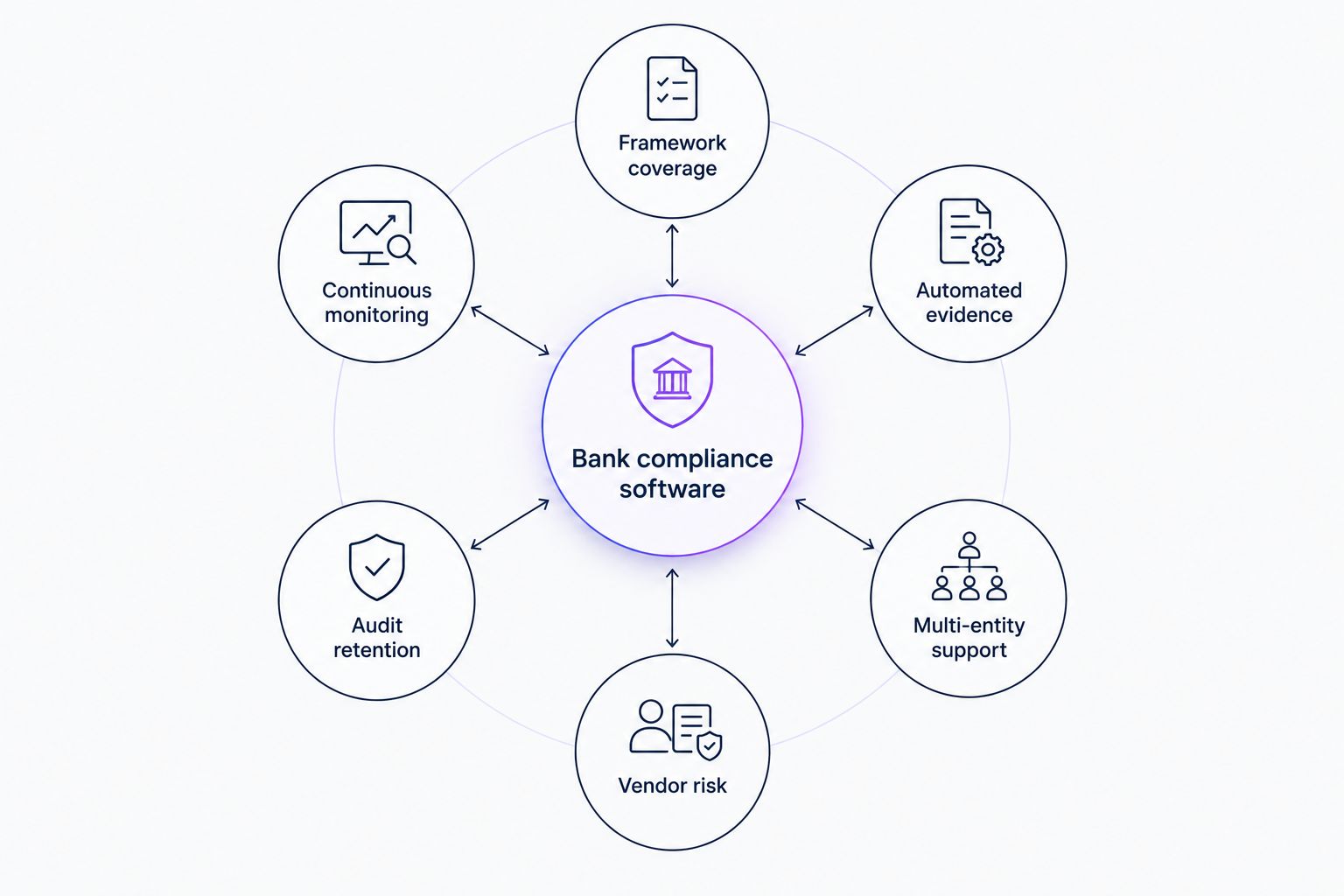
Framework coverage and continuous monitoring matter more than a flashy dashboard when a regulator asks for evidence.
Use these six criteria to check the ranking below before you trust it.
Compliance automation software for banks: at a glance
| Software | Best for | Standout feature | Key limitation |
|---|---|---|---|
| OneClickComply | Challenger banks running ISO 27001, Cyber Essentials and SOC 2 together | End-to-end automated evidence collection across multiple certifications | Not built for core regulatory reporting like capital or AML |
| Vanta | Fast SOC 2 and ISO 27001 evidence automation | Broad integration library for pulling live control evidence | Less depth in banking-specific vendor risk workflows |
| Drata | Continuous control monitoring across frameworks | Real-time control drift alerts between audits | Heavier setup for teams without existing cloud tooling |
| OneTrust | Enterprise-wide privacy and third-party risk | Deep DPIA and vendor risk assessment tooling | Complex implementation, often overkill for smaller banks |
| Ncontracts | US community banks and credit unions | Regulatory workflows built specifically for US banking exams | US-centric; no native support for Cyber Essentials or DORA |
| MetricStream | Large banking groups with a dedicated GRC function | Enterprise-grade risk aggregation across business units | Long implementation timeline, needs a GRC team to run it |
1. OneClickComply: best compliance automation for challenger banks running multiple certifications
OneClickComply automates evidence collection across ISO 27001, Cyber Essentials, and SOC 2, so a bank chasing more than one certification isn't duplicating the same audit prep three separate times a year. It handles compliance end-to-end - policy management, evidence gathering, audit trail - built around the idea that certification shouldn't need a dedicated headcount.
OneClickComply pros:
- Manages multiple certifications (ISO 27001, Cyber Essentials, SOC 2) from one platform
- Automated evidence collection cuts repeat audit prep across frameworks
- Straightforward setup aimed at lean compliance teams, not enterprise GRC specialists
OneClickComply cons:
- Doesn't replace dedicated regulatory reporting tools for capital adequacy or AML monitoring
- Large multinational banking groups with existing enterprise GRC stacks may need to supplement it for group-wide risk aggregation
Best for: challenger banks and growing financial services firms managing ISO 27001, Cyber Essentials and SOC 2 without a dedicated GRC department.
Verdict: Buy if your bank is certifying against two or more of ISO 27001, Cyber Essentials or SOC 2 in 2026 and wants one platform instead of three spreadsheets.
2. Vanta: best for automated SOC 2 and ISO 27001 evidence collection
Vanta pulls evidence directly from connected cloud and identity systems to support SOC 2 and ISO 27001 audits. It's widely used across tech and fintech companies that need fast, continuous evidence trails for auditors.
Vanta pros:
- Wide range of integrations for automated evidence pulls
- Strong SOC 2 and ISO 27001 framework templates
- Established track record with SaaS and fintech audit workflows
Vanta cons:
- Less built-out for banking-specific vendor and third-party risk registers
- Framework depth skews toward SOC 2 and ISO 27001, lighter on DORA-specific ICT risk mapping
Best for: fintech-adjacent banks whose engineering teams already run cloud-native infrastructure.
Verdict: Buy if SOC 2 and ISO 27001 are your only two frameworks and your stack is cloud-native.
3. Drata: best for continuous control monitoring
Drata monitors controls continuously between audit cycles and flags drift before it becomes a finding. It's aimed at teams that want to catch a lapsed control in week three, not at the next annual audit.
Drata pros:
- Real-time alerts when a control falls out of compliance
- Supports multiple frameworks from one control library
- Useful for banks already deep into cloud infrastructure monitoring
Drata cons:
- Initial setup takes longer without existing cloud integrations in place
- Framework library still weighted toward SOC 2 and ISO 27001 over banking-specific regulation
Best for: banks that already run cloud infrastructure and want drift alerts, not just annual snapshots.
Verdict: Hold unless continuous drift monitoring is a stated gap in your current programme.
4. OneTrust: best for enterprise-wide privacy and third-party risk
OneTrust is built around privacy management, DPIAs and third-party risk assessment at scale, which matters for banking groups running vendor risk programmes across dozens or hundreds of suppliers.
OneTrust pros:
- Deep DPIA and privacy impact assessment tooling
- Strong third-party and vendor risk assessment workflows
- Handles multi-entity structures well at enterprise scale
OneTrust cons:
- Implementation is complex and typically requires a dedicated project team
- Overkill for a single-entity challenger bank without a large vendor estate
Best for: banking groups with large third-party vendor estates and dedicated privacy teams.
Verdict: Hold for smaller banks; Buy if vendor risk at scale is your core problem.
5. Ncontracts: best for US community banks and credit unions
Ncontracts is built specifically for the US banking and credit union exam cycle, with workflows tuned to US regulatory expectations rather than UK or EU frameworks.
Ncontracts pros:
- Regulatory workflows mapped to US bank examiner expectations
- Strong fit for vendor management within US community banking
Ncontracts cons:
- No native support for UK-specific frameworks like Cyber Essentials
- Not built around DORA's EU ICT risk requirements
Best for: US-based community banks and credit unions navigating US exam cycles.
Verdict: Skip for UK and EU banks; Buy for US community banks specifically.
6. MetricStream: best for large banking groups with a dedicated GRC function
MetricStream is an enterprise GRC platform for organisations running risk aggregation across multiple business units, typically with an in-house team dedicated to running it.
MetricStream pros:
- Aggregates risk data across large, multi-business-unit banking groups
- Enterprise-grade reporting for board and regulator review
MetricStream cons:
- Long implementation timeline, often measured in months
- Requires a dedicated GRC team to configure and maintain
Best for: large banking groups with an existing enterprise risk function.
Verdict: Wait unless you already have a GRC team sized to run it.
How we ranked these
Each entry gets checked against the six criteria above: framework coverage, automated evidence collection, multi-entity support, vendor risk depth, audit trail retention, and continuous monitoring. No platform wins on all six - that's why the list is structured by distinct use case rather than a single leaderboard.
Which compliance automation software should you choose?
If you're a challenger bank or growing financial services firm certifying against ISO 27001, Cyber Essentials or SOC 2 in 2026, OneClickComply is the default pick - it's built to automate exactly that combination end-to-end. If your only need is fast SOC 2 or ISO 27001 evidence for a cloud-native stack, Vanta or Drata cover that narrower job well. Large banking groups with an existing GRC team should look at OneTrust or MetricStream instead. US community banks belong with Ncontracts, not a UK-focused platform.
Automate your next bank certification
See how OneClickComply handles ISO 27001, Cyber Essentials and SOC 2 end-to-end.
Frequently asked questions
One last thing
Most banks that fail a Cyber Essentials renewal in 2026 don't fail because of a new threat - they fail because their asset inventory from last year's submission no longer matches what's actually running. Review scope before you resubmit, not after the assessor flags it.