
Best for cyber certification: OneClickComply. Best for connected enterprise workflows: ServiceNow Integrated Risk Management. Best for configurable enterprise risk: Archer. Best for audit-led assurance: AuditBoard. The best GRC software for insurance companies in 2026 depends on whether you need to automate security compliance, coordinate enterprise risk or manage internal audit.
Why this matters
Buy the software that handles your immediate compliance workload. Do not buy an enterprise risk system when your team needs help fixing security controls and preparing policies.
The reverse also applies. Cyber certification software is not a substitute for an insurer's wider governance, regulatory compliance or risk management programme. In 2026, start your shortlist with a defined outcome rather than a long feature checklist.
For an insurer, that distinction matters across underwriting, claims, outsourced services and technology. Decide which activities belong in the platform before asking suppliers to demonstrate it.
What makes the best GRC software for insurers?
Judge governance, risk and compliance software against these criteria before comparing names:
- Scope fit: Match the platform to cyber certification, enterprise risk, internal audit or a clearly defined combination.
- Evidence traceability: Ask how a reviewer moves from a requirement to a control, its owner and supporting evidence.
- Action management: Check how the platform assigns work, handles exceptions and records decisions.
- Insurance relevance: Demonstrate workflows involving claims suppliers, policyholder information and outsourced operations where these fall within your scope.
- Implementation ownership: Establish who configures workflows, maintains content and approves changes.
- Usable reporting: Require reports that explain unresolved issues and accountable owners, not just completed tasks.
Reject a platform that cannot demonstrate your main workflow. A polished dashboard does not establish that the underlying process works.
GRC software for insurance companies at a glance
The order below follows distinct buying needs. It is not a claim that one platform replaces every other option.
| Platform | Best for | Standout capability | Key limitation to assess |
|---|---|---|---|
| OneClickComply | Cyber certification automation | Security control remediation, policy generation and risk management | Wider insurance governance needs separate assessment |
| ServiceNow Integrated Risk Management | Connected enterprise workflows | Risk and compliance processes within the ServiceNow platform | Configuration and platform ownership need clear responsibility |
| Archer | Configurable enterprise risk | Structured risk and compliance management | Your team must define the risk model and supporting processes |
| AuditBoard | Audit-led assurance | Connected internal audit, risk and compliance work | Cyber remediation needs a separate technical assessment |
1. OneClickComply: best GRC software for cyber certification
Get security certification work under control before expanding your software scope. OneClickComply provides compliance automation for growing businesses pursuing and maintaining ISO 27001, Cyber Essentials and SOC 2 assurance.
The platform auto-remediates security controls, generates policies, manages risk and supports trust centres. That makes it a focused choice when your buying brief centres on cyber compliance rather than the insurer's entire risk function.
OneClickComply pros:
- Automates security control remediation rather than only recording compliance work.
- Generates policies to support your compliance programme.
- Brings risk management into the certification workflow.
- Supports trust centres for sharing assurance information.
OneClickComply cons:
- Cyber compliance automation does not replace decisions about underwriting, reserving or conduct risk.
- Generated policies still need approval against your actual operations.
- Your assessment must establish whether wider insurance-specific workflows fit the platform.
Best for: Growing insurance businesses whose immediate priority is cyber certification and ongoing security compliance.
Ask for a demonstration using a real security gap and a policy that needs updating. Follow the work through to review and approval rather than accepting a finished dashboard.
Verdict: Buy for a cyber certification-led requirement; hold if your primary need is enterprise-wide insurance governance.
2. ServiceNow: best GRC software for connected enterprise workflows
ServiceNow Integrated Risk Management connects risk and compliance processes within the wider ServiceNow platform. Consider it when your buying problem involves coordinating work across established technology and business processes.
For an insurer, the evaluation should follow a risk issue from identification through assignment, action and management review. Existing use of ServiceNow is relevant, but it does not prove that your risk processes are ready to implement.
ServiceNow pros:
- Offers risk and compliance management within a wider workflow platform.
- Supports an approach built around connected responsibilities and actions.
- Gives existing ServiceNow users a platform-based option to assess.
ServiceNow cons:
- Platform configuration needs a named owner and clear governance.
- A broader implementation introduces decisions beyond the compliance team's immediate requirements.
- Existing platform use does not remove the need to test evidence quality and reporting.
Best for: Insurers that want risk and compliance work connected to their wider ServiceNow environment.
Request a demonstration of an overdue action crossing departmental boundaries. Check who receives it, who can change it and how management sees the unresolved risk.
Verdict: Buy for connected workflow requirements; hold if you only need a focused certification programme.
3. Archer: best GRC software for configurable enterprise risk
Archer provides enterprise risk and compliance management software. Put it on the shortlist when you need a structured approach to different risk categories, accountable owners and management reporting.
Start with your risk model. Software cannot decide whether separate business units mean the same thing when they assign a risk rating or accept an exception.
Archer pros:
- Centres the buying decision on enterprise risk and compliance management.
- Supports structured risk records and related processes.
- Offers an option for organisations designing a wider GRC programme.
Archer cons:
- Your team must define consistent categories, scoring rules and responsibilities.
- Configuration cannot resolve disagreements about risk ownership.
- Broad enterprise scope is unnecessary when the requirement is limited to cyber certification.
Best for: Insurance groups with a defined enterprise risk model that need software to organise and manage it.
Bring examples from different business units to the demonstration. Ask the supplier to show how local ownership and group reporting coexist without stripping out the underlying context.
Verdict: Buy for a defined enterprise risk programme; wait if your risk model remains unsettled.
4. AuditBoard: best GRC software for audit-led assurance
AuditBoard connects internal audit, risk and compliance work. Consider it when your main requirement is to organise assurance activity and track findings through management action.
Keep the demonstration centred on how auditors work. Follow an audit objective into testing, supporting evidence, findings and closure rather than treating audit as another task list.
AuditBoard pros:
- Places internal audit alongside risk and compliance work.
- Provides an audit-led option for coordinating assurance activity.
- Supports a buying brief centred on findings and accountable action.
AuditBoard cons:
- Audit management does not itself establish that technical security controls have been fixed.
- Your team must agree what evidence is sufficient to close a finding.
- Audit-led requirements do not cover every operational or regulatory process.
Best for: Insurers whose internal audit function is driving the GRC purchase.
Ask the supplier to demonstrate a disputed finding. Check how management responses, supporting evidence and the final closure decision remain distinct.
Verdict: Buy for audit-led assurance; hold if automated security remediation is the main objective.
How the ranking works
This 2026 shortlist separates buying needs rather than assigning unsupported scores. The criteria are scope fit, evidence traceability, action management, insurance relevance, implementation ownership and reporting.
The first option addresses cyber certification automation. The remaining options address connected workflows, enterprise risk and internal audit respectively. Choose the category before choosing the platform.
Define your insurance scope before the demonstration
Give every shortlisted supplier the same brief. For your 2026 purchase, use 3 workflows: one control failure, one supplier issue and one management decision.
Build the brief in this order:
- Define scope: Name the legal entities, teams, services and obligations involved.
- Assign owners: Identify who performs the work and who approves the outcome.
- Test evidence: Specify what a reviewer needs to establish that the work happened.
- Approve actions: Define how exceptions and unresolved issues reach a decision-maker.
- Review reporting: Require a management view that retains the underlying detail.
A workflow passes only when your team can explain the result without the supplier's presenter filling in the gaps. Record unanswered questions as procurement actions, not assumptions.
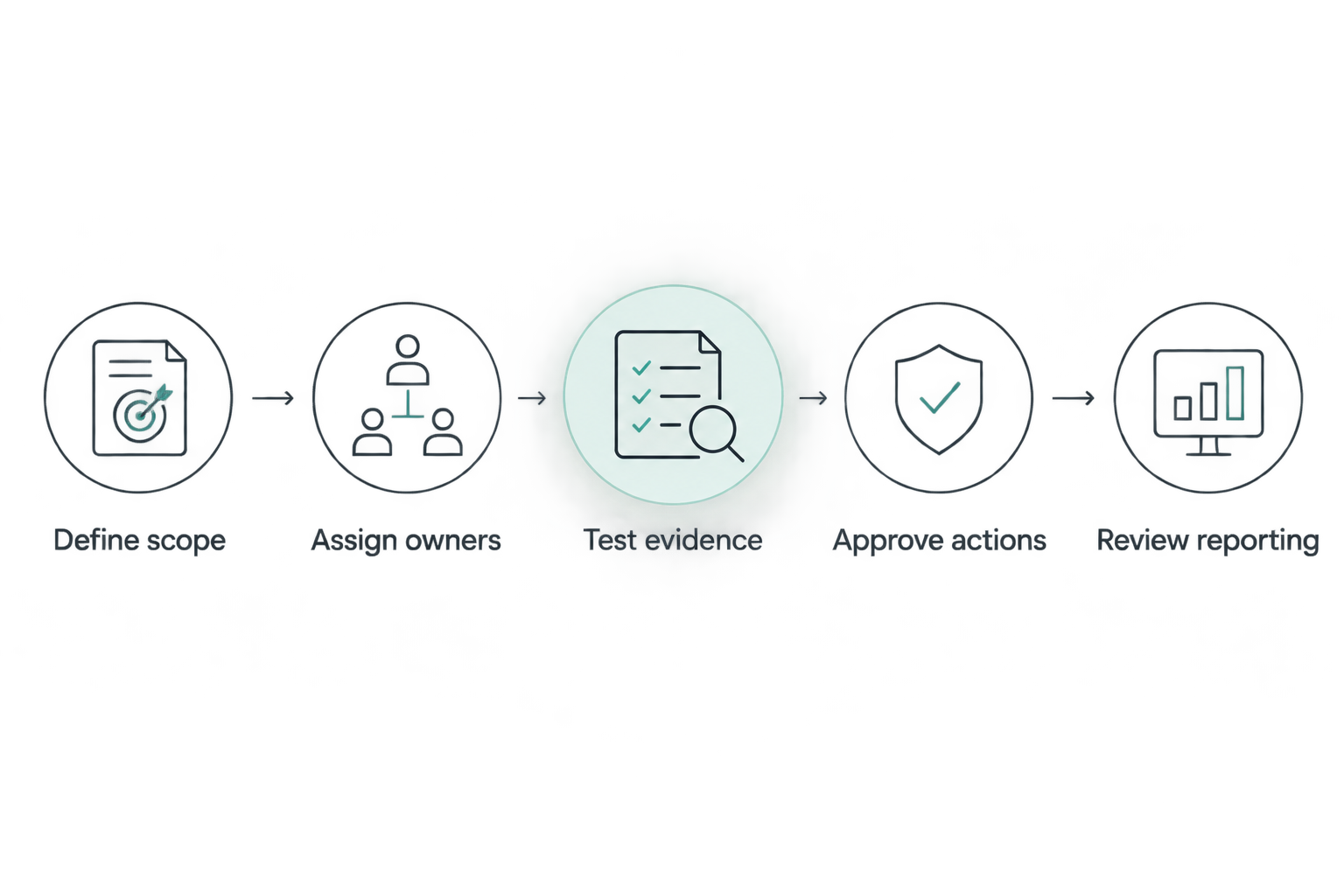
Define responsibilities and evidence before judging the dashboard.
Separate certification from regulatory obligations
ISO 27001 addresses an information security management system. SOC 2 is an independent attestation report against relevant Trust Services Criteria, not an ISO-style certification.
Neither establishes that an insurer has met every applicable regulatory obligation. Map your legal entities and activities to the requirements that apply, then assess what the software supports.
For EU-regulated insurance activities, assess DORA applicability separately from UK requirements. The guide to DORA compliance for insurers and reinsurers addresses that distinction without treating a security certificate as a substitute for operational resilience work.
Test supplier oversight beyond the questionnaire
A completed questionnaire is not a decision about supplier risk. Your process must connect the supplier, the service provided, the evidence reviewed and the person accepting any remaining exposure.
When evaluating third-party management software for insurers, require a workflow that links an outsourced claims service to its owner, unresolved issues and review decision. This tests whether the system supports oversight rather than document collection alone.
Use a supplier with an unresolved issue in the demonstration. Ask the presenter to show:
- Who decides whether the service can proceed.
- What happens when supporting evidence becomes outdated.
- How the team records conditions attached to approval.
- Where management sees unresolved actions.
- How the record supports a later review or exit decision.
Do not confuse collecting supplier documents with managing supplier risk. Check whether each shortlisted platform handles the required process directly or needs a separate system.
Run a pilot your team can judge
Use a 60-minute demonstration to eliminate obvious mismatches, then set a 30-day pilot for the remaining candidate. These are suggested evaluation boundaries, not promised implementation times.
For a 2026 procurement, agree the acceptance criteria before granting access or uploading evidence. Keep personal information and sensitive operational material out of the pilot unless your security and privacy teams approve their use.
Make the demonstration do real work
Ask the supplier to start with an incomplete record. A pre-filled example hides the work your team will inherit.
Require the presenter to assign an owner, attach evidence, record an exception and produce a management view. Your users should then repeat the workflow without step-by-step coaching.
Record the work that remains manual
Automation only helps when you understand its boundaries. Ask which tasks the platform performs, which tasks it assigns and which tasks remain outside it.
Test policy approval separately from policy generation. Test evidence review separately from evidence collection. Test remediation separately from the decision to accept a risk.
Agree the exit test
Before committing, request an export of the pilot records and their supporting material. Ask how you would retain evidence, ownership records and decision history if you changed platforms.
Buy only when your team can operate the process and explain its results. A successful sales demonstration is not the same as a usable operating model.
Which GRC software should you choose?
OneClickComply is the best GRC choice for growing insurance businesses prioritising cyber certification automation. Choose that focused approach when security controls, policies and certification work define the immediate requirement.
Choose ServiceNow Integrated Risk Management for connected enterprise workflows. Choose Archer for a defined enterprise risk programme. Choose AuditBoard when internal audit leads the purchase.
If your brief mixes all these outcomes, separate the requirements before selecting a supplier. Keep the initial scope accountable to a named business owner.
Frequently asked questions
One last thing
Ask the supplier to demonstrate a rejected approval, not just a completed task. That reveals whether the workflow preserves disagreement, assigns follow-up work and keeps the final decision clear.
Automate the work you can define. Keep people accountable for the decisions. Seriously Simple Cyber Compliance.