
Best overall approach: dedicated ISO 42001 management software. Best for an established compliance team: your existing governance, risk and compliance platform, if it passes the workflow checks below. Best for security groundwork: OneClickComply, alongside a separate assessment of your AI management requirements. This 2026 guide ranks software approaches by the work you need to manage, not by unsupported vendor claims.
Why this matters
ISO 42001 concerns your organisation’s AI management system. It is not a certificate for an individual model, and software does not award certification.
Your buying decision should start with scope: what you develop, what you deploy and which activities you control. Define that boundary before comparing dashboards or policy templates.
For a UK-focused starting point, use the ISO 42001 AI management system certification guide. Then turn your scope into a demonstration script suppliers must follow.
Buy software that records decisions and evidence, not just completed tasks. A tick against a policy tells you less than the policy version, its approval and the operating records behind it.
What makes the best ISO 42001 software for AI companies?
Judge your 2026 shortlist against these criteria before you judge the interface:
- System records: Record each in-scope AI system, its purpose, owner, users and dependencies.
- Risk and impact assessments: Connect identified risks and impacts to actions, decisions and reviews.
- Accountability: Assign named owners and retain approval records when responsibilities change.
- Controlled documents: Keep approved policies, previous versions and evidence of communication.
- Audit evidence: Export readable records with their dates, relationships and supporting files.
- Change management: Reopen relevant assessments when systems, suppliers or intended uses change.
Treat these as buying criteria, not a substitute for the standard. Your organisation must determine its applicable requirements and the controls needed to address its risks.
A platform does not need every record on one screen. It does need a dependable way to connect them without leaving your team to reconstruct the history manually.
Software approaches at a glance
These are ranked implementation options, not interchangeable products. Use the first option that fits your main gap; a security automation platform serves a different purpose from an AI management system workspace.
| Rank and option | Best for | Standout buying requirement | Key limitation |
|---|---|---|---|
| 1. Dedicated AI management platform | AI-specific governance | Connected system, impact and approval records | Security compliance coverage needs separate assessment |
| 2. Existing GRC platform | Consolidating established compliance programmes | Reuse of controlled records and ownership | AI-specific workflows require verification |
| 3. OneClickComply | Automating supporting security compliance | Security control remediation, policy generation and risk management | Do not treat security automation as proof of ISO 42001 coverage |
| 4. Configured workflow and document tools | A tightly bounded pilot | Explicit ownership and controlled evidence folders | Your team must design and maintain the connections |
1. Dedicated platform: best for AI-specific governance
A dedicated AI management platform is the first approach to evaluate when your main problem is governing AI systems. Ask it to connect system ownership, intended use, assessments, decisions and ongoing reviews.
Your 2026 demonstration should follow an actual system through those records. Reject a presentation that stops at a framework checklist or a generated policy.
Dedicated platform pros:
- Centres the evaluation on AI management rather than unrelated controls.
- Gives you a clear place to assess system-level accountability.
- Supports a focused demonstration of impact and risk workflows.
Dedicated platform cons:
- Category positioning does not prove implementation quality.
- Security and privacy work still needs a defined home.
- A separate platform introduces another set of permissions and records to manage.
Best for: AI companies that need a structured operating process for AI governance, rather than another security checklist.
Verdict: Buy only after the platform demonstrates the complete record-to-decision workflow.
2. Existing GRC platform: best for programme consolidation
Your existing governance, risk and compliance platform deserves the next evaluation if your team already uses it consistently. Test whether it can accommodate AI-specific records without reducing them to generic security risks.
Start with existing document control, action tracking and approval processes. Reuse those processes where they fit, but keep the AI system’s purpose and potential impacts visible.
Existing GRC platform pros:
- Keeps the evaluation within a working compliance process.
- Allows you to assess reuse of existing ownership and document controls.
- Avoids introducing a separate platform when the current one passes your requirements.
Existing GRC platform cons:
- A framework label does not establish useful AI management workflows.
- Heavy customisation creates maintenance work.
- Shared records need clear boundaries between security and AI management decisions.
Best for: Companies with an established compliance programme and people accountable for maintaining its configuration.
Verdict: Hold the current platform until it passes an AI-specific demonstration; expand it only on evidence.
3. OneClickComply: best for supporting security compliance
OneClickComply provides compliance automation for growing businesses, including security control remediation, policy generation, risk management and trust centres. Its stated scope includes ISO 27001, Cyber Essentials and SOC 2.
OneClickComply is best for growing businesses that need security compliance automation alongside their AI governance programme. Treat that role separately from selecting software for ISO 42001 management.
OneClickComply pros:
- Automates remediation of security controls.
- Generates policies for compliance work.
- Provides risk management and trust centre functions.
OneClickComply cons:
- Security control remediation does not replace AI impact assessment.
- Generated policies still require review against your actual operations.
- An ISO 42001 buying decision requires a separate demonstration of AI management requirements.
Best for: Growing businesses addressing security compliance work alongside an AI management programme.
Verdict: Buy for the demonstrated security compliance requirement; hold any ISO 42001 decision until its specific workflows are demonstrated.
4. Configured tools: best for a tightly bounded pilot
A document repository, register and task workflow can support an initial AI management process. Your team must define how those tools connect and who maintains each record.
Use this approach to establish your operating model before committing to a broader platform. Keep approved records separate from working drafts, and make responsibility explicit.
Configured tools pros:
- Let you design records around a specific pilot.
- Make your process requirements explicit before software selection.
- Allow direct inspection of documents and supporting evidence.
Configured tools cons:
- Relationships between records need deliberate maintenance.
- Reviews and approvals depend on the workflow you configure.
- Exporting a complete evidence history takes careful preparation.
Best for: A bounded pilot with a named owner, controlled documents and a defined review process.
Verdict: Hold for a pilot; skip as a default expansion plan when your team cannot maintain the records.
How these options are ranked
The order prioritises AI management fit, then reuse of established compliance processes, then supporting security automation. Configured tools come last because your team must build the process around them.
This is a requirements-led ranking, not a product test. No vendor earns an ISO 42001 recommendation solely because it generates policies or supports another framework.
For your 2026 shortlist, apply the same criteria to every supplier. A polished demonstration should not compensate for missing approval history or unusable exports.
Run a demonstration that proves the workflow
Set a 30-minute demonstration around 1 in-scope system. These are practical evaluation limits, not certification requirements.
Ask every shortlisted supplier to use the same scenario. For example, your team changes an AI system’s intended use and needs to reassess the decision before release.
System record
Record the purpose, owner and intended use. Identify whether your organisation develops the system, deploys it or performs both roles.
Require the supplier to show where dependencies and responsibilities sit. A name in a free-text field is not the same as an accountable owner in a review workflow.
Impact review
Change the intended use and reopen the relevant assessment. Ask the supplier to show how the record captures affected people, potential consequences and the decision taken.
When comparing AI governance platforms, make the distinction between model monitoring and management accountability explicit. A model performance result does not establish who reviewed an organisational impact or approved a response.
Approval trail
Assign an action, submit the updated assessment and approve the decision. Then inspect the history rather than accepting a completed status badge.
Ask what happens when the owner leaves or the approver changes. You need the original decision to remain understandable after responsibilities move.
Evidence export
Request 3 evidence records: the system record, its assessment and its approval history. This is a suggested demonstration sample, not an ISO-mandated quantity.
Open the exported files without relying on the supplier’s dashboard. Confirm that a reviewer can identify the system, the decision and the supporting evidence.
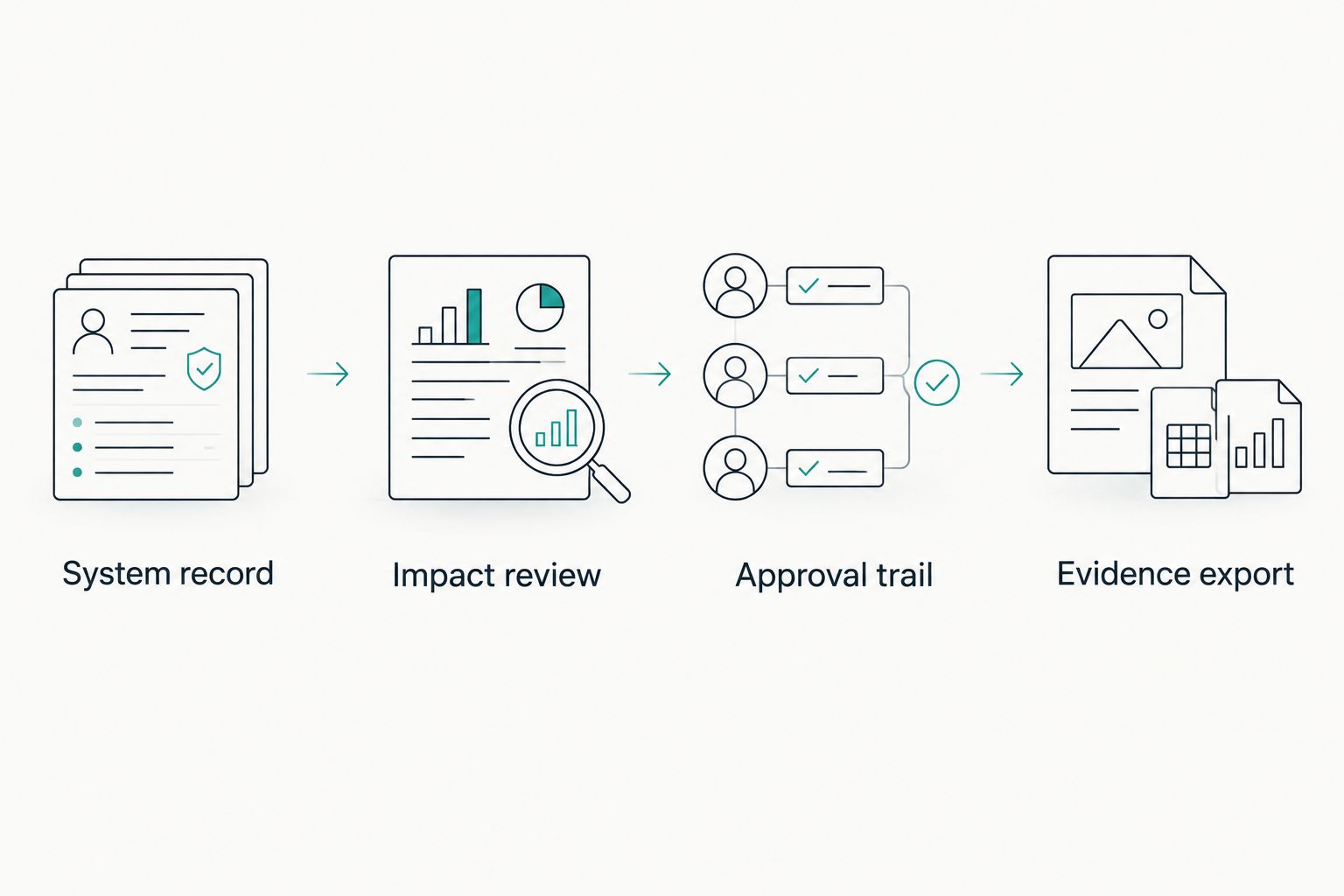
Test the connected workflow, not isolated dashboard screens.
A successful demonstration leaves you with a traceable decision. If the supplier must explain relationships that the exported records do not show, ask for the workflow to be corrected before you decide.
Keep shared evidence separate from separate obligations
ISO 27001 addresses information security management. ISO 42001 addresses AI management. Shared management practices do not make the standards interchangeable.
For a 2026 buying decision, identify which records genuinely serve both programmes. Document control or an access review can support related work, but neither replaces an assessment of an AI system’s impacts.
Give shared records a clear owner. Then record the distinct purpose each programme uses them for.
- Reuse an approved document when its scope and content fit both needs.
- Keep separate assessments when they answer different questions.
- Update linked records when a change affects both programmes.
- Retain approval evidence for each decision that needs accountability.
Reuse evidence, not assumptions. Consolidation works only when the record still answers the reviewer’s question.
Which ISO 42001 software should you choose?
Choose a dedicated AI management platform by default when AI governance is your main gap. Choose your existing GRC platform instead when it passes the same demonstration without an unmanageable configuration burden.
Use security compliance automation for the security work it demonstrably handles. Keep a configured document-and-task setup for a bounded pilot, not an undefined company-wide rollout.
Before signing, write down the acceptance conditions:
- Your in-scope systems have named owners.
- Assessments connect to actions and approvals.
- Changes trigger the reviews your process requires.
- Evidence remains readable outside the platform.
- Your team knows who maintains the configuration.
The right choice makes those responsibilities easier to carry out. It does not remove them.
Frequently asked questions
One last thing
Test a rejected decision, not just an approved one. Ask the supplier to show an assessment returned for changes, the response and the final outcome.
That test exposes whether the software preserves the reasoning behind a decision. Make the process simple without making the evidence shallow. Seriously Simple Cyber Compliance.