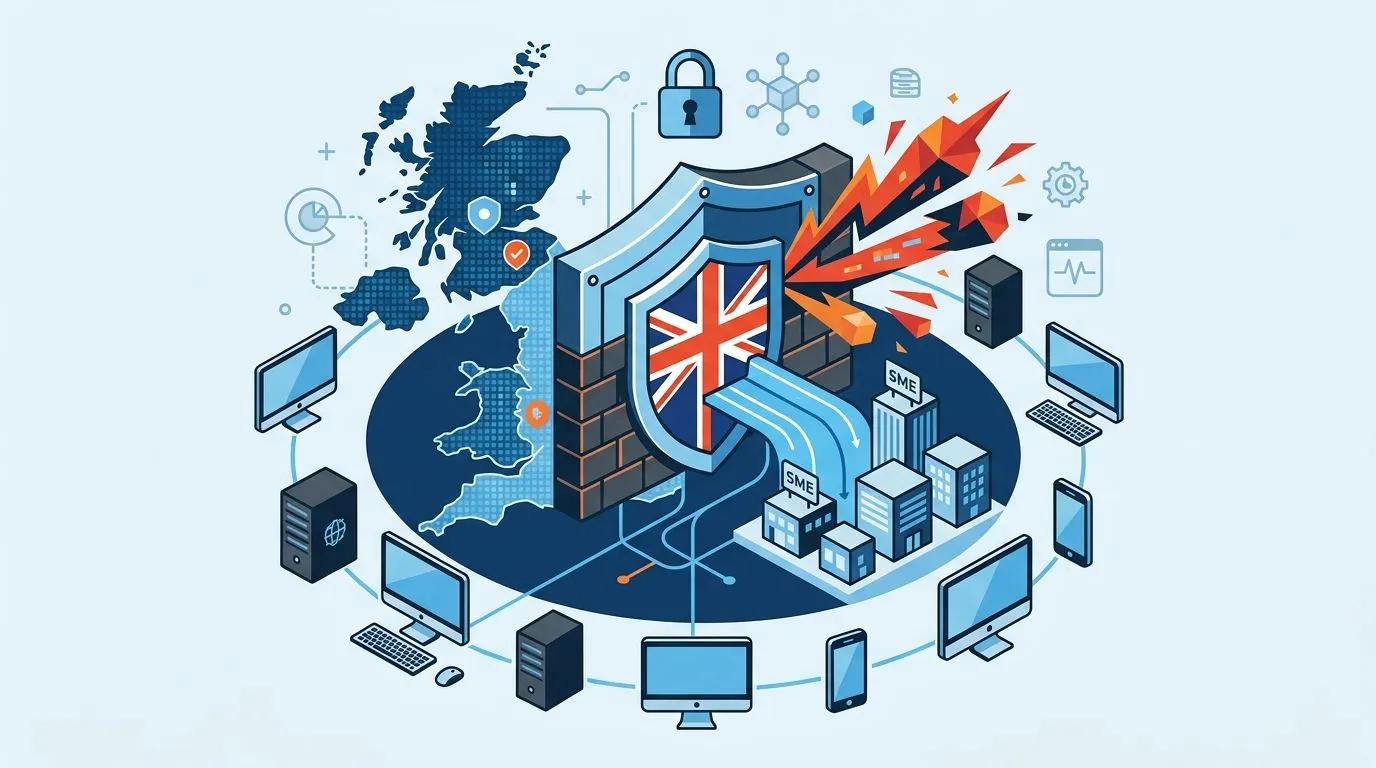
Managed firewall services for UK SMEs range from a single Sophos box configured in-house to a fully outsourced MSP contract that patches, monitors, and reports on your network edge around the clock. Six options cover most of the UK SME market in 2026, and the right pick depends on how many sites you run, how much in-house IT you have, and whether your firewall logs need to double as compliance evidence.
Why this matters
Cyber Essentials, the UK government-backed scheme, lists boundary firewalls as one of its five required technical controls, alongside secure configuration, patch management, access control, and malware protection. Following the NCSC 10 Steps to Cyber Security puts firewall management inside a wider security programme rather than treating it as a one-off box purchase.
A firewall you buy and forget is worse than no firewall audit trail at all, because an assessor will ask for patch records you don't have. That's the gap managed firewall services close: someone else owns the config, the firmware updates, and the reporting.
What makes the best managed firewall service
- 24/7 monitoring and alerting - not a log dump nobody reads until something breaks
- Patch and firmware management built into the contract, not left to whoever remembers
- Reporting detailed enough to double as audit evidence for Cyber Essentials or ISO 27001
- UK-based support with a documented SLA response time, not a ticket queue in another timezone
- Scales without a full network redesign as you add sites, staff, or remote workers
- One point of accountability when the connection drops at 2am
At a glance
| Service | Best for | Standout feature | Key limitation |
|---|---|---|---|
| Sophos Firewall | SMEs already on Sophos endpoint | Unified console with endpoint protection | Full value depends on staying inside the Sophos ecosystem |
| Cisco Meraki MX | Multi-site retail and hospitality | Single cloud dashboard across every branch | Dashboard access is tied to an active license, not a one-off hardware buy |
| Fortinet FortiGate (managed) | Compliance-heavy SMEs needing audit evidence | Deep logging detail for ISO 27001 and Cyber Essentials Plus | Configuration complexity usually needs an MSP or in-house engineer |
| WatchGuard Firebox | Lean IT teams, single site | Firewall, VPN, and web filtering bundled in one box | Smaller UK partner bench than Sophos or Fortinet |
| SonicWall TZ series | Branch and remote-office setups | Compact hardware, established UK reseller network | Security subscription content needs active management to stay current |
| MSP-managed firewall (BYO hardware) | SMEs with no in-house IT | Entire lifecycle handled by one provider | Quality varies hugely - vet the SLA before signing |
1. Sophos Firewall: best for SMEs already running Sophos endpoint protection
Sophos Firewall (the XGS series) plugs into Sophos Central, so an SME already running Sophos on laptops and servers gets one console showing both endpoint and network activity. That single view is the whole pitch: fewer dashboards, one alert stream, one vendor to call.
Sophos Firewall pros:
- Synchronized Security shares threat data between endpoint and firewall automatically
- Interface built for smaller IT teams, not network engineers
- Straightforward to bundle with existing Sophos licensing
Sophos Firewall cons:
- Full value only shows up if you're already inside the Sophos ecosystem
- Advanced routing and SD-WAN features lag more enterprise-grade platforms
Best for: SMEs standardised on Sophos endpoint tools. Verdict: Buy.
2. Cisco Meraki MX: best for multi-site retail and hospitality chains
Cisco Meraki MX runs on a cloud dashboard that shows every site's firewall status on one screen, which matters the moment you have more than two locations. New sites get zero-touch provisioning - plug in the box, and it pulls its config from the cloud.
Cisco Meraki MX pros:
- One dashboard for every branch, no VPN-in-to-check-the-other-office routine
- Zero-touch provisioning speeds up new site rollouts
- Built-in SD-WAN for businesses running multiple internet connections
Cisco Meraki MX cons:
- Dashboard access is licensed, so budgeting has to account for renewal, not just the hardware
- Less appealing for a genuine single-site business with no expansion plans
Best for: multi-site retail, hospitality, and franchise operations. Verdict: Buy.
3. Fortinet FortiGate (managed): best for compliance-heavy SMEs needing audit evidence
FortiGate has a reputation for deep logging and strong intrusion prevention, which is exactly what an ISO 27001 or Cyber Essentials Plus assessor wants to see. Most UK SMEs don't run FortiGate themselves - they pair it with an MSP that handles the configuration and pulls the reports on request.
Fortinet FortiGate pros:
- Logging detail granular enough to use directly as audit evidence
- Strong reputation for intrusion prevention and threat detection
- Scales from a single office to a distributed multi-entity structure
Fortinet FortiGate cons:
- Steeper configuration learning curve than SMB-first platforms
- Realistically needs an MSP or dedicated engineer to run well
If you already track evidence for ISO 27001 or Cyber Essentials, ask whoever manages your FortiGate to export logs in a format your compliance automation can ingest directly - it saves a manual evidence chase every audit cycle.
Best for: compliance-heavy SMEs pursuing ISO 27001 or Cyber Essentials Plus. Verdict: Buy, paired with a managed provider.
4. WatchGuard Firebox: best for lean IT teams running a single site
WatchGuard Firebox bundles firewall, VPN, and web filtering into one box with a management console aimed at generalist IT staff rather than network specialists. For a single-site SME with one IT person wearing five hats, that's the point.
WatchGuard Firebox pros:
- Firewall, VPN, and content filtering in one bundle
- Console designed for generalists, not certified network engineers
- Reasonable fit for a single office without complex routing needs
WatchGuard Firebox cons:
- Smaller UK partner and MSP bench than Sophos or Fortinet, so support varies by reseller
- Threat intelligence feed depth trails the bigger enterprise platforms
Best for: single-site SMEs without a dedicated security engineer. Verdict: Buy.
5. SonicWall TZ series: best for branch and remote-office setups
SonicWall's TZ range is compact hardware built for branch and remote-office deployments, backed by an established UK reseller network. It's a reasonable box behind a managed contract, less so as a set-and-forget purchase.
SonicWall TZ pros:
- Compact hardware suited to small branch or remote sites
- Established UK reseller and support network
- Straightforward remote-office VPN setup
SonicWall TZ cons:
- Security subscription content needs active renewal and management to stay current
- Best value shows up paired with a managed contract, not standalone
Best for: branch offices behind an actively managed contract. Verdict: Hold - fine for branch use, only with active patch monitoring in place.
6. MSP-managed firewall (bring-your-own hardware): best for SMEs with no in-house IT
Some UK SMEs skip the vendor decision entirely and hand the whole firewall lifecycle - hardware choice, configuration, patching, monitoring, reporting - to a local managed service provider. For a business with no in-house IT function, that's often the simplest route to a properly maintained boundary firewall.
Firewalls sit at the network edge, but plenty of SME workloads now sit off it entirely, in the cloud. Vetting managed cloud hosting providers deserves the same scrutiny as vetting a firewall MSP, since both control who touches your infrastructure and how fast they respond when something goes wrong.
MSP-managed firewall pros:
- 24/7 monitoring and alerting without hiring anyone
- Single point of accountability for firewall and broader network security
- Easier to align with compliance evidence needs since the MSP already holds change logs and patch records
MSP-managed firewall cons:
- Quality varies hugely by provider - check SLA response times and named contacts before signing
- Switching providers later can be costly if the firewall config is treated as proprietary
Best for: SMEs with no dedicated IT staff. Verdict: Buy, once the SLA is checked.
How the ranking works
Each entry above is ranked against the criteria listed earlier: monitoring depth, patch cadence, audit-ready reporting, UK support, and scalability. None of these six is objectively "best" in isolation - the ranking reflects which use case each platform fits, not a single leaderboard position. A business running four retail sites and a business running one law office need different answers to the same question.
Getting patch management tools right matters as much as the firewall choice itself - a well-chosen box on a neglected patch schedule fails a Cyber Essentials assessment just as fast as the wrong box entirely.
Which service should you choose?
If you're already on Sophos endpoint protection, buy Sophos Firewall and stop comparing. If you run more than two sites, Cisco Meraki MX earns its license fee on dashboard time saved alone. If ISO 27001 or Cyber Essentials Plus evidence is the priority, Fortinet FortiGate managed via an MSP gives assessors the logging depth they want.
For everyone else - single site, no in-house IT, no immediate compliance deadline - an MSP-managed contract with WatchGuard or SonicWall hardware behind it covers the basics without over-engineering the network. OneClickComply doesn't sell or manage firewalls, but the compliance automation side of the picture - turning firewall config records and patch logs into ready-to-submit Cyber Essentials or ISO 27001 evidence - is exactly the gap that trips SMEs up after the hardware decision is already made.
Automate your Cyber Essentials evidence
Firewall configs, patch logs, and access records collected automatically.
Frequently asked questions
One last thing
Most SMEs assume the "boundary firewall" in Cyber Essentials only means a dedicated appliance. It doesn't. Home routers and ISP-supplied routers used by remote workers count as boundary firewalls too, and they need the same configuration discipline - default password changed, unnecessary ports closed, firmware current. A managed firewall service covering the office network while remote workers sit on unmanaged home routers leaves exactly the gap an assessor is trained to find in 2026. OneClickComply's compliance automation approach maps that kind of gap across every device in scope before an assessor does - which is the whole point of Seriously Simply Cyber Compliance.