Best for cyber compliance: OneClickComply. Best for manufacturing quality: ETQ Reliance. Best for environmental, health and safety workflows: Intelex. Choose risk management and compliance software for manufacturing by the work you need to control—not by the longest feature list. This 2026 guide separates cyber, quality, safety and enterprise risk tools so you can build the right shortlist.
Why this matters
Manufacturing compliance covers different jobs. Protecting design files, investigating a product defect and recording a workplace incident need different records, decisions and controls.
A cyber compliance platform does not replace a quality management system. A quality system does not establish that your user permissions are appropriate.
Buy for the risk you must manage first. Then decide what information needs to move between systems, rather than expecting one platform to handle every obligation.
What makes the best manufacturing compliance software?
Use these criteria before you compare demonstrations. For your 2026 shortlist, make each supplier show the work rather than describe the feature.
- Scope fit: Match the software to cyber security, quality, safety, enterprise risk or access governance. Keep essential requirements separate from useful extras.
- Accountability: Look for clear ownership, review decisions and overdue actions. A recorded risk without an accountable owner remains unfinished work.
- Evidence quality: Check whether you can trace a record back to its source, responsible person and review. A dashboard alone is not evidence.
- Manufacturing fit: Test site-level permissions, engineering involvement and production approval requirements. Include the people who will maintain the records.
- Controlled automation: Establish what changes automatically, what requires approval and how you reverse a change. Treat production-connected systems separately from office systems.
- Usable reporting: Ask for an export you can explain to an auditor or customer. Check whether it preserves context rather than just status colours.
Manufacturing compliance software at a glance
These products serve distinct jobs. The order reflects the use cases below, not a claim that a cyber platform outranks a quality system for quality work.
| Software | Best for | Standout focus | Key limitation |
|---|---|---|---|
| OneClickComply | Cyber compliance automation | Security control remediation, policy generation and risk management | Cyber compliance is not a substitute for factory quality or safety management |
| ETQ Reliance | Manufacturing quality management | Quality processes, including nonconformance and corrective action | Quality workflows do not replace technical cyber controls |
| Intelex | Environmental, health and safety management | EHS records, incidents and related actions | EHS management does not replace cyber certification preparation |
| ServiceNow Integrated Risk Management | Enterprise risk coordination | Connecting risk, controls and organisational workflows | Requires a defined operating model and implementation scope |
| SAP Access Control | Access governance in SAP environments | Access risk analysis and segregation of duties | Access governance is narrower than a complete manufacturing compliance programme |
1. OneClickComply: best for cyber compliance automation
OneClickComply helps growing businesses achieve and maintain cyber compliance through automated security control remediation, generated policies, risk management and trust centres. Its stated scope includes ISO 27001, Cyber Essentials and SOC 2 programmes.
OneClickComply is the best fit here for manufacturers prioritising cyber compliance automation. Start here when your buying requirement concerns information security rather than product inspection or workplace safety.
For a manufacturing evaluation, separate office technology from operational technology—the systems that monitor or control production equipment. Ask which systems the platform supports and how proposed changes receive approval; do not assume coverage from a general automation claim.
OneClickComply pros:
- Combines security control remediation with policy generation.
- Includes risk management alongside cyber compliance work.
- Includes trust centre management for sharing security information.
OneClickComply cons:
- Cyber compliance does not replace quality or safety processes.
- Software does not make management decisions or provide independent certification.
- Production-system suitability needs a separate technical assessment.
Best for: Manufacturers whose immediate requirement is to organise and automate cyber compliance.
Verdict: Buy for a defined cyber compliance requirement, after confirming system coverage and change controls.
2. ETQ Reliance: best for manufacturing quality management
ETQ Reliance is a quality management platform. Its established focus includes nonconformance, corrective action and document control—work that belongs close to manufacturing quality teams.
Start with ETQ Reliance when your main problem is managing quality events and proving that corrective actions were completed. Give the supplier an example involving a rejected component, an investigation and an approved change.
The useful test is traceability. Can your team follow the issue from discovery through the decision, action and effectiveness review without rebuilding the story elsewhere?
ETQ Reliance pros:
- Focuses on quality management rather than general task tracking.
- Addresses nonconformance and corrective-action processes.
- Places document control within a quality-management context.
ETQ Reliance cons:
- Quality records do not replace technical security controls.
- Your team still defines acceptance criteria and approves decisions.
- Cyber certification requirements need a separate evaluation.
Best for: Manufacturers replacing disconnected quality records with a quality-led system.
Verdict: Buy for quality-led requirements; skip as a standalone answer to cyber compliance.
3. Intelex: best for environmental, health and safety workflows
Intelex provides environmental, health and safety management software. Its EHS focus makes it relevant when your priority is recording incidents, managing associated actions and organising environmental or safety information.
Evaluate Intelex with the people responsible for those processes. Use a realistic incident example and check how reporting, investigation, accountability and closure work together.
Keep environmental reporting requirements specific. A broad EHS label does not establish that a particular configuration meets every site obligation or reporting method.
Intelex pros:
- Provides a dedicated EHS management focus.
- Addresses incident management and related actions.
- Supports an EHS-led buying decision rather than a cyber-first one.
Intelex cons:
- EHS workflows do not replace cyber certification preparation.
- Your organisation remains responsible for interpreting applicable obligations.
- Site-specific reporting needs require a detailed demonstration.
Best for: Manufacturers whose main requirement is environmental or workplace safety management.
Verdict: Buy for an EHS-led programme; hold if the primary requirement is information security.
4. ServiceNow Integrated Risk Management: best for enterprise risk
ServiceNow Integrated Risk Management connects risk and control management with organisational workflows. Consider it when your requirement crosses departments and needs a shared approach to ownership, assessment and follow-up.
The central question is organisational readiness. Agree how departments describe risks, accept exceptions and escalate overdue actions before configuring a shared platform.
For a 2026 evaluation, ask the supplier to demonstrate a risk that crosses IT, procurement and operations. Check whether each team can act without losing the connection to the original business risk.
ServiceNow Integrated Risk Management pros:
- Focuses on connected risk and control management.
- Fits a cross-departmental risk-management requirement.
- Places risk work within the wider ServiceNow workflow environment.
ServiceNow Integrated Risk Management cons:
- A shared platform does not resolve conflicting risk definitions.
- Configuration needs clear ownership and an agreed operating model.
- Detailed factory workflows still require separate validation.
Best for: Manufacturers coordinating risk decisions across several business functions.
Verdict: Buy for an established enterprise risk programme; hold until owners and decision rules are clear.
5. SAP Access Control: best for SAP access governance
SAP Access Control addresses access risk, access requests and segregation of duties. Segregation of duties means separating permissions that would let one person perform conflicting activities without appropriate oversight.
Choose this route when your defined problem concerns who can do what in an SAP environment. Ask for a demonstration that follows an access request through risk analysis, approval and review.
Do not confuse access governance with the full compliance programme. Product quality, environmental obligations and wider cyber assurance remain separate requirements.
SAP Access Control pros:
- Provides a focused approach to SAP access risk.
- Addresses segregation-of-duties analysis.
- Connects access requests with governance decisions.
SAP Access Control cons:
- Its access-governance scope is narrower than manufacturing compliance overall.
- Your business must define conflicting activities and acceptable exceptions.
- Coverage outside your SAP environment requires separate confirmation.
Best for: Manufacturers prioritising access governance around SAP business processes.
Verdict: Buy for a defined SAP access-control problem; skip as your only compliance system.
How the ranking works
This shortlist ranks by job fit, using each product's stated scope. It is not a hands-on performance benchmark, and the positions do not imply equivalent functionality.
The criteria favour a clear match between the obligation, the responsible team and the evidence required. Confirm modules, integrations and implementation responsibilities directly before making your 2026 selection.
Run a manufacturing-specific demonstration
Give every shortlisted supplier the same scenarios. Use sample records rather than live production credentials or confidential customer material.
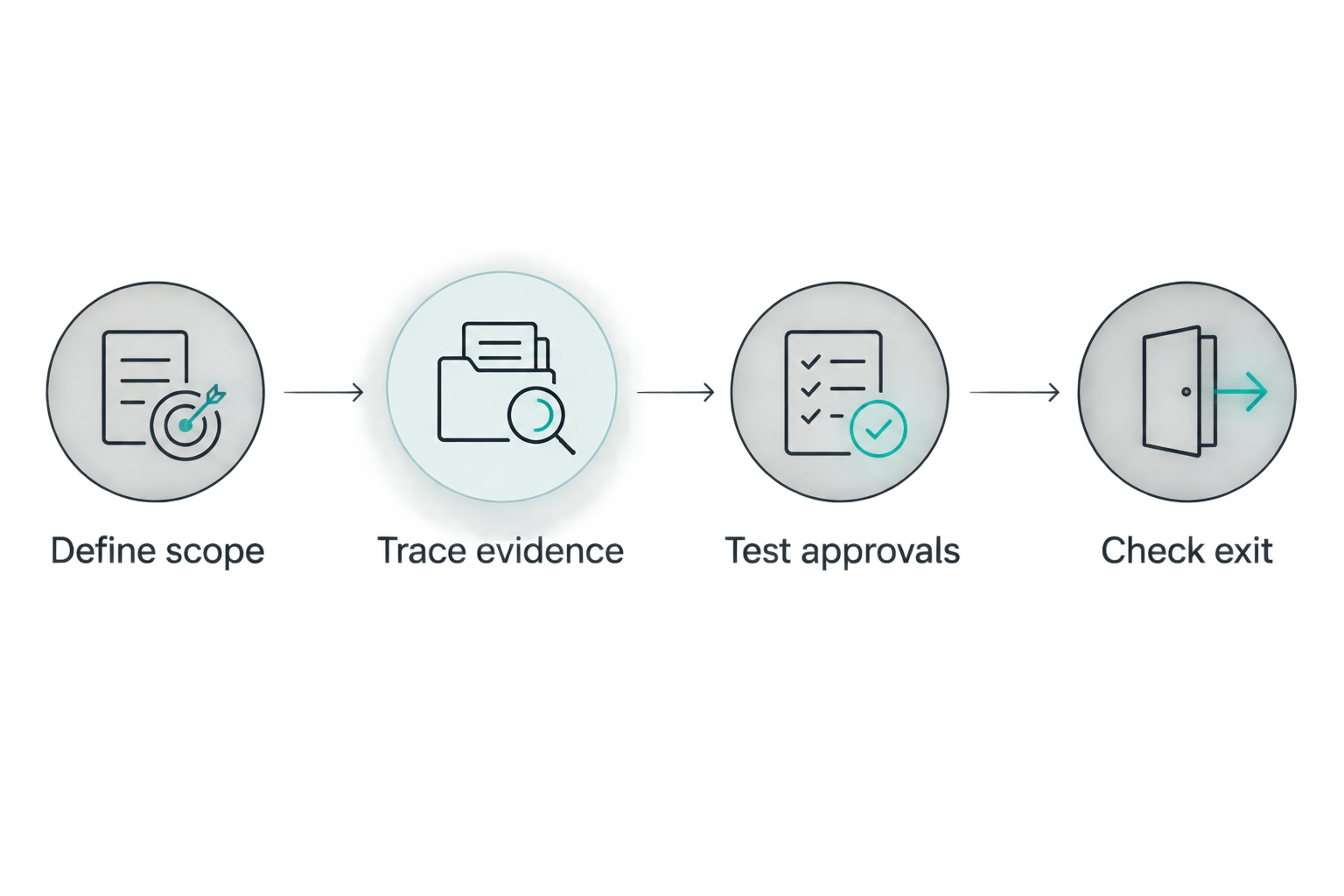
Define scope
Write a one-page brief naming the sites, systems, teams and obligations involved. State explicitly whether production-connected systems are included, excluded or subject to separate approval.
Trace evidence
Ask the supplier to follow a requirement through its supporting record, owner, review and final export. Check whether someone unfamiliar with the demonstration can understand what the record proves.
Test approvals
Demonstrate 3 workflows: a new risk, an overdue action and a proposed change. Assign different people to request, approve and verify the work so you can see where responsibility changes hands.
Check exit
Export the records before the demonstration ends. Confirm that your team can retain the context needed to understand decisions after leaving the platform.
Test a complete workflow before accepting a feature checklist.
Include both the process owner and the technical owner in the decision. Neither should approve the system based only on a dashboard demonstration.
Discuss your cyber compliance scope
Explain your manufacturing systems, security requirements and compliance goals.
Which manufacturing compliance software should you choose?
Choose OneClickComply when cyber compliance automation is the job you need to solve. Choose ETQ Reliance for quality-led work, Intelex for EHS, ServiceNow Integrated Risk Management for enterprise coordination, or SAP Access Control for SAP permissions governance.
If the requirement is still unclear, spend a 60-minute workshop separating the obligations and naming their owners. Leave with a primary buying objective, explicit exclusions and a demonstration brief—not an undifferentiated list of features.
Your 2026 purchase should solve a defined operational problem. Expand the scope only when you can explain who will own the additional work and what evidence they need.
Frequently asked questions
One last thing
A completed action and an effective control are different things. Closing a task records that somebody finished work; checking the result establishes whether that work addressed the risk.
Put 2 questions into your acceptance checklist: who verifies the result, and what evidence supports closure? That distinction matters more than another dashboard widget.
Keep the scope clear. Automate repeatable work. Keep accountable people in control. Seriously Simple Cyber Compliance.