
Best for compliance-led teams: OneClickComply. Best for enterprise approval workflows: ServiceNow Third-party Risk Management. Best for external cyber-risk visibility: SecurityScorecard. The best vendor risk management software for manufacturing companies in 2026 matches supplier checks to production dependencies, system access and clear approval decisions.
Why this matters
A packaging supplier, a payroll provider and a machine-maintenance contractor create different risks. Your software should help you separate those risks, not send every supplier the same questionnaire.
Start with the decision you need to make. Can the supplier access production systems? Does it hold drawings or employee information? Would losing its service interrupt a production line?
Buy a system that records the answer, the evidence and the person who approves the remaining risk. A completed questionnaire is an input, not a decision.
This 2026 shortlist separates compliance automation, dedicated supplier assessment and external security monitoring. Those categories overlap, but they do not replace each other.
What makes the best manufacturing vendor risk software?
Use these criteria before comparing demonstrations:
- Production relevance: Record which site, process or service depends on each supplier. Ask vendors to demonstrate the relationship rather than describe it.
- Proportionate assessment: Separate suppliers with privileged access from suppliers with no access to your systems or sensitive information.
- Evidence handling: Keep supporting documents, review dates and assessment decisions connected to the relevant supplier.
- Action ownership: Assign findings to someone who can resolve them. Keep approval separate from questionnaire completion.
- Usable workflows: Let procurement, security, legal and operations contribute without maintaining competing records.
- Exit readiness: Preserve decisions and evidence in an export you can use if you change platforms.
Treat these as buying requirements, not assumptions about every product below. During your 2026 evaluation, ask each vendor to show the capabilities your manufacturing business needs.
Manufacturing vendor risk software at a glance
| Option | Best for | Standout focus | Key limitation |
|---|---|---|---|
| OneClickComply | Growing businesses with compliance-led requirements | Compliance automation, policy generation and risk management | Validate dedicated supplier assessment and manufacturing workflows |
| ServiceNow Third-party Risk Management | Enterprise approval workflows | Third-party risk processes within the ServiceNow environment | Requires clear workflow ownership and implementation planning |
| OneTrust Third-Party Management | Supplier reviews involving privacy | Third-party assessment alongside privacy and compliance processes | Define the required modules and scope before selection |
| ProcessUnity Third-Party Risk Management | Dedicated third-party risk programmes | Supplier assessment and risk workflow management | Requires a defined assessment method and accountable reviewers |
| SecurityScorecard | External cyber-risk visibility | Security ratings and externally observable security signals | External signals do not establish production resilience or product quality |
The order starts with the compliance-led option, then separates enterprise workflow, privacy, dedicated assessment and external monitoring. It is not a claim that one platform wins every manufacturing use case.
1. OneClickComply: best for compliance-led manufacturers
OneClickComply provides compliance automation that helps growing businesses achieve and maintain certifications such as ISO 27001 and Cyber Essentials. Its stated capabilities include security-control remediation, policy generation, risk management and trust centres.
OneClickComply is best for growing businesses that need compliance automation alongside risk management. For manufacturers, that is a starting point when supplier security sits within a wider certification programme.
OneClickComply pros:
- Combines risk management with compliance work.
- Generates policies rather than leaving policy creation entirely manual.
- Supports security-control remediation alongside certification preparation.
OneClickComply cons:
- Confirm supplier questionnaires, approval routing and review reminders during the demonstration.
- Require a demonstration of any site-level dependencies or operational-technology requirements you need.
Do not assume a trust centre performs inbound supplier assessment. Sharing your security information with customers and checking your own suppliers are different workflows.
Best for: A growing manufacturer whose immediate priority is managing compliance and risk together.
Verdict: Hold until the supplier workflow passes your demonstration. Choose the platform for its confirmed capabilities, not an assumed manufacturing feature set.
2. ServiceNow: best for enterprise approval workflows
ServiceNow Third-party Risk Management supports third-party risk assessment and management within the wider ServiceNow environment. Put it on your shortlist when supplier approval needs to connect several departments through a controlled workflow.
Your buying question is organisational: can procurement, security, legal and operations work from an agreed process? A configurable platform still needs someone to define who decides what.
ServiceNow pros:
- Provides a dedicated third-party risk management application.
- Fits evaluations centred on connected enterprise workflows.
- Offers a route for organisations already using the ServiceNow environment.
ServiceNow cons:
- Workflow design and implementation need accountable owners.
- An existing ServiceNow relationship does not prove the supplier process fits your factories.
Ask the vendor to demonstrate a maintenance contractor awaiting operational approval while a separate privacy issue remains open. The system should preserve both decisions without confusing their owners.
Best for: A manufacturer with established enterprise workflows and cross-department approval requirements.
Verdict: Buy only after the end-to-end approval process works in your pilot. Skip selection based solely on your existing platform footprint.
3. OneTrust: best for privacy-linked supplier reviews
OneTrust offers third-party management alongside its broader privacy and compliance products. Include it when supplier checks need meaningful input from privacy teams as well as security reviewers.
This use case includes suppliers handling employee records or other personal information. Your assessment should capture what they process and why, rather than treating a security certificate as a complete privacy review.
OneTrust pros:
- Offers third-party assessment capabilities.
- Brings a privacy-focused context to supplier evaluation.
- Fits buying processes that require privacy and compliance teams to contribute.
OneTrust cons:
- Define the product scope and modules required for your workflow.
- Privacy review alone does not establish whether a supplier can support production continuity.
During a 2026 demonstration, separate privacy approval from operational acceptance. A supplier can satisfy a data-handling requirement while leaving a production dependency unresolved.
Best for: A manufacturer whose supplier reviews regularly involve personal information and privacy obligations.
Verdict: Buy when the demonstrated privacy-linked workflow matches your requirements. Hold if your main problem is production dependency mapping.
4. ProcessUnity: best for dedicated third-party risk programmes
ProcessUnity provides third-party risk management software focused on supplier assessments and associated risk workflows. Shortlist it when vendor risk is a defined programme rather than a small part of certification preparation.
Dedicated software does not remove the need for an assessment method. You still need to define supplier categories, evidence requirements and the authority to accept unresolved findings.
ProcessUnity pros:
- Focuses directly on third-party risk management.
- Supports an assessment-led approach to supplier oversight.
- Fits evaluations led by an accountable vendor risk function.
ProcessUnity cons:
- Your team must define what constitutes an acceptable supplier.
- Supplier questionnaires do not independently verify factory-floor access or recovery arrangements.
Ask for a demonstration covering onboarding, an unresolved finding, approval and reassessment. That sequence tests the work your team must actually complete.
Best for: A manufacturer building a dedicated supplier risk programme with named reviewers and decision-makers.
Verdict: Buy after proving the assessment-to-approval workflow. Wait if nobody owns the process the software will manage.
5. SecurityScorecard: best for external cyber-risk visibility
SecurityScorecard provides security ratings based on externally observable security signals. It serves a different purpose from a supplier questionnaire or an internal factory assessment.
Use external signals to inform questions and follow-up work. Do not treat a rating as proof that a supplier protects your drawings, controls remote machine access or can recover a disrupted service.
SecurityScorecard pros:
- Adds an external perspective to supplier security reviews.
- Supports monitoring beyond a supplier's questionnaire answers.
- Helps focus follow-up discussions on observable security issues.
SecurityScorecard cons:
- External visibility does not reveal every internal control.
- Ratings do not establish product quality, delivery capability or production recovery readiness.
Ask how findings relate to the supplier entity and service you actually use. An issue needs a clear connection to your relationship before you use it to make an approval decision.
Best for: A manufacturer adding external cyber-risk monitoring to an existing supplier assessment process.
Verdict: Buy as a supporting input, not a complete vendor risk programme. Skip it as your only supplier approval mechanism.
Test the shortlist against a manufacturing workflow
For your 2026 pilot, bring 3 supplier records: a production-critical component supplier, a remote maintenance provider and a business software provider. Use anonymised records if necessary.
These are proposed test cases, not a claim about how many suppliers any business needs. They expose different requirements without turning the demonstration into a generic feature tour.
Build the pilot around these stages:
- Supplier identity: Identify the legal entity, contracted service and relevant site.
- Risk assessment: Record production dependency, system access and information handled.
- Evidence review: Connect documents and answers to the specific service under review.
- Approval decision: Assign unresolved findings and record who accepts the remaining risk.
- Ongoing review: Show what happens when the service changes or evidence needs reassessment.
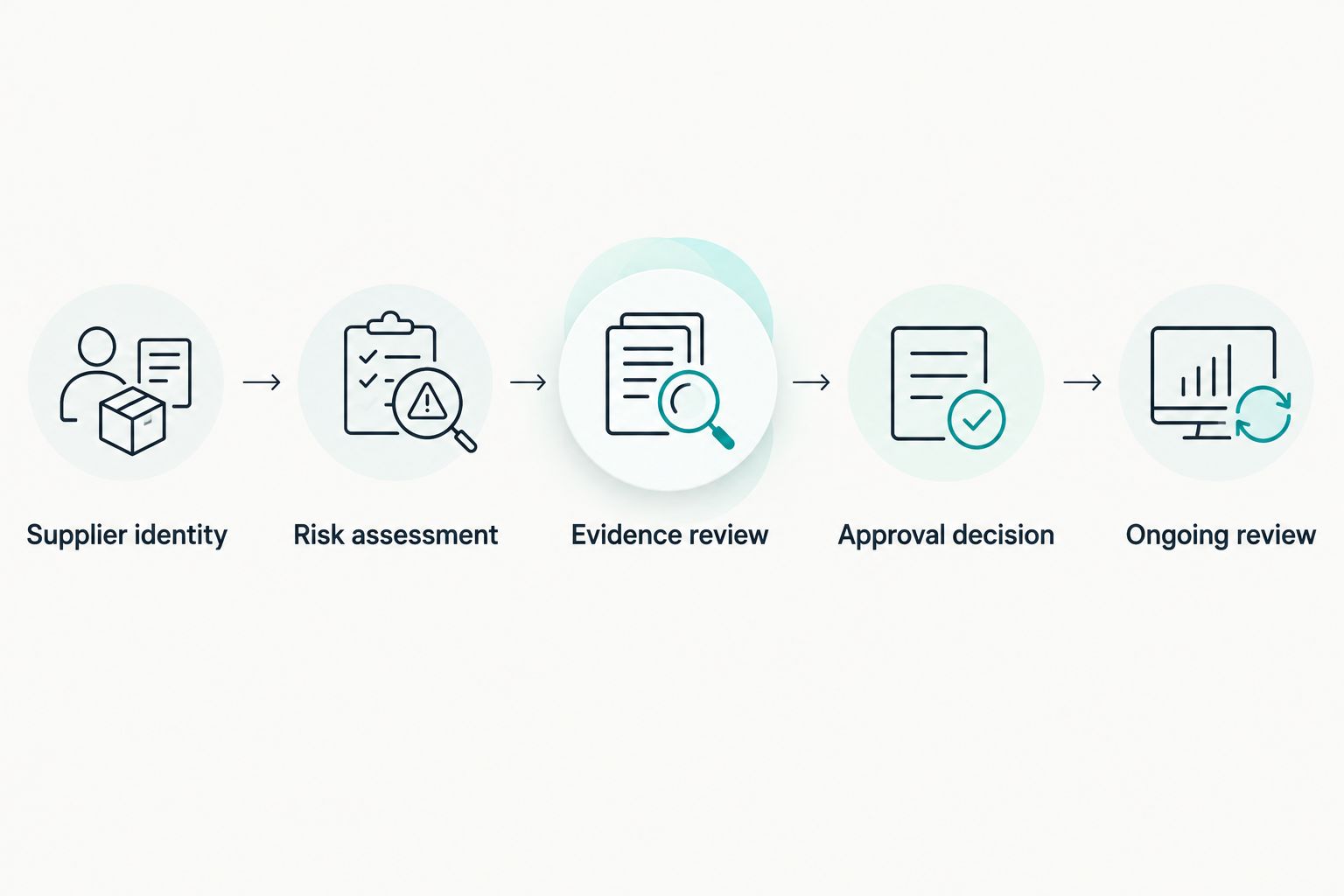
Keep supplier identity, evidence and approval connected throughout the review.
Distinguish identity checks from security assurance. Automated supplier due diligence should sit alongside checks of the supplier's access, evidence and production role; confirming the business entity does not establish that its service is secure.
Ask the demonstrator to leave a finding unresolved. Then test whether the record shows a named owner, an approval condition and the reason for the decision.
Finally, export the result. Your team should be able to explain the approval without reconstructing it from email.
Set approval rules before automating them
Give every supplier review 1 named owner. Other departments contribute, but someone must make sure the assessment reaches a recorded decision.
Use 3 decision outcomes in your pilot: approve, approve with conditions, or reject. Define who can select each outcome and what evidence they need.
These are recommended starting rules. Adjust them to your governance rather than adopting a software default without discussion.
For a remote maintenance provider, test whether your process captures:
- The equipment and sites the supplier can access.
- Who authorises and removes that access.
- How access activity is recorded.
- What happens when the contract ends.
For a component supplier, focus the review on the relevant production dependency and recovery arrangements. Do not mistake a strong cyber-security assessment for a complete assessment of supply continuity.
Define your vendor risk assessment process before configuring automation. Otherwise, you automate inconsistent decisions.
How the shortlist is ranked
The shortlist uses the criteria above: production relevance, proportionate assessment, evidence handling, ownership, usable workflows and exit readiness. Each option holds a distinct role rather than competing for the same label.
This is a use-case shortlist, not a hands-on performance benchmark. Product focus explains inclusion; your pilot determines selection.
For 2026 procurement, separate essential requirements from supporting features. A missing approval record matters more than a presentation feature your team will not use.
Which vendor risk software should you choose?
Choose dedicated third-party risk software by default when supplier assessment is the main problem. Evaluate ProcessUnity for that role, ServiceNow for connected enterprise workflows, and OneTrust when privacy-linked reviews drive the requirement.
Choose compliance automation when certification, policies and internal risk management dominate the work. Add external security ratings when you need another source of evidence, not a substitute for supplier review.
Before signing, require a written record of the workflows demonstrated, the scope included and the responsibilities your team retains. Select the option that handles your real approval decision.
Frequently asked questions
One last thing
Test supplier offboarding before you buy. Ask who removes remote access, closes open actions and records the end of the relationship.
An onboarding demonstration shows how a supplier enters your business. An offboarding demonstration shows whether you retain control when the relationship changes. Automate the administration. Keep ownership clear. Seriously Simple Cyber Compliance.