
Yes, you can get Cyber Essentials certified within a week if your systems already meet the requirements, your answers are accurate and a certification body can assess your submission in time. The deadline must include fixing gaps and answering assessor queries, not just completing the questionnaire; a one-week turnaround is a target, not a guaranteed certification time.
Can you get Cyber Essentials certified in a week?
Yes—provided the security work is substantially complete before you submit. A short deadline becomes harder when you still need to identify devices, replace unsupported software or establish who controls your cloud accounts.
Separate preparation from assessment. You control your answers and corrective work; the certification body controls its assessment and certification decision. The wider guide to how long Cyber Essentials certification takes explains that distinction.
Use this sequence before you promise a completion date:
- Confirm the requirement. Check whether your customer needs Cyber Essentials or Cyber Essentials Plus.
- Define the scope. Identify the organisation, systems and services the certificate must cover.
- Check the controls. Compare actual settings with the applicable scheme requirements.
- Resolve the gaps. Complete changes and verify the result before describing them as implemented.
- Confirm assessment timing. Ask the certification body about review, clarification and certificate issue.
For a 2026 application, use the questionnaire and technical requirements applicable to that application. Do not reuse an old answer set without checking it against your current systems.
Why this matters
A customer deadline does not change the certification requirements. If you submit before your controls meet them, you still have the same technical work to finish, plus an assessment to manage.
The useful question is not how quickly you can fill in a form. It is whether you can demonstrate that every applicable requirement is met and leave time for assessment.
Read the customer's wording before you begin. An application receipt, an intended certification date and an issued certificate are different things; confirm which evidence the customer will accept.
Cyber Essentials: an assessed questionnaire
Cyber Essentials is the better fit when your customer requires the baseline certification and does not specify Plus. You complete a self-assessment questionnaire, and an authorised assessor evaluates the answers.
The advantage is that the baseline route does not add the independent technical audit required for Plus. The limitation is that self-assessment still demands accurate knowledge of your environment; confident answers do not compensate for missing controls.
The NCSC's Cyber Essentials scheme covers five technical control areas: firewalls, secure configuration, security update management, user access control and malware protection. Use the applicable scheme documents to establish the detailed requirements for your application.
Ask whoever manages your IT to verify the answers. If an external provider handles updates, accounts or firewalls, obtain specific confirmation rather than relying on a general statement that everything is managed.
Cyber Essentials Plus: independent technical verification
Cyber Essentials Plus is the better fit when your customer explicitly requires independently tested implementation of the Cyber Essentials controls. It builds on baseline Cyber Essentials certification and adds a technical audit.
The benefit is independent verification, not a different shortcut through the requirements. The limitation for a one-week target is that you must also arrange testing and address any findings.
For your 2026 plan, confirm the required certification level before scheduling work. Preparing for baseline Cyber Essentials alone does not satisfy a contract that explicitly requires Plus.
| Certification | Best for | Assessment approach | Benefit | Deadline constraint |
|---|---|---|---|---|
| Cyber Essentials | Businesses whose customer requires baseline certification | Assessed self-assessment questionnaire | No additional Plus technical audit | Readiness, accurate answers and assessor turnaround |
| Cyber Essentials Plus | Businesses whose customer requires independent technical verification | Baseline certification plus technical audit | Independent checks of implementation | Audit scheduling, technical readiness and findings |
Choose the level your contract requires. Neither route is automatically the right choice simply because your deadline is short.
Build a one-week preparation plan
Treat the following as a proposed allocation of your team's effort, not a published certification timetable. It assumes you have access to the people and systems needed to check and change settings.
Scope check: allocate 1 day
Start with the legal entity and business activity the certificate needs to cover. List the devices, operating systems, cloud services and people relevant to that scope.
Include remote working and personal-device use where applicable. Do not assume equipment sits outside scope simply because your business does not own it.
Record who can approve changes. A device list is useful, but a device list with an accountable owner lets you act.
Control checks and fixes: allocate 2 days
Check settings against the applicable requirements, then fix gaps in an order that reflects dependencies. An account change, for example, needs the right administrator and a way to confirm that users retain appropriate access.
Use the scheme's five control areas as your working checklist:
- Firewalls: check the relevant protections and how you manage access.
- Secure configuration: check that systems use appropriate settings and unnecessary access is removed.
- Security update management: check software support and required updates.
- User access control: check accounts, privileges and applicable authentication requirements.
- Malware protection: check that the required protection is implemented.
Do not mark a fix complete when you have only requested it. Verify the changed setting and record what you checked.
Answer review: allocate 1 day
Complete the questionnaire using verified information. Keep descriptions consistent across scope, devices, software and account management.
Ask a second person to challenge vague answers. Replace statements such as everything updates automatically with a description that accurately answers the question being assessed.
Obtain the required organisational approval before submission. Then keep the technical owner available for clarification rather than assuming the task ends when you submit.
Assessment: agree the remaining time
Confirm assessment arrangements before you depend on the remaining part of the week. Do not assume a calendar week provides uninterrupted working time for your team or the certification body.
Ask how the body handles clarifications and who will receive them. Identify an internal contact who can respond without waiting for another round of approvals.
The practical sequence is scope check, control checks, fix gaps, answer review, then assessment. Keep that order even when different people work in parallel.
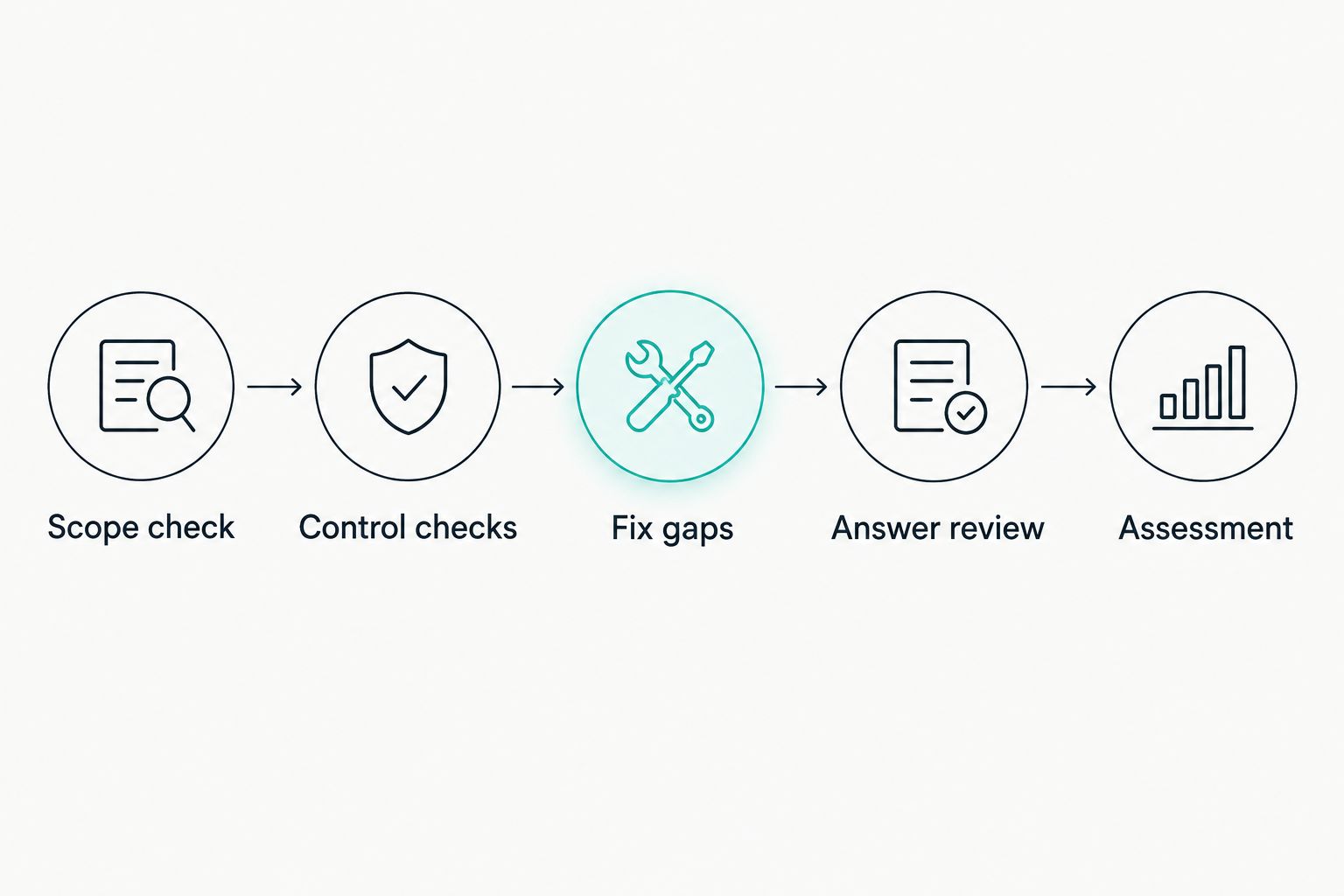
Verify security changes before you submit answers that describe them as complete.
Why Cyber Essentials certification time varies
Your starting position determines the preparation work. For a 2026 deadline, inspect these factors before agreeing a date:
- Scope clarity. Missing devices, services or business activities leave you checking the wrong environment.
- Software support. Unsupported systems require a resolution, not a more carefully worded questionnaire answer.
- Administrative access. You need someone who can inspect and change the settings under assessment.
- External dependencies. An IT provider or service owner must confirm and complete the work they control.
- Answer quality. Inconsistent descriptions create questions that accurate preparation would prevent.
- Assessment arrangements. Review, clarification and any Plus testing must fit the deadline.
A small team does not automatically mean a short preparation period. Check the actual systems rather than using headcount as a substitute for readiness.
What should you ask the certification body before starting?
Give the certification body your required completion date, certification level and intended scope. Ask whether its assessment process can accommodate that deadline without treating the answer as a guaranteed pass.
Get clear answers to these questions:
- Which questionnaire and technical requirements apply to this application?
- What must be complete before submission?
- How are assessor questions sent and answered?
- What assessment timing can the body confirm?
- If Plus is required, how will the technical audit be arranged?
- What happens if the assessment identifies a gap?
Keep the answers with your project plan. A confirmed assessment arrangement is more useful than a general claim that certification is fast.
For a 2026 customer commitment, distinguish an expected date from a confirmed certificate. Tell the customer what has actually happened, not what your internal schedule assumes.
Can software get you Cyber Essentials certified faster?
Software can help you organise and complete preparation, but it cannot make an unmet requirement disappear or issue an assessor's decision. Use automation for work it actually supports and keep people accountable for scope and accurate answers.
OneClickComply suits growing businesses that want to automate Cyber Essentials preparation. OneClickComply provides compliance automation, security-control remediation, policy generation and risk management.
The practical benefit of OneClickComply for Cyber Essentials is support with implementing and managing controls. The boundary is equally clear: a platform's role does not replace the certification body's assessment or guarantee completion within a week.
Do not turn the project into a policy-writing exercise. Documents help explain how you manage security, but the technical controls must operate in the systems covered by your application.
Can you apply before fixing every security gap?
Do not submit answers that describe planned changes as completed controls. You can organise the application and speak to the certification body while preparing, but your assessment answers must reflect reality.
Keep a short action list with an owner, the required change and a verification record. Close each item only after someone confirms the result.
If a blocker cannot be resolved within your target week, revise the date. An honest timetable is more useful than a submission that depends on work nobody has completed.
What if your customer needs the certificate this week?
Tell the customer whether you already hold certification, have submitted an application or are still preparing. Ask whether they require an issued certificate before the next contractual step.
Do not present a submitted questionnaire as certification. Equally, do not assume the customer will reject an updated timetable without asking.
Keep the conversation factual: name the outstanding work, the assessment arrangement and the next confirmed update. Avoid promising a certificate before the certification body makes its decision.
Frequently asked questions
One last thing
Before you start the questionnaire, ask your IT owner to show you how they know the answers are true. That conversation turns assumptions into checks and gives each unresolved item an owner.
For your 2026 deadline, work backwards from assessment rather than forwards from form completion. Get the controls right, verify the answers and confirm the review arrangements. Seriously Simple Cyber Compliance.