
Your Cyber Essentials certification cost in 2026 depends on your organisation’s size, the certification level you need and the work required to meet the controls. The assessment fee is only part of your budget: include internal staff time, technical fixes, any external support and annual renewal.
What affects Cyber Essentials certification cost in 2026?
Compare the total work needed to achieve certification, not just the assessment fee. Cyber Essentials and Cyber Essentials Plus assess the same 5 technical control areas, but they use different assessment methods.
Start with the level your customer or contract requires. Then check your readiness and how long Cyber Essentials certification takes before setting a submission date.
| Certification level | Assessment method | Best for | Main benefit | Main limitation |
|---|---|---|---|---|
| Cyber Essentials | An assessor reviews your organisation’s self-assessment answers | Businesses that need the baseline certificate and can accurately explain their controls | Establishes compliance with the scheme’s technical baseline | Does not include the independent technical testing provided by Plus |
| Cyber Essentials Plus | Independent technical testing, alongside the Cyber Essentials requirements | Businesses whose buyers require tested assurance | Checks that technical controls work in practice | Requires additional testing preparation and assessor coordination |
Neither level replaces the need to maintain your controls. A successful assessment records your position at that point; your team still needs to manage devices, accounts and updates afterwards.
Why this matters
A certification budget is also a delivery plan. If you approve the assessment but leave nobody responsible for unsupported software or account changes, you have funded the review without funding the work needed to pass it.
For your 2026 budget, separate external charges from internal work. That makes it clear who owns each task and whether your planned submission date is realistic.
The useful question is not simply what certification costs. It is what your organisation needs to change, who will make those changes and what evidence will show they are complete.
Cyber Essentials: budget for accurate answers and working controls
Best for: businesses that need the baseline certificate without the additional technical testing of Plus. Cyber Essentials uses a self-assessment questionnaire reviewed by an assessor; self-assessment does not mean awarding yourself a certificate.
Your preparation work centres on understanding your environment and answering accurately. You need to know which devices, software, accounts and services fall within scope, and how your organisation manages them.
Build your preparation plan around these 5 control areas:
- Firewalls: check how you control connections to and from your systems.
- Secure configuration: remove unnecessary access and settings that expose systems.
- Security update management: identify supported software and apply required updates.
- User access control: manage permissions, account access and authentication.
- Malware protection: confirm that the required protections cover relevant devices.
The benefit is a defined technical baseline. The limitation is that completing the questionnaire still requires reliable knowledge of your systems; a policy document alone does not establish that a control operates.
Ask your IT owner to validate technical answers before submission. Where an external IT provider manages a control, get a clear explanation of what it handles and what remains your responsibility.
Cyber Essentials Plus: budget for technical verification
Best for: businesses that need independent testing of the Cyber Essentials controls. Choose Plus because a buyer requires it or because you want that additional assurance—not because the word sounds more impressive.
Plus adds technical verification. Your preparation must therefore cover access for the assessor, the systems selected for testing and the people needed to resolve findings.
Confirm the following before agreeing the assessment:
- The organisational scope and systems covered.
- The information the assessor needs to plan testing.
- Who will provide access and support during the assessment.
- How findings will be communicated.
- What the agreement includes if further testing is needed.
The benefit is direct testing rather than relying only on questionnaire answers. The trade-off is additional coordination and the need to demonstrate that controls work on the systems examined.
Do not treat Cyber Essentials Plus as a general penetration test. They serve different purposes, so confirm the precise requirement before commissioning either service.
Why Cyber Essentials certification cost varies
Your certification plan should explain the work behind the budget. These factors determine what you need to assess, prepare and maintain:
- Organisation size. Confirm the size band used for your application and describe your organisation accurately.
- Certification level. Cyber Essentials Plus adds technical testing to the baseline requirements.
- Scope and complexity. Different device types, operating systems, cloud services and locations create different preparation tasks.
- Current readiness. Unsupported software, unnecessary administrator access and incomplete device records need attention before assessment.
- Support required. Decide whether your staff can complete the work or need help with interpretation, configuration or coordination.
- Remediation and reassessment. Confirm responsibility for fixes and the assessor’s terms for reviewing corrected answers or repeating tests.
A larger device estate does not, by itself, tell you the full workload. Consistent management matters: a well-maintained environment is easier to explain and check than one with unclear ownership.
Keep the distinction between a certification requirement and a wider security improvement. Both deserve attention, but combining them without explanation makes the certification budget difficult to approve.
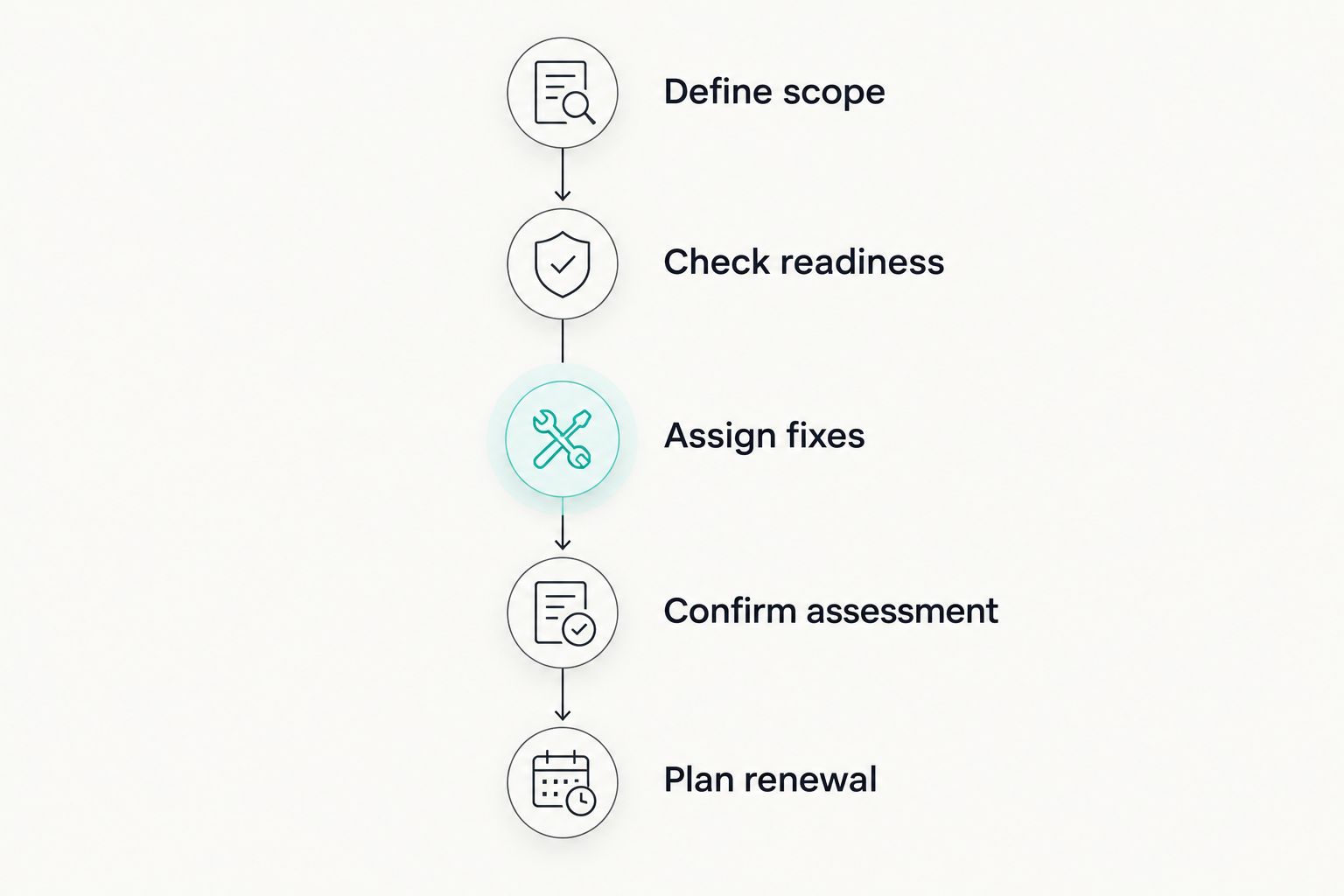
Build your certification budget in five steps
Use the same written brief for every provider you approach in 2026. This makes differences in scope visible before you commit.
1. Define scope
List the legal entity, business activities, devices and services you intend to cover. Include remote working and cloud services in your scope discussion rather than assuming they sit outside the assessment.
Confirm any proposed exclusions with the assessor. Your certificate needs to cover the business activity your customer expects, not just the easiest systems to prepare.
2. Check readiness
Review your environment against the scheme’s current requirements. Record what already meets them, what needs changing and what you cannot yet verify.
Assign each gap to a named owner. An unanswered technical question is a task to resolve, not a reason to guess on the application.
3. Assign fixes
Separate configuration changes from purchases, migrations and staff administration. These tasks need different approvals and different people.
Ask the person doing the work to estimate the effort. Keep internal time visible even when no external supplier is involved.
4. Confirm assessment
Ask the provider to document the level, scope, preparation support and assessment arrangements. Check whether support means explaining requirements, making technical changes or both.
Read the terms covering corrections and further assessment. Do not assume every provider includes the same follow-up work.
5. Plan renewal
Cyber Essentials certificates are valid for 12 months. Set an owner for renewal and maintain the information needed for the next application throughout that period.
Record changes to devices, services and account management as they happen. That gives the next assessment a usable starting point rather than another discovery exercise.
Define the work before approving the assessment.
What should your assessment agreement include?
Get inclusions and exclusions in writing. A brief description such as certification support does not tell you who changes settings, answers technical questions or deals with findings.
Ask the provider to specify:
- The certification level and agreed scope.
- Any preparation review included before submission.
- Who completes and approves the questionnaire.
- Who makes technical changes.
- How corrections and further testing are handled.
- Which renewal activities require a separate agreement.
Keep tax treatment and payment terms clear in the proposal. Compare like-for-like scope rather than treating every assessment package as interchangeable.
Also identify dependencies on your IT provider. If the assessor requests technical information, somebody needs authority and access to supply it.
Can compliance software reduce preparation work?
OneClickComply is best for growing businesses that want to automate Cyber Essentials compliance preparation. The platform supports compliance work through security-control remediation, policy generation and risk management.
Use OneClickComply where those capabilities match the tasks in your readiness plan. Ask which controls it can address in your environment and which actions still need your IT team.
The benefit of OneClickComply’s compliance automation is support for preparing and maintaining controls. The limitation is clear: software does not replace the independent assessor or guarantee a certification outcome.
Evaluate automation against specific work, not a promised saving. Identify the task, confirm how it is handled and decide who reviews the result before relying on it for assessment.
How do you reduce certification costs without cutting corners?
Remove avoidable work, not required controls. Start by making your device and account records accurate, then resolve gaps before submitting your answers or arranging technical testing.
Standardise configurations where practical. Consistent settings give your IT team a clearer basis for checking compliance and explaining how controls apply across your environment.
Use existing management tools before buying another product. Confirm whether they provide the required functionality, whether it is enabled and whether it covers the relevant systems.
Keep approval decisions separate from technical tasks. Your assessor should not be waiting for a business decision that your team could have resolved during preparation.
For 2026, prioritise a repeatable process over a last-minute certification exercise. Maintain control ownership between assessments so renewal starts with current information.
Does Cyber Essentials renewal require another budget?
Cyber Essentials certification lasts 12 months, so renewal belongs in your operating plan. Budget for the next assessment and the work needed to confirm that your answers remain accurate.
Do not assume last year’s application still describes your business. New cloud services, staff devices and changes in IT support all need review.
Check the requirements that apply to your next application. Reusing old answers without checking them removes the preparation step that makes those answers dependable.
Is Cyber Essentials Plus necessary for every business?
Cyber Essentials Plus is not necessary for every business; choose the level that meets your buyer’s requirement and your assurance objective. Ask for the exact certification wording before approving the work.
A request for Cyber Essentials does not automatically mean Plus. Equally, a baseline certificate does not satisfy a requirement that explicitly names Plus.
If the requirement is unclear, resolve it with the buyer before commissioning an assessment. That prevents your team from preparing for the wrong outcome.
Frequently asked questions
One last thing
Before approving your 2026 certification budget, ask your IT owner to explain one proposed questionnaire answer using a real device or account. If the answer cannot be verified, resolve that gap before submitting it.
Fund the work that makes your answers true. Then maintain those controls between assessments. Seriously Simple Cyber Compliance.