
ISO 42001 certification has no fixed completion period: your timeline depends on the work needed to make your AI management system audit-ready and complete independent certification. Preparation is only part of the schedule; auditor availability, corrective actions and the certification decision also affect the finish date. For your 2026 plan, set the target from a gap assessment and an agreed audit programme, not a generic promise of certification within a set number of weeks.
How long does ISO 42001 certification take?
There is no universal deadline or fixed implementation period for ISO 42001 certification. You need to establish the management system, demonstrate that it operates, complete the certification audits and resolve findings as required by your certification body.
Start with an ISO 42001 gap analysis before certification. Use the results to separate work you control from dates that depend on your auditor.
Build your schedule around these steps:
- Define scope. Identify the activities, teams and AI systems your certification will cover.
- Assess gaps. Compare your current arrangements with the standard's requirements.
- Implement controls. Assign responsibilities, assess risks and impacts, and put agreed processes into use.
- Check effectiveness. Complete your internal audit and management review, and address findings.
- Complete certification. Progress through the external audit process, corrective actions and certification decision.
Some preparation tasks can run together. Others depend on earlier decisions: you cannot assess a clearly defined scope until you have agreed what belongs inside it.
A credible finish date needs both an implementation plan and confirmation from your certification body. Neither replaces the other.
Why this matters
A customer deadline is not an audit-readiness assessment. If a buyer asks for certification during 2026, confirm whether they require an issued certificate or will accept a documented programme while assessment continues.
Keep those milestones separate in sales conversations. An audit booking, a completed readiness review and an issued certificate describe different states.
Your team also needs to distinguish effort from elapsed time. A task can require limited hands-on work but remain open while an owner approves a decision, a supplier provides evidence or an auditor reviews a response.
Your starting point changes the preparation work
Existing management processes give you material to assess and adapt. They do not remove the need to show how you manage AI within the proposed scope.
Use this comparison to identify your starting position. These are planning situations, not guaranteed certification speeds.
| Starting position | Best for | Useful starting point | Main limitation |
|---|---|---|---|
| Existing ISO 27001 management system | Teams adding AI governance to established security processes | Document control, internal audit and management review arrangements | Security evidence does not automatically demonstrate AI risk and impact management |
| Established AI governance without certification | Teams already recording AI decisions and responsibilities | Inventories, assessments and operational records | Existing practices still need checking against the full standard |
| New AI management system | Teams formalising previously informal AI use | A clearly defined starting scope | Responsibilities, processes and supporting records need establishing |
Existing ISO 27001 processes: assess before reusing
Reuse processes where they meet the requirement and cover the right scope. For example, your document-control process can manage AI policies alongside security policies.
Check the content separately. An information-security risk assessment does not, by itself, address every consequence of an AI system's use for individuals, groups or society.
Reuse the process; validate the evidence. Copying a document into a new folder does not establish that it covers the AI management system.
Existing AI governance: test completeness
Your product and engineering teams might already document model evaluations, human oversight and release decisions. Assess those records against the management system rather than replacing useful work with templates.
Look beyond technical testing. Leadership responsibilities, competence, objectives, internal audit and management review also belong in the certification programme.
Starting from scratch: agree boundaries first
Choose a scope you can explain and operate. Define the relevant activities and interfaces, including responsibilities shared with suppliers or other teams.
A narrower scope is not permission to ignore dependencies. If an external service affects the AI activity inside your scope, account for that relationship in your assessment and controls.
Build your certification schedule around evidence
For a 2026 certification programme, use completion conditions rather than unsupported weekly estimates. Each phase should end with something your team can inspect: an approved scope, an assessment, an operating record or an audit result.
The following sequence makes those handovers explicit. Adjust the work to your organisation, but keep responsibility for each outcome clear.
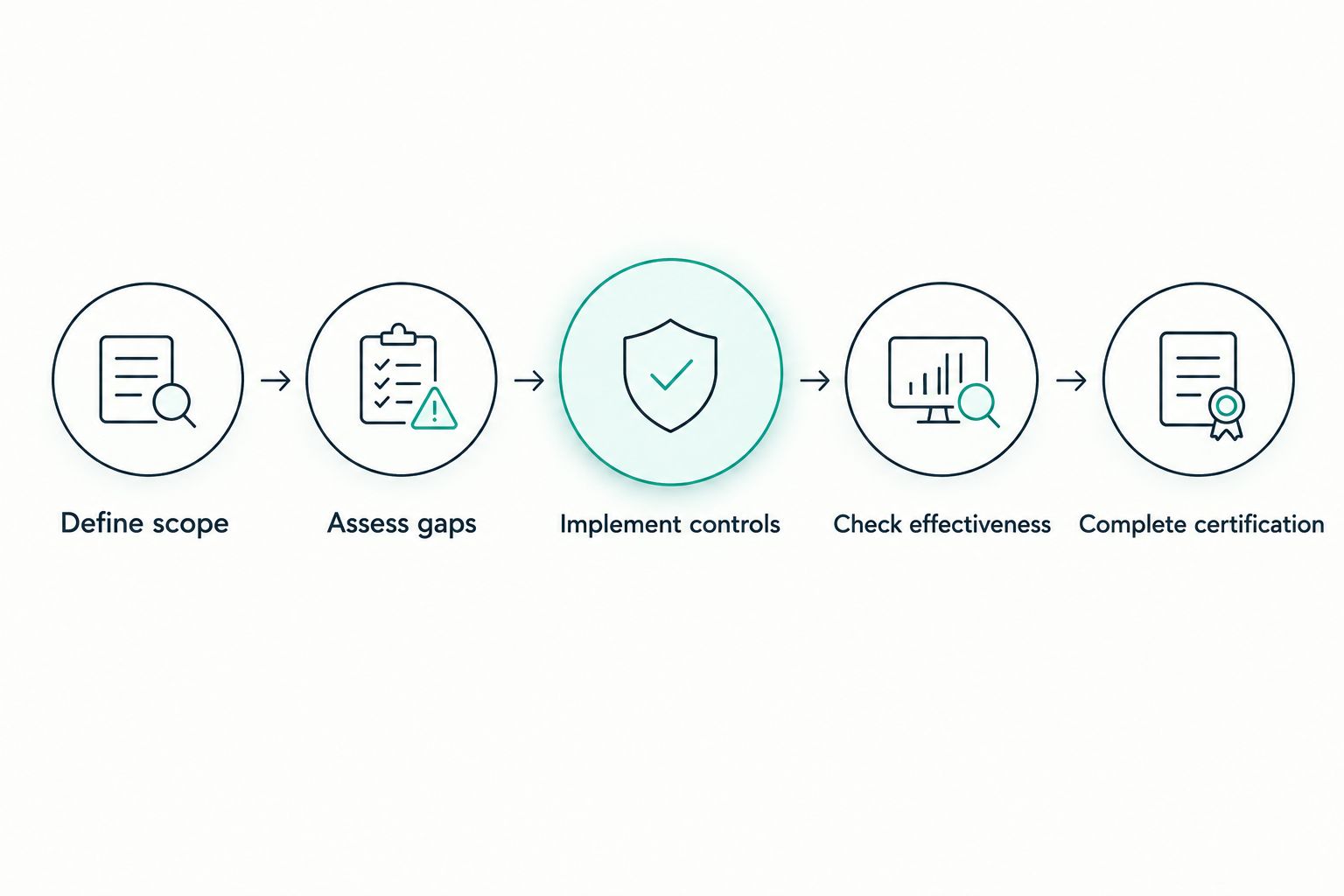
Agree the evidence needed at each handover before fixing the next milestone.
Define scope
Record which organisational activities and AI systems the management system covers. Explain your role, such as developing, providing or using AI, and identify the teams responsible.
Make the boundary understandable to someone outside your business. An auditor should not need to infer which product, business unit or activity your certificate is intended to cover.
Completion condition: your scope is documented, agreed internally and understood by the certification body.
Assess gaps
Check requirements against actual practice. Record the evidence you already hold, what needs improving and what does not yet exist.
Separate a missing document from a missing activity. Writing a supplier-review procedure does not demonstrate that you have assessed the relevant supplier.
Completion condition: each gap has an owner, an action and a clear evidence requirement.
Implement controls
Put your agreed arrangements into use. This includes the controls selected through your risk-treatment process and the responsibilities needed to operate them.
Keep records tied to real decisions. Useful evidence explains what was assessed, who approved the response and how the organisation checked the outcome.
Completion condition: relevant processes operate within scope, with records that support your claims.
Check effectiveness
ISO 42001 clause 9.2 addresses internal audit; clause 9.3 addresses management review. Your programme needs both activities, not just an external audit appointment.
Use the internal audit to evaluate conformity and implementation. Use management review to assess the management system and record leadership decisions about changes, resources and improvement.
Completion condition: both activities are complete, with findings and decisions addressed through your management processes.
Complete certification
Initial management-system certification normally involves Stage 1 and Stage 2 audits. Stage 1 assesses preparedness, while Stage 2 evaluates implementation and effectiveness within the agreed scope.
The certification body then handles its review and certification decision. A completed audit is therefore not the same milestone as an issued certificate.
Completion condition: your certification body confirms the certification decision and issues the certificate.
Why ISO 42001 certification timelines vary
These factors explain why copying another company's schedule creates an unreliable target. Use them to challenge your own 2026 plan before committing to a delivery date.
- Scope and complexity. Different activities, locations and AI responsibilities create different assessment and implementation work.
- Existing processes. Established document control, governance and assurance processes give you material to assess and adapt.
- Evidence quality. Approved documents and records of actual operation answer different audit questions; you need the relevant evidence for both.
- Owner availability. Risk decisions, technical changes and leadership approvals depend on people completing their responsibilities.
- External dependencies. Supplier information, certification-body scheduling and review steps sit outside your team's direct control.
- Audit findings. Corrective actions add work that your original plan must accommodate before certification can progress.
Do not treat company size as a complete explanation. A small organisation with unclear responsibilities still needs to resolve them; a larger organisation still needs evidence that covers its scope.
How do you get a dependable certification date?
Ask your certification body to distinguish audit effort, available appointments and the steps after the audit. Those are separate inputs to your schedule.
For a 2026 target, get written confirmation of:
- The proposed certification scope and application assumptions.
- The planned Stage 1 and Stage 2 audit arrangements.
- The readiness information needed before each audit.
- How findings are classified and addressed.
- The evidence required to close relevant findings.
- What happens between audit completion and the certification decision.
Compare that programme with your internal action plan. If an audit depends on evidence that does not yet exist, resolve the dependency rather than assuming the appointment makes you ready.
Keep an audit target and a certificate target as separate dates. Update both when scope, readiness or findings change.
Can compliance software shorten the preparation work?
Compliance software supports administration and repeatable processes. It does not make your organisation's risk decisions or issue an independent certificate.
OneClickComply is best suited to growing businesses that want compliance automation for policy generation, security-control remediation and risk management. Those are supported platform capabilities; they are not a guaranteed ISO 42001 certification timeline.
When assessing OneClickComply, check the exact framework coverage and evidence workflows you need before choosing it for this programme. Keep ISO 42001-specific suitability separate from general compliance-automation capabilities.
The benefit is practical: automate suitable tasks and keep people responsible for approvals and decisions. The limitation is equally clear: software-generated policies still need to match how your business operates.
Does ISO 27001 certification make ISO 42001 automatic?
ISO 27001 certification does not automatically give you ISO 42001 certification. The standards address different management-system requirements, even where organisational processes overlap.
Assess shared processes once, then check their coverage for each framework. Keep AI-specific risk, impact and operational evidence visible rather than assuming security certification covers it.
Can you book the external audit before preparation is finished?
You can discuss scheduling before every preparation task is complete, but an appointment is not proof of readiness. Agree the certification body's requirements and make remaining dependencies explicit.
Before confirming progression, check whether the necessary records, internal audit and management review will be ready. Use those checks to make the booking decision, not pressure from a sales deadline.
Frequently asked questions
One last thing
The final audit is not the final milestone. Put the certification decision and certificate issue into your plan before you tell a customer when certification will be complete.
Start with the scope. Assign the work. Automate suitable tasks, keep decisions accountable and prove the system works. Seriously Simple Cyber Compliance.