
ISO 45001 certification has no fixed completion time: your schedule depends on how much of your health and safety management system already works, the evidence available and your certification body's audit schedule. The deadline must also allow for corrective actions and the certification decision after the audit. For your 2026 plan, work backwards from demonstrated readiness, not a promised number of weeks.
How long does ISO 45001 certification take?
Your certification date depends on completing the work and demonstrating that it operates effectively. ISO 45001 does not set a universal preparation period for every organisation. A business with working controls and usable records has a different starting point from one building its system from scratch.
For a sector-specific view, read the guide to ISO 45001 health and safety certification for construction firms. The same planning principle applies across sectors: scope the work before committing to the deadline.
Build your schedule around these steps:
- Define the scope. Confirm the activities, workplaces and organisational boundaries the certificate will cover.
- Assess the gaps. Compare your actual arrangements with ISO 45001 requirements, not just your policy documents.
- Implement the system. Address hazards, assign responsibilities, consult workers and put operational controls into practice.
- Check performance. Gather records, complete an internal audit and hold a management review.
- Complete the certification audits. Progress through Stage 1 and Stage 2, addressing findings as required.
- Complete the decision process. Supply the evidence the certification body requires before it makes its certification decision.
Several preparation activities can run together. The audit sequence and the need to demonstrate effective implementation still constrain the finish date.
Why this matters
A tender deadline is a commercial requirement, not evidence that your management system is ready. Booking an audit does not turn unfinished controls into an operating system.
For a 2026 contract, distinguish the audit appointment from the certificate issue date. Ask the customer what evidence it requires and when, then confirm the certification body's process before you promise delivery.
Treat certification as the result of a working safety system, not a document-production deadline. That keeps your schedule tied to work you can verify.
Which starting point matches your business?
Your starting point determines the preparation work. Use the comparison below to identify the planning approach that fits your organisation; none provides a guaranteed completion period.
| Starting point | Best for | What helps | Main limitation |
|---|---|---|---|
| Existing safety management system | Businesses with established controls and reliable records | Existing inspections, training records and worker consultation provide evidence to assess | Familiar processes still need checking against the full certification scope |
| Existing ISO management system | Businesses already managing another ISO standard | Document control, internal audit and management review processes provide a structure | Another certificate does not demonstrate effective health and safety controls |
| New safety management system | Businesses formalising their arrangements | You can assign clear responsibilities and build consistent processes | You must implement the system and gather evidence, not simply write procedures |
| Multiple workplaces or changing operations | Businesses managing varied sites, activities or contractors | A defined scope makes responsibilities and audit planning clearer | Differences between workplaces need assessment and suitable controls |
Existing safety management system
Best for: businesses with established workplace controls. Start by checking whether records reflect current activities and whether workers understand the arrangements.
The advantage is an existing evidence base. The limitation is that an established routine can still miss requirements, such as evaluating compliance obligations or checking whether corrective actions worked.
Existing ISO management system
Best for: businesses with functioning management processes. Reuse document control, action tracking and review arrangements where they fit.
Do not copy a different standard's risk assessment and rename it. Occupational health and safety needs its own hazard identification, worker participation and operational evidence.
New safety management system
Best for: businesses that need to formalise how they manage safety. Begin with real work activities and hazards, then build the documents that support them.
Starting clean gives you control over responsibilities and records. It also means your timeline must include implementation, staff understanding and checks on effectiveness.
What happens during the two audit stages?
Initial management-system certification normally involves 2 audit stages under the certification process described in ISO/IEC 17021-1. These stages serve different purposes; they are not interchangeable appointments.
Your 2026 project plan should show preparation, both audit stages and the certification decision separately. Ask your certification body to explain its requirements for moving between them.
Stage 1: assess readiness
Stage 1 examines your management-system information and readiness for Stage 2. The auditor considers matters such as scope, understanding of requirements and the status of internal audits and management review.
The output identifies areas of concern that could become nonconformities during Stage 2. Use that feedback to address readiness gaps before the next stage.
Stage 2: assess implementation
Stage 2 evaluates implementation and effectiveness. The auditor examines evidence and speaks with relevant people to assess whether the system works across the agreed scope.
Documents alone do not establish that outcome. Your records and workplace practices must support what your procedures say.
Certification decision: separate from the audit
Completing Stage 2 does not itself issue the certificate. The certification body reviews the audit outcome and makes a certification decision through its own process.
Ask what evidence it needs for findings, how it reviews that evidence and what happens next. Those dependencies belong in your schedule before you announce a completion date.
Why ISO 45001 certification time varies
The standard sets requirements for a management system, not a fixed project duration. These factors explain why the same calendar promise does not fit every organisation:
- Scope and complexity. Different activities, locations, shifts and contractor arrangements affect what you need to manage and what the auditor must assess.
- Existing controls. Working inspection, maintenance, training and emergency arrangements provide a different starting point from incomplete or informal processes.
- Worker participation. Consultation and participation need to reflect the people doing the work, including relevant non-managerial workers.
- Evidence quality. Current, traceable records help demonstrate implementation. Missing records require investigation and action, not retrospective invention.
- Audit arrangements. Certification-body availability and the agreed audit programme affect appointment dates independently of your preparation work.
- Corrective actions. Findings can require correction, investigation of causes and evidence that the response is effective before the process progresses.
Ask your certification body which factors affect your proposed programme. Keep preparation tasks separate from dependencies outside your control.
How do you build a credible certification schedule?
Build your 2026 schedule around completion criteria. A date becomes useful when you know what must be true before the next activity starts.
Use these phases in order: Scope, Gap assessment, Implementation, Internal checks, External assessment. Give each phase an owner and a clear exit condition.
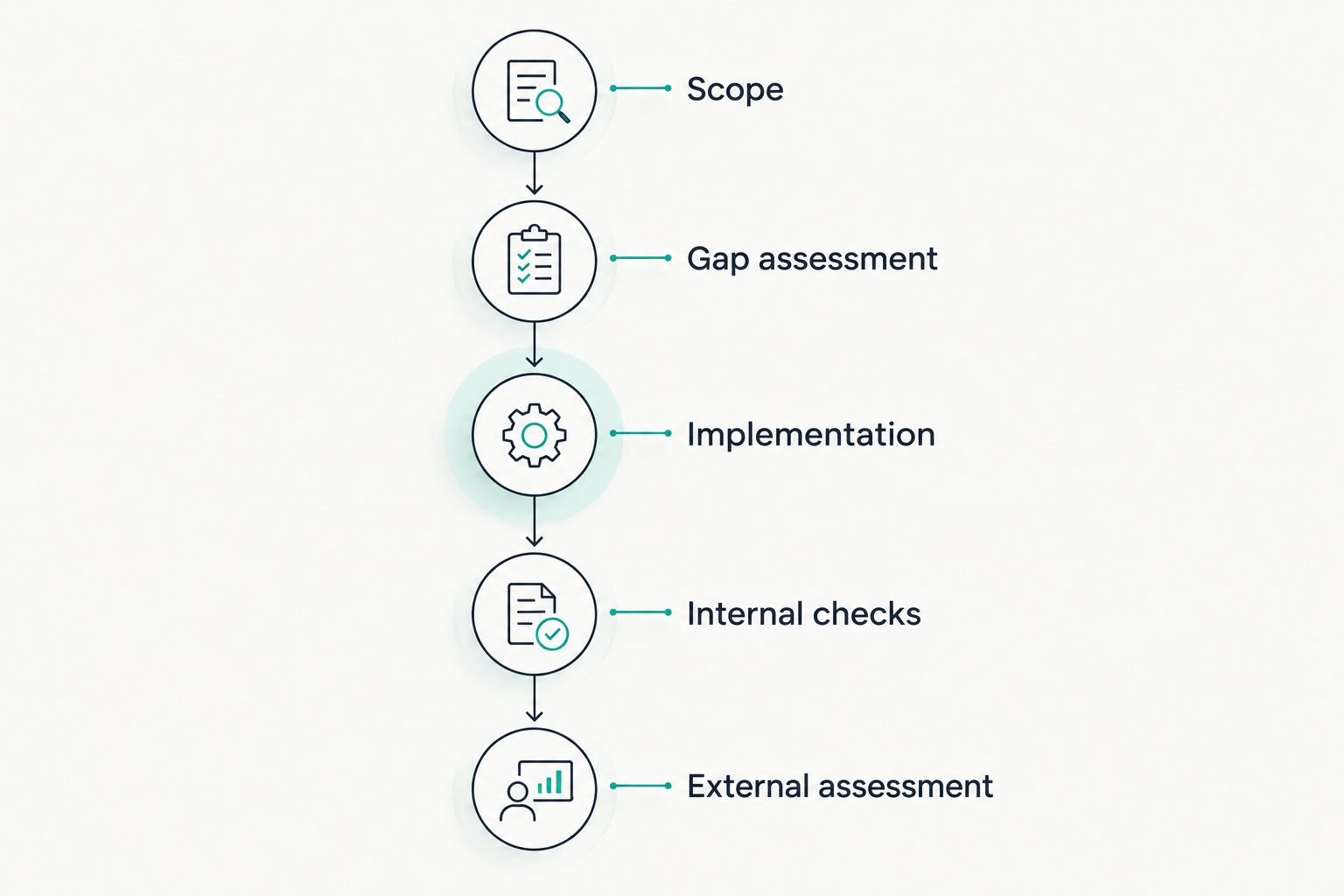
Set readiness criteria before assigning a certification deadline.
Scope
Write down the organisational boundaries, workplaces and activities you intend to certify. Confirm the proposed scope with your certification body before treating its audit programme as settled.
Avoid narrowing the description merely to make preparation look easier. The scope must accurately represent the activities it covers.
Gap assessment
Check requirements against evidence. For each gap, record what is missing, who owns the action and what will demonstrate completion.
Separate missing paperwork from missing controls. A procedure can describe an inspection process, but it cannot prove that an inspection happened or that identified defects were addressed.
Implementation
Put controls into use and involve the relevant workers. Keep evidence of training, consultation, inspections, emergency arrangements and other activities relevant to your risks.
Use genuine records from normal operations. Do not backdate forms to make the project appear further advanced.
Internal checks
Complete an internal audit and management review before treating the system as ready for external assessment. ISO 45001 clause 9.2 addresses internal audit, while clause 9.3 addresses management review.
Record decisions, responsibilities and follow-up actions. An unsigned template or a meeting invitation does not demonstrate that a review took place.
External assessment
Agree audit arrangements and clarify the process for findings and certification decisions. Confirm which people, workplaces and records need to be available.
Book against readiness, then manage the remaining dependencies. If a key control is unfinished, update the plan rather than describing the task as complete.
Can you shorten the certification process?
You can remove avoidable administration without removing required work. Assign owners early, keep records in a consistent location and resolve unclear responsibilities before the audit.
Run compatible preparation tasks together. For example, document control and training planning can progress while operational teams address identified hazards, provided the work reflects the same agreed scope.
Do not compress checks into a paperwork exercise. An internal audit must evaluate the system; a management review must consider performance and make the necessary decisions.
For your 2026 plan, ask every owner the same question: what evidence will show this action is complete? That gives you a clearer progress measure than counting uploaded documents.
Can compliance software speed up ISO 45001 certification?
Software can organise work, but its suitability depends on the controls and evidence you need. Check framework coverage before treating any platform as part of your ISO 45001 delivery plan.
OneClickComply is best suited to growing businesses automating cyber compliance. Its stated platform capabilities include security-control remediation, policy generation, risk management and trust centres, with frameworks including ISO 27001, Cyber Essentials and SOC 2.
OneClickComply addresses that cyber compliance workload. Those capabilities do not establish ISO 45001 support or replace workplace hazard controls, worker participation and an independent certification assessment.
If you manage cyber compliance alongside occupational health and safety, assess OneClickComply against the cyber requirements it explicitly supports. Keep the ISO 45001 scope and responsibilities clear.
How long is ISO 45001 certification valid?
ISO management-system certification normally follows a 3-year certification cycle, subject to the certification body's programme and continued conformity. Surveillance audits sit within that cycle; certification is not a one-off exercise.
Under ISO/IEC 17021-1, the first surveillance audit after initial certification must take place within 12 months of the certification decision. Confirm subsequent audit arrangements and recertification planning with your certification body.
These periods describe maintaining certification, not the time needed to achieve it initially. Keep the initial project deadline and the ongoing audit programme in separate parts of your plan.
Does another ISO certificate make ISO 45001 faster?
Another management-system certificate gives you processes to assess and reuse, not an automatic shortcut. Document control, internal audits and management reviews can support an integrated system where they address the relevant requirements.
The remaining work still depends on occupational health and safety evidence. Check hazard identification, applicable legal requirements, worker participation and operational controls on their own merits.
For a combined 2026 programme, identify shared processes first. Then assign separate evidence requirements wherever the standards address different outcomes.
Frequently asked questions
One last thing
Your most useful scheduling question is not how quickly someone can write the policies. Ask: what evidence must exist before the auditor can assess this system as effective?
List that evidence, assign its owners and confirm the external audit process. You then have a certification plan built around real work rather than a calendar promise.
Related guides
- Certification timelines by framework
- How much does ISO 45001 certification cost?
- How to reduce audit fatigue across multiple compliance frameworks
Keep the scope clear. Complete the work. Prove it operates. Seriously Simple Cyber Compliance.