
Your SOC 2 Type I audit cost depends on the system you put in scope, the criteria covered and the preparation your business needs. The auditor’s fee is only part of the budget: add readiness work, security improvements, software and your team’s time. For a useful 2026 estimate, request an itemised quote against a written scope rather than treating a headline fee as the total.
Why this matters
Budget for the report your customer needs, not just the examination you can buy. A Type I report will not satisfy a requirement that explicitly asks for Type II, even if the underlying system is the same.
Before requesting quotes, confirm the customer requirement and document your starting position. A SOC 2 readiness checklist helps you separate controls already in place from work that still needs an owner.
Keep those decisions together. Your scope, readiness position and required report should describe the same service.
How much does a SOC 2 Type I audit cost?
Build your SOC 2 Type I budget from the independent examination plus the work needed to reach the examination date. Ask each supplier to identify which parts their proposal covers and which remain your responsibility.
Use this breakdown for your 2026 budget. It compares budget components, not quoted prices.
| Budget component | What it covers | What to confirm |
|---|---|---|
| Independent examination | Auditor assessment and report preparation | System boundary, criteria, report type and deliverables |
| Readiness assessment | Review of current controls against the intended scope | Whether advice includes implementation or only findings |
| Remediation | Changes needed to address control gaps | Who implements, approves and verifies each change |
| Compliance software | Tools supporting policies, risks and preparation | Subscription scope and responsibilities left with your team |
| Supporting security work | Testing or specialist reviews relevant to your controls | Whether separately commissioned work is included |
| Internal delivery | Staff time for documentation, decisions and auditor requests | Named owners and time reserved for the work |
A proposal covering only the examination is not equivalent to a proposal that includes preparation support. Compare the deliverables before comparing the totals.
Also distinguish cash expenditure from internal effort. Engineering work still consumes capacity when it does not create a separate supplier invoice.
What should the auditor’s quote specify?
Ask for a written engagement scope that identifies:
- The legal entity and service covered.
- The systems, locations and supporting processes included.
- The selected Trust Services Categories.
- The Type I examination date and intended reporting timetable.
- Your responsibilities for the system description and supporting evidence.
- Assumptions, exclusions and the process for approving extra work.
Do not accept “SOC 2 audit” as a complete scope description. The engagement needs enough detail for you to understand what the resulting report will cover.
Type I or Type II: which report should you budget for?
SOC 2 has 2 report types: Type I and Type II. Under the AICPA reporting framework, Type I addresses the description of the system and the suitability of control design at a specified date; Type II also addresses operating effectiveness over a specified period.
That distinction changes the work you need to plan. A Type I examination does not provide the same evidence about ongoing operation as a Type II examination.
| Report | Best for | Main benefit | Limitation |
|---|---|---|---|
| Type I | A buyer requirement for assurance at a specified date | Reports on the system description and control design at that date | Does not report on operating effectiveness over a period |
| Type II | A buyer requirement for assurance over a specified period | Includes testing of operating effectiveness during that period | Requires evidence covering the examination period |
For a 2026 procurement requirement, get the required report type in writing. Ask whether the buyer specifies particular categories or services as well.
Do not assume that Type I is a compulsory first step before Type II. Discuss the intended route with your auditor and the customer requesting assurance.
Why SOC 2 Type I audit cost varies
A useful estimate describes the work behind it. These factors explain why proposals with the same report label can cover different engagements:
- System boundary. Your service, infrastructure, people, procedures and data define what the auditor needs to understand. A clear boundary avoids ambiguity about included systems.
- Selected categories. SOC 2 has 5 Trust Services Categories: Security, Availability, Processing Integrity, Confidentiality and Privacy. Security is included in SOC 2 engagements; additional categories depend on the engagement scope.
- Control readiness. Documented controls that match actual practice create a different preparation task from policies that still need implementation.
- Organisational complexity. Separate entities, teams and operating processes need clear treatment in the system description and control responsibilities.
- Supporting evidence. Records need to support the controls and date under examination. Unclear ownership creates additional preparation work.
- Service boundaries. Readiness advice, implementation, software and the independent examination are distinct responsibilities, even when a commercial proposal groups them together.
Keep scope tied to the service and commitments you need assessed. Excluding a relevant dependency to make the engagement look smaller weakens the usefulness of the report.
Conversely, do not add unrelated services without a business reason. Ask the auditor to explain how each inclusion supports the reporting objective.
How do you get comparable SOC 2 Type I quotes?
Send every provider the same scope brief. Otherwise, differences in the proposals can reflect different assumptions rather than different charges for equivalent work.
Use this sequence for your 2026 procurement process.
- Confirm the requirement. Record the customer’s required report type, covered service and deadline. Clarify whether Type I is acceptable before commissioning preparation.
- Define the scope. Describe the service, infrastructure, data, supporting teams and relevant suppliers. Identify the categories you intend to include.
- Check readiness. Record existing controls, missing documentation and implementation gaps. Assign an owner to each open action.
- Request itemised quotes. Separate examination, advisory support, software and other services. Ask providers to state exclusions and dependencies.
- Approve the budget. Assign internal capacity alongside supplier expenditure. Record how you will approve scope changes and additional work.
The scope brief does not need polished sales language. It needs a consistent description that each provider can assess and challenge.
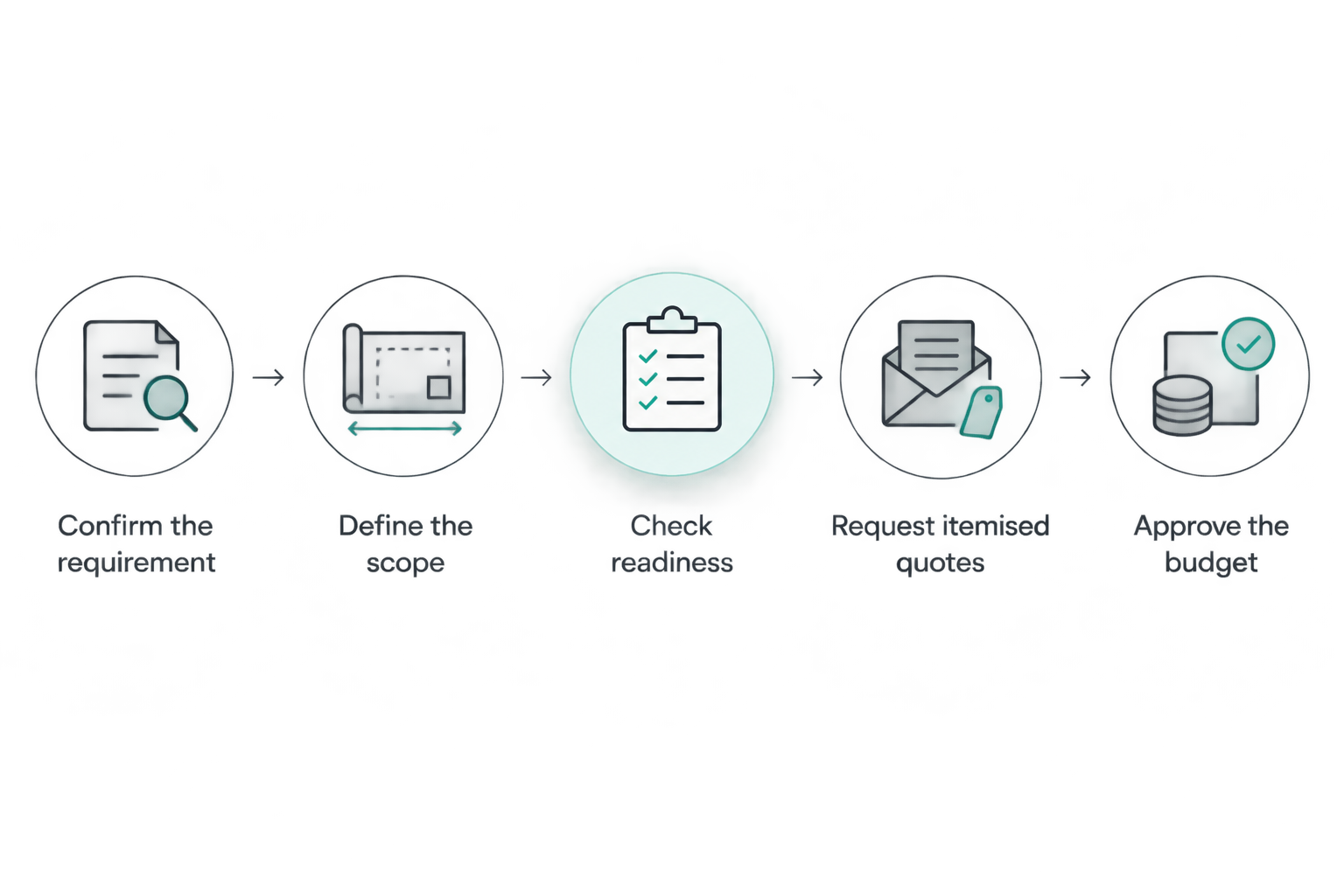
Agree the requirement and scope before you compare proposals.
Questions to send with your scope brief
Ask each prospective auditor to answer the same practical questions:
- What exactly does the engagement include?
- What must your team complete before examination work begins?
- Who prepares the system description, and what review support is included?
- How will the auditor request and review evidence?
- What happens if readiness gaps remain at the planned date?
- What triggers a change to the agreed engagement?
Keep the answers with the proposal. Verbal assumptions are difficult to compare and easy to lose when responsibility passes between teams.
How can you control preparation work without cutting scope?
Reduce duplicated effort, not relevant coverage. Give each control a clear owner and connect its description to how your business actually works.
Start with access management, change management and other processes relevant to your scoped system. Check whether policies describe the process your team follows, rather than the process you intend to introduce later.
Use a simple working record:
- Control: What action or safeguard operates?
- Owner: Who is responsible for it?
- Evidence: What demonstrates implementation?
- Gap: What still needs to change?
- Decision: Who approves completion or accepts the remaining risk?
Avoid collecting documents without a purpose. Ask which control each record supports and whether it relates to the system and date under examination.
Where compliance automation fits
OneClickComply is best for growing businesses that want SOC 2 compliance preparation supported by automated control remediation, policy generation and risk management. The platform supports preparation; it does not replace the independent auditor’s judgement.
OneClickComply provides those compliance automation functions alongside trust centre management. Your team still owns scope decisions, approvals and the accuracy of the information supplied for the examination.
Assess the platform against your actual gaps. Software is useful when its functions match work you need to manage; it is not a substitute for implementing a control or assigning responsibility.
Does the audit fee include penetration testing?
The audit fee includes penetration testing only when the engagement explicitly includes that service. Check the proposal rather than assuming that security testing forms part of every SOC 2 examination.
SOC 2 does not prescribe an identical testing package for every business. Discuss the testing appropriate to your risks, commitments and controls with the auditor, then confirm responsibility for commissioning and remediation.
A testing report and an audit report serve different purposes. If testing identifies issues, assign owners to address them and retain the resulting records.
Can you complete SOC 2 Type I without a consultant?
You can prepare for SOC 2 Type I without a consultant if your team can define the system, implement controls and produce the required documentation. You still need an appropriately qualified independent CPA firm to perform the examination and issue the report.
Use outside support for a defined gap in skills or capacity. Specify the output you need, such as a readiness review or help preparing the system description, rather than commissioning undefined “compliance support”.
Keep management decisions with your business. External help does not transfer responsibility for the controls described in your report.
Should your budget include work after the Type I report?
Your budget should include the work needed to maintain controls after the Type I examination date. A Type I report addresses a specified date, not a promise that controls will remain unchanged.
For your 2026 plan, decide whether the next objective is Type II, another customer assurance request or continued internal control management. Give that next stage an owner before closing the initial project.
Do not treat the report as the end of security work. Access changes, supplier changes and product changes still need management after issuance.
Frequently asked questions
One last thing
Ask the customer to confirm that the proposed report will meet its requirement before you sign the audit engagement. Send the report type, scoped service and selected categories—not just the words SOC 2.
That check keeps your 2026 budget tied to the outcome you need. Define the scope. Assign the work. Seriously Simple Cyber Compliance.