
PCI DSS compliance has no single UK retail tariff: your total depends on how you take payments, which systems fall into scope and what validation your acquiring bank requires. An assessment quote alone does not cover the full workload; include technical fixes, applicable testing and ongoing staff time. Build your 2026 budget around your actual payment setup, not your turnover alone.
Why this matters
Define the payment environment before requesting quotes. Otherwise, suppliers can quote for different systems, different tests and different deliverables. Those proposals are not directly comparable.
Start with a payment-flow diagram and a written list of systems. Use the guide to scoping a penetration test before you buy one before commissioning technical work.
For your 2026 purchasing decision, separate three things: meeting security requirements, proving that you meet them and maintaining those controls. A questionnaire addresses validation; it does not perform the underlying security work.
How much does PCI DSS compliance cost for UK online retailers?
Your PCI DSS budget needs a scoped proposal, not a generic average. Ask your acquiring bank or payment provider which validation route applies, then request a breakdown against the same payment environment.
Use this structure to compare proposals. Keep internal effort visible even when no external supplier invoices you for it.
| Budget component | What the work covers | What to confirm before approval |
|---|---|---|
| Scope and gap review | Identifying payment flows, relevant systems and unmet requirements | Which storefronts, integrations and payment channels are included? |
| Technical remediation | Fixing applicable weaknesses in systems and processes | Who implements changes and supplies evidence? |
| Security testing | Required scanning, penetration testing and follow-up work | Which tests apply, and are retests included? |
| Validation | Completing the required questionnaire or assessment and supporting documents | What will your acquiring bank accept? |
| Ongoing operation | Maintaining access controls, monitoring, policies and evidence | Which tasks remain with your team? |
| Change management | Reviewing changes to checkout, hosting and connected services | What triggers a new scope review or further testing? |
Approve the complete programme, not just the assessment. Ask suppliers to identify exclusions beside each deliverable rather than burying them in general terms.
For a 2026 budget, separate initial implementation from recurring work. This prevents a one-off readiness project from being mistaken for a maintained compliance programme.
Hosted checkout: define your retained responsibilities
A fully outsourced, provider-hosted checkout keeps payment processing away from your own application when implemented correctly. That supports a narrower payment environment, but eligibility for a particular Self-Assessment Questionnaire, or SAQ, depends on meeting its criteria.
Check the actual journey. A redirect to a payment provider, an embedded payment form and a form built by your development team are not interchangeable arrangements.
Ask for evidence that the provider's PCI DSS validation covers the services you use. Then document which requirements the provider handles and which remain yours.
Do not treat a provider's compliance statement as your own validation. Your acquiring bank still determines the evidence it requires from your business.
Embedded payment forms: inspect the integration
An embedded checkout needs closer examination than a screenshot of the payment page. Establish who supplies each payment element and whether your website can affect payment security.
Give the reviewer the integration documentation, not just the provider's name. Include scripts, plugins and administrative access that can change the checkout experience.
The budget question is whether the implemented integration meets the intended validation route's eligibility criteria. Resolve that before buying a questionnaire-completion service or assuming that your website sits outside scope.
Direct card handling: budget for the wider environment
If your application receives or processes cardholder data, the compliance exercise extends beyond a hosted payment page. You must identify the relevant systems, connections, people and processes.
Include infrastructure administration, software changes, access management and applicable testing in the work plan. Document any segmentation used to separate the payment environment from other systems.
Do not assume that deleting stored card details removes every responsibility. Processing and transmitting cardholder data also matter when defining PCI DSS scope.
Which payment approach fits your operating model?
The comparison below explains the trade-offs. These are payment architectures, not interchangeable compliance packages.
| Payment approach | Best for | Main advantage | Main limitation |
|---|---|---|---|
| Provider-hosted redirect | Retailers prioritising outsourced payment handling | Keeps the payment-entry experience with the provider | Requires integration checks and retained merchant responsibilities |
| Embedded provider form | Retailers needing payment entry within their storefront | Supports an integrated checkout experience | Eligibility depends on the exact implementation and applicable criteria |
| Direct card handling | Retailers with a defined need to operate payment systems | Gives control over the payment implementation | Brings responsibility for a wider technical environment |
For your 2026 review, choose the architecture your team can maintain securely. Avoid operating a larger payment environment merely because an old integration already exists.
Why PCI DSS compliance costs vary
The differences come from the work required, not simply the supplier's assessment fee. Compare these factors across every proposal:
- Payment scope. Identify where cardholder data flows and which systems can affect its security.
- Validation route. Confirm whether you need an eligible SAQ or an assessment resulting in a Report on Compliance.
- Existing security controls. Separate controls already operating effectively from work still needed.
- Testing obligations. Establish applicable scanning, penetration testing and segmentation testing before commissioning services.
- Payment channels. Include online checkout, telephone orders and any other card-acceptance channels you operate.
- Internal ownership. Name the people who implement fixes, approve policies and maintain evidence after external support ends.
Turnover alone is not a scope statement. Your acquiring bank's validation requirements and your technical payment environment answer different questions; record both.
Build a budget you can approve
Use the following sequence to turn an open-ended compliance request into defined work. Each step should produce something the next supplier can use.
- Map payments. Show where customers enter card details, where the data travels and which providers handle it. Include refunds and alternative ordering routes.
- Confirm validation. Ask your acquiring bank which documents and assessment route it requires. Confirm SAQ eligibility against your actual implementation.
- Check gaps. Compare existing controls with applicable requirements. Record missing controls and missing evidence separately.
- Assign fixes. Give each action an owner and an acceptance condition. Agree who handles application, hosting and provider changes.
- Compare proposals. Send suppliers the same scope, required deliverables and exclusions checklist. Separate initial work from ongoing support.
A useful scope document is specific enough for your developer, payment provider and assessor to recognise the same environment. If those parties describe different payment flows, resolve the disagreement before approving work.
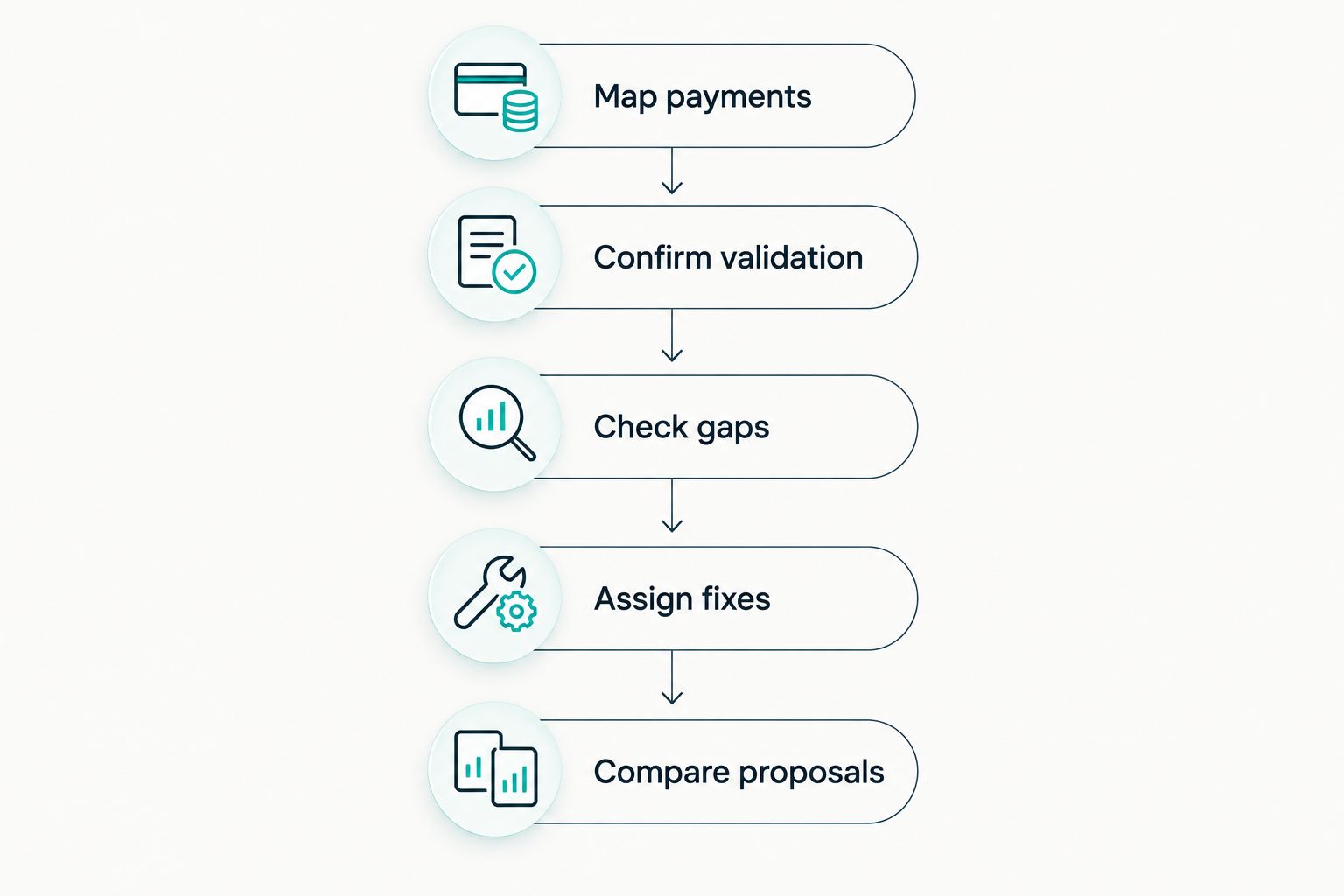
Confirm the payment scope before comparing supplier proposals.
Ask suppliers to define completion
A deliverable needs an acceptance condition. A completed questionnaire, a passing scan and a remediation report each prove different things.
Ask the supplier to state:
- Which systems and channels the proposal covers.
- Which documents you receive at completion.
- Whether implementation work is included or only recommended.
- Whether failed findings receive a retest.
- What support applies when your acquiring bank asks follow-up questions.
- Which responsibilities stay with your team.
Do not accept a promise to “handle PCI” without this detail. You need named outputs, not a broad service label.
What ongoing work belongs in the budget?
PCI DSS is not finished when you submit validation documents. Your team must keep applicable controls operating and retain the evidence those requirements call for.
The technical reference for this 2026 guide is the PCI Security Standards Council's PCI DSS v4.0.1, covering entities that store, process or transmit cardholder data and systems that can affect its security. Its 12 principal requirements cover both technical controls and operational responsibilities.
Build your operating calendar around the requirements that apply to your environment:
- Where required, external vulnerability scans by an Approved Scanning Vendor run at least every 3 months.
- Where applicable, penetration testing runs at least every 12 months and after significant infrastructure or application changes.
- Review changes to payment integrations, access and service providers rather than relying on the previous assessment's scope.
These intervals are not universal testing instructions for every outsourced retailer. Your applicable requirements and validation route determine the work; your acquiring bank confirms its submission expectations.
Can I reduce PCI DSS work by outsourcing payments?
Outsourcing payment processing can reduce your technical scope, but it does not eliminate merchant responsibilities. Use an appropriately validated provider and confirm that your integration meets the eligibility criteria for your intended validation route.
Keep the provider's relevant compliance evidence and a clear division of responsibilities. Revisit that division when you change services or checkout design.
Do I need a consultant or a qualified assessor?
Your validation route determines the assessment support you need. A consultant can help define scope and fix gaps; a Qualified Security Assessor performs assessment work within the PCI SSC qualification programme.
Do not buy an assessor-led engagement solely because the terminology sounds more official. First establish what your acquiring bank requires and whether your team can complete the relevant work accurately.
Can compliance software replace the PCI DSS assessment?
Software does not replace required PCI DSS validation. It can support the controls and evidence within its documented capabilities, but your acquiring bank's requirements still apply.
OneClickComply is best for growing businesses seeking compliance automation, not a substitute for PCI DSS validation. The platform generates policies, manages risk and automates security-control remediation across its stated compliance offering.
Before selecting OneClickComply for compliance automation alongside a PCI DSS programme, confirm the exact PCI-specific controls, evidence and integrations you need. Do not assume that support for another framework establishes PCI DSS coverage.
Frequently asked questions
One last thing
Inspect your card-data flow before buying more compliance work. Check whether support tickets, order notes or telephone-order processes introduce card details into systems outside the documented checkout journey.
That review gives your scope practical meaning. For your 2026 plan, simplify the payment environment first, then automate the repeatable work your controls actually require.
Keep the outcome clear: fewer unmanaged tasks, named responsibilities and evidence you can explain. Seriously Simple Cyber Compliance.