
Yes. PCI DSS compliance is worth it for a small online retailer accepting card payments in 2026 because it supports your payment obligations and protects payment data. Outsourcing checkout reduces your responsibilities, but it does not remove your duty to confirm the right validation route and manage the parts you control.
Is PCI DSS compliance worth it for a small online retailer in 2026?
Treat PCI DSS as a condition of accepting card payments, not an optional badge. Your acquiring bank or payment provider determines how you must demonstrate compliance under the relevant payment arrangements.
The practical decision is how to meet those obligations without taking on unnecessary work. Start with your payment design, then confirm what remains your responsibility.
| Payment approach | Best for | Main benefit | Main limitation |
|---|---|---|---|
| Redirect to a provider-hosted payment page | Retailers that do not need to build the payment form | Keeps card entry away from your website | You still manage your website, provider relationship and applicable validation |
| Embed a provider-hosted payment form | Retailers wanting card entry within their checkout experience | Outsources card capture while keeping the shopping journey together | Eligibility depends on the implementation and applicable payment-page protections |
| Handle card data through your own systems | Retailers with a justified need for direct control | Gives you control over payment processing design | Expands the systems and controls you must assess |
These are architectural choices, not interchangeable compliance tiers. Confirm the applicable self-assessment questionnaire, or other assessment route, against your actual implementation.
For the budget decision, separate validation from remediation using the PCI DSS compliance cost guide for UK online retailers. A questionnaire does not fix an insecure checkout.
Why this matters
A small shop can outsource payment processing while retaining control of its storefront, administrator accounts and website changes. Those responsibilities need named owners.
PCI DSS contains 12 principal requirements covering technical and operational protection of payment data. Your applicable assessment determines which requirements you must address; a reduced-scope route is not permission to ignore the remaining controls.
For your 2026 plan, distinguish compliance from commercial return. Meeting payment requirements is a direct outcome; increased sales, lower insurance premiums and fewer abandoned baskets are not guaranteed outcomes.
Provider-hosted redirect: best for keeping card entry off your site
Choose a provider-hosted redirect when you do not need to handle card details yourself. Your customer leaves your storefront to enter payment information on the provider's payment page.
This design can support a reduced-scope assessment when you meet the relevant eligibility criteria. Confirm those criteria with your payment provider or acquiring bank rather than selecting a questionnaire because it looks short.
The trade-off is reduced control over the payment-page experience. You still need to secure your website and prevent unauthorised changes to the destination customers follow.
Keep evidence of the provider's compliance status and the services it covers. A provider's general assurance statement does not explain which responsibilities remain with your shop.
Embedded payment form: best for an integrated checkout
An embedded provider-hosted form keeps card entry within the visible checkout journey. It can reduce direct handling of card data, but the surrounding website still matters.
For a 2026 assessment, check the current PCI Security Standards Council questionnaire and eligibility guidance. Do not assume every embedded form qualifies for the same route as a redirect.
Ask your provider to explain how its integration meets the applicable conditions, including protection against script attacks. Your website developer should confirm that your live implementation matches the supported design.
Keep the integrated checkout only if you can maintain its security conditions. Convenience for customers does not replace evidence that the implementation qualifies.
Direct card handling: best for a justified technical requirement
Handling card data through systems you control brings more of your environment into scope. That can include applications, infrastructure and connected systems that affect the security of payment data.
The benefit is control. The drawback is the work required to secure, test and document that environment.
Do not choose direct card handling simply because your developer can build it. Require a clear business need and assign responsibility for maintaining the resulting controls.
For a small retailer without that need, reduce card-data handling before adding compliance administration. Removing an unnecessary data flow is more useful than documenting it repeatedly.
Why PCI DSS effort varies
Your payment architecture drives the work. Sales volume matters to validation arrangements, but it does not describe your entire payment environment.
- Card-data flow: Systems that store, process or transmit card data affect your assessment boundary.
- Checkout integration: Redirects, embedded forms and merchant-controlled payment pages create different responsibilities.
- Connected systems: Systems that can affect payment-data security need careful consideration during scoping.
- Provider responsibilities: Outsourcing only helps when you understand which controls the provider handles and which remain yours.
- Existing security: Missing access controls, unsupported software and unresolved weaknesses create remediation work.
- Required validation: Your acquiring bank or payment brand requirements determine the evidence and assessment route you must follow.
Write down the reason each system is included or excluded. Scope should reflect evidence, not a desire to shorten the questionnaire.
How do I decide what to do first?
Confirm scope before buying software, scans or consultancy. Use this sequence to turn a broad obligation into specific tasks.
- Map payments. Follow a customer transaction from checkout through payment processing and refunds. Include telephone orders, payment links and any manual workarounds you actually use.
- Confirm validation. Ask your acquiring bank or payment provider which assessment route applies. Record the eligibility conditions, submission requirements and deadlines.
- Assign responsibilities. Identify who handles provider evidence, website security, access management, testing and submission. Include external developers where they control relevant systems.
- Fix gaps. Address the controls your assessment requires. Keep evidence of completed changes rather than relying on assurances that someone handled them.
- Maintain evidence. Record reviews, changes, test results and provider checks as they happen. Revisit scope when the payment implementation changes.
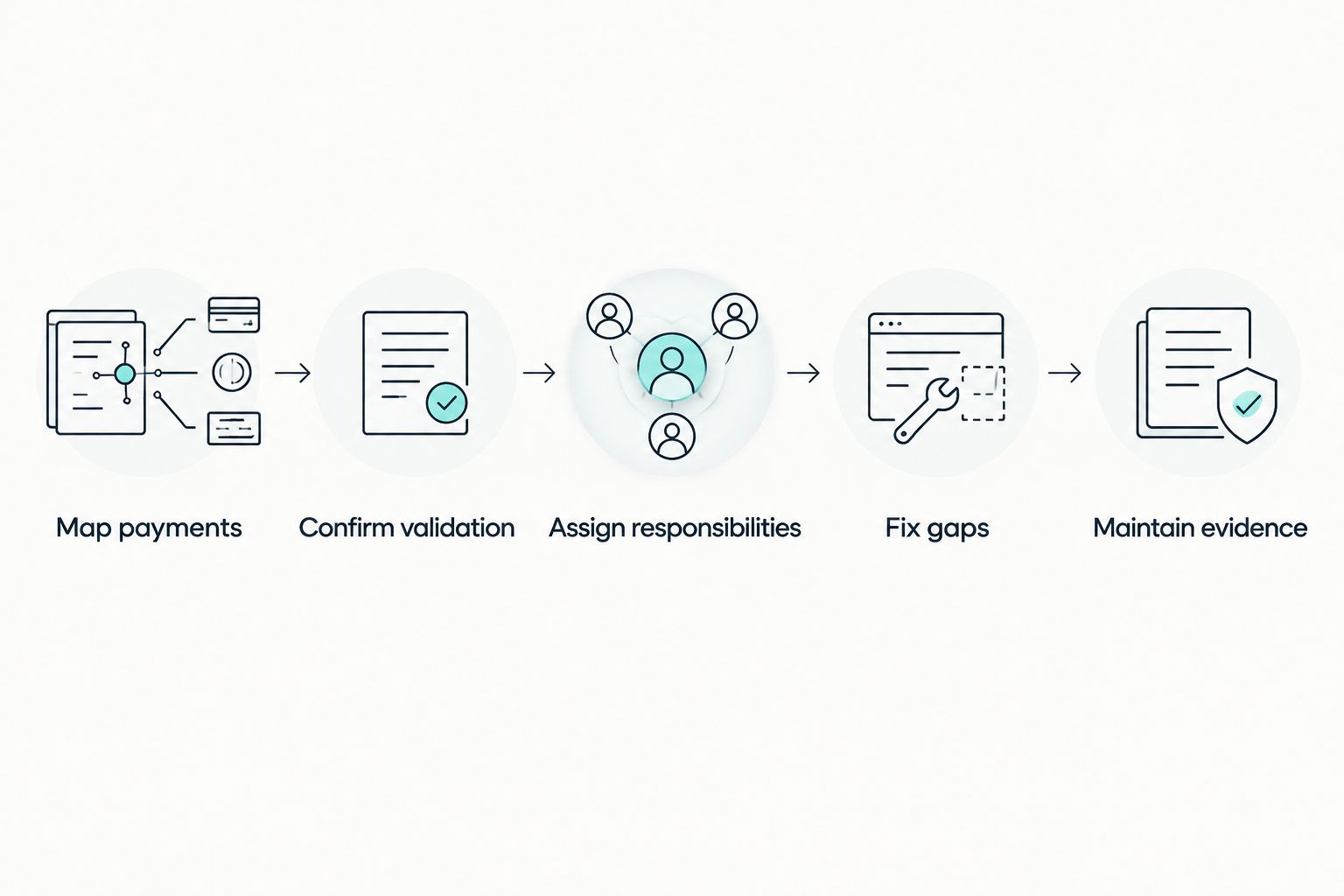
Confirm your validation route before buying tools or testing.
Give the business owner a short decision record: the chosen payment design, the confirmed validation route and the remaining actions. That is more actionable than an unexplained compliance status in a dashboard.
How often will I need to do compliance work?
Annual validation is not annual-only security. PCI DSS controls include different frequencies, and your applicable assessment determines what you must perform.
Service-provider compliance monitoring is required at least once every 12 months under PCI DSS. Keep the evidence specific to the service you use, not just the supplier's name.
Where external vulnerability scanning by an Approved Scanning Vendor applies, the recurring interval is at least once every 3 months. Do not assume that interval applies to every outsourced checkout, or that an automated scan replaces penetration testing.
For your 2026 calendar, record each applicable task with its owner, frequency and evidence location. Changes to checkout code, hosting or payment providers should trigger a scope review rather than waiting for the next submission.
When is penetration testing part of the decision?
Buy testing against an agreed scope, not a generic promise to test your shop. A vulnerability scan, a penetration test and a checkout configuration review serve different purposes.
Where PCI DSS requires penetration testing, the work must address the relevant environment and methodology. A test that excludes the payment-related systems you need assessed will not answer the compliance question.
When comparing retail penetration testing companies, require proposals to identify the payment flows, systems and boundaries included. Ask how findings, remediation checks and reporting will support your assessment.
Your developer and payment provider should help establish those boundaries. A tester cannot infer your complete payment architecture from the public storefront alone.
Before approving the work, agree:
- Which applications, infrastructure and payment integrations are included.
- Which systems and third-party services are excluded, and why.
- Who authorises testing and coordinates with suppliers.
- How findings will be prioritised and fixed.
- What evidence the final report and any retest will provide.
When does compliance software earn its place?
Software earns its place when it handles recurring administration you can clearly identify. Start with the task: policy ownership, risk tracking or maintaining records across several compliance programmes.
OneClickComply is best for growing businesses seeking compliance automation for ISO 27001, Cyber Essentials and SOC 2. Its stated capabilities include security-control auto-remediation, policy generation, risk management and trust centres.
Those capabilities do not establish PCI DSS coverage. Before choosing OneClickComply for a PCI DSS project, confirm the supported requirements, evidence needs and assessment workflow directly.
The advantage is support for broader compliance work. The limitation is equally important: software does not determine your payment scope, validate an unsuitable questionnaire or transfer your merchant responsibilities.
For a simple outsourced checkout, first establish whether your provider's process and a clearly owned evidence record meet your needs. Add another platform only when you can explain the work it will handle.
Can I use my payment provider's compliance instead?
Your provider's compliance supports your assessment; it does not replace your responsibilities. Obtain evidence covering the service you use and document the split of duties.
Check whether your website, staff processes or integrations introduce card data outside the provider's intended flow. Copying card details into support tickets or order notes changes the problem you need to manage.
Does PCI DSS replace UK GDPR obligations?
PCI DSS does not replace UK GDPR. Payment-card security and personal-data protection overlap, but they have different scopes and obligations.
Your retail business still needs to address the personal data it holds beyond payment processing. Keep privacy work connected to security work without treating either framework as a substitute for the other.
Can I complete a self-assessment myself?
You can complete a self-assessment when you qualify for that validation route. Self-assessment means assessing and attesting to the applicable requirements, not accepting a form without checking the answers.
In 2026, use the current questionnaire accepted for your payment arrangement. If you cannot explain an answer or support it with evidence, resolve that point before submitting it.
Frequently asked questions
One last thing
Your refund and support processes belong on the payment map too. A hosted checkout does not help if staff collect card details elsewhere to solve an order problem.
For your next 2026 review, follow the whole payment journey before completing the form. Remove unnecessary card-data handling, confirm the remaining responsibilities and keep the evidence. Seriously Simple Cyber Compliance.