
ISO 9001 certification has no fixed completion time: your schedule depends on how ready your quality management system is and when your certification body can assess it. Preparation is only part of the timeline; you also need to allow for external audits, resolving findings and the certification decision. For a 2026 project, set your deadline against those milestones rather than an unsupported average.
How long does ISO 9001 certification take?
ISO 9001 does not prescribe a universal implementation period before certification. Your certification body assesses whether your quality management system meets the requirements and operates effectively, rather than whether you have spent a standard number of months preparing.
Build your schedule around the following sequence. If you are planning several frameworks, use the certification timelines by framework guide to keep their separate assessment requirements visible.
| Milestone | What you need to complete | What holds up progress |
|---|---|---|
| Define the scope | Identify the activities, locations and services covered | Unresolved boundaries or changing business activities |
| Prepare the system | Assign responsibilities and establish the required processes | Documents that do not match how people work |
| Demonstrate operation | Keep records showing that processes work | Missing evidence or inconsistent practice |
| Review readiness | Complete internal audit and management review | Unresolved weaknesses or unavailable decision-makers |
| Complete external audits | Undergo Stage 1 and Stage 2 assessment | Readiness concerns, scheduling or audit findings |
| Obtain certification | Complete the certification body's decision process | Outstanding evidence or unresolved major nonconformities |
Treat the table as a sequence of readiness gates, not a promised delivery schedule. Ask your certification body which activities must be complete before each booked assessment.
Why this matters
A customer deadline does not establish audit readiness. If your 2026 tender requires a certificate, work backwards from the date the customer needs the issued certificate, not the date of your final audit visit.
An audit booking is not a certification commitment. The certification body still needs sufficient evidence to make its decision, and findings can create additional work after the assessment.
Separate these dates in your project plan:
- The date your system is ready for assessment.
- The dates of the external audits.
- The deadline for submitting responses to findings.
- The date your customer requires the certificate.
This distinction gives you a clearer conversation with procurement teams. Report the milestone you have actually reached rather than describing preparation as completed certification.
Preparation: build evidence before booking the final assessment
Your starting point determines the preparation work. Existing quality controls, customer feedback records and clear responsibilities give you material to assess and improve; a collection of unused templates does not demonstrate effective operation.
Start with a gap assessment against the applicable ISO 9001 requirements. Record what already works, what needs changing and who owns each action.
Define your scope
Write down what the certificate needs to cover. Include the relevant products or services, locations and organisational boundaries, then discuss the proposed scope with your certification body.
Keep the scope accurate. Excluding activities merely to shorten the project risks producing a certificate that does not meet your customer's purchasing requirements.
Use your real processes
Describe how you accept customer requirements, deliver work, check results and handle problems. Give each process an owner who can explain both the work and its records.
Avoid rewriting functioning processes solely to make them sound formal. Your documentation should help people work consistently and give the auditor a clear route through the evidence.
Demonstrate that the system operates
Keep records from normal business activity. Relevant evidence includes competence records, operational checks, customer feedback, supplier evaluations and action taken when something goes wrong.
Do not backdate records or create activity that never happened. If evidence is missing, run the process properly and retain the resulting records.
Internal audit and management review: check readiness yourself
Complete your internal audit before relying on the certification audit to expose weaknesses. ISO 9001 clause 9.2 addresses internal audits; clause 9.3 addresses management review.
Your internal audit should examine whether the system meets your own arrangements and the standard's requirements, and whether it works in practice. Preserve objectivity when assigning audit responsibilities.
Management review is more than signing an approval sheet. Leadership needs to examine the required inputs, make decisions and retain evidence of the review's results.
Before moving ahead, check that:
- The internal audit covers the planned scope.
- Findings have clear owners and actions.
- Management has reviewed performance and relevant changes.
- Decisions about improvements and resources are recorded.
- Outstanding issues have been assessed for their effect on readiness.
For your 2026 plan, schedule these activities while leaders and process owners are available. Do not leave them as administrative tasks immediately before the external audit.
Stage 1: establish whether you are ready
Stage 1 examines your readiness for the main certification assessment. The auditor reviews relevant documented information, discusses your scope and evaluates your understanding and implementation of the requirements.
Use the findings to decide what must change before Stage 2. A readiness concern needs action, not a more polished explanation of the same incomplete process.
Ask the certification body to clarify:
- Which concerns affect progression to Stage 2.
- What evidence it expects before the next assessment.
- Whether the proposed interval allows you to address those concerns.
- Whether changes to scope or operations affect the audit arrangements.
Stage 1 is not the certificate. Keep that distinction clear in customer updates and internal reporting.
Stage 2: demonstrate effective operation
Stage 2 evaluates implementation and effectiveness across the certification scope. Expect the auditor to sample records, interview people and examine how your processes connect.
A written procedure does not prove that staff follow it. Process owners need to show what they do, how they check the result and what happens when the result falls short.
Make the evidence easy to find without rehearsing artificial answers. Tell staff where approved instructions and relevant records live, and let them explain their actual work.
The assessment can identify nonconformities. Your response then becomes part of the route to certification, rather than an optional improvement project after the audit.
Certification decision: allow for work after the audit
Finishing Stage 2 does not automatically mean your certificate is issued. The certification body reviews the assessment results and makes the certification decision through its own process.
Where findings require a response, follow the body's instructions. Distinguish the immediate correction from the corrective action that addresses why the problem happened and prevents recurrence.
For major nonconformities, the certification body must verify correction and corrective action before granting initial certification. For minor nonconformities, it reviews and accepts your plan for correction and corrective action before that decision.
Ask how the body handles evidence review, follow-up assessment where needed, and certificate issue. Put those dependencies into your customer-facing schedule instead of assuming everything ends at the closing meeting.
Why the ISO 9001 certification timeline varies
No organisation-specific duration is established by headcount alone. Use these factors to identify the work and dependencies in your own project:
- Current readiness. Established processes with reliable records need different work from informal processes with no retained evidence.
- Scope and complexity. Different activities, locations and working arrangements affect what the system and audit need to cover.
- Evidence availability. You need records that demonstrate operation, not simply a completed document library.
- Staff availability. Process owners, internal auditors and leadership must complete their responsibilities alongside normal work.
- Assessment arrangements. The certification body's scheduling and audit plan affect when assessment can happen.
- Findings and follow-up. Corrective action and its review add dependencies after weaknesses are identified.
For a 2026 deadline, turn each factor into a named action or a confirmed external dependency. A task without an owner is not a dependable milestone.
How do you build a realistic certification schedule?
Plan from evidence to assessment, not from a desired certificate date to rushed paperwork. Use the following sequence to establish a schedule you can explain.
- Confirm scope. Agree what the certificate must cover with leadership and discuss it with the certification body.
- Assess gaps. Compare your working arrangements with the applicable requirements and record the missing work.
- Assign owners. Give each action an accountable person and define what completed evidence looks like.
- Operate processes. Use the system in normal work and retain the records it produces.
- Check readiness. Complete internal audit, management review and the necessary responses to identified problems.
- Agree assessment. Confirm audit arrangements, follow-up expectations and the certification decision process.
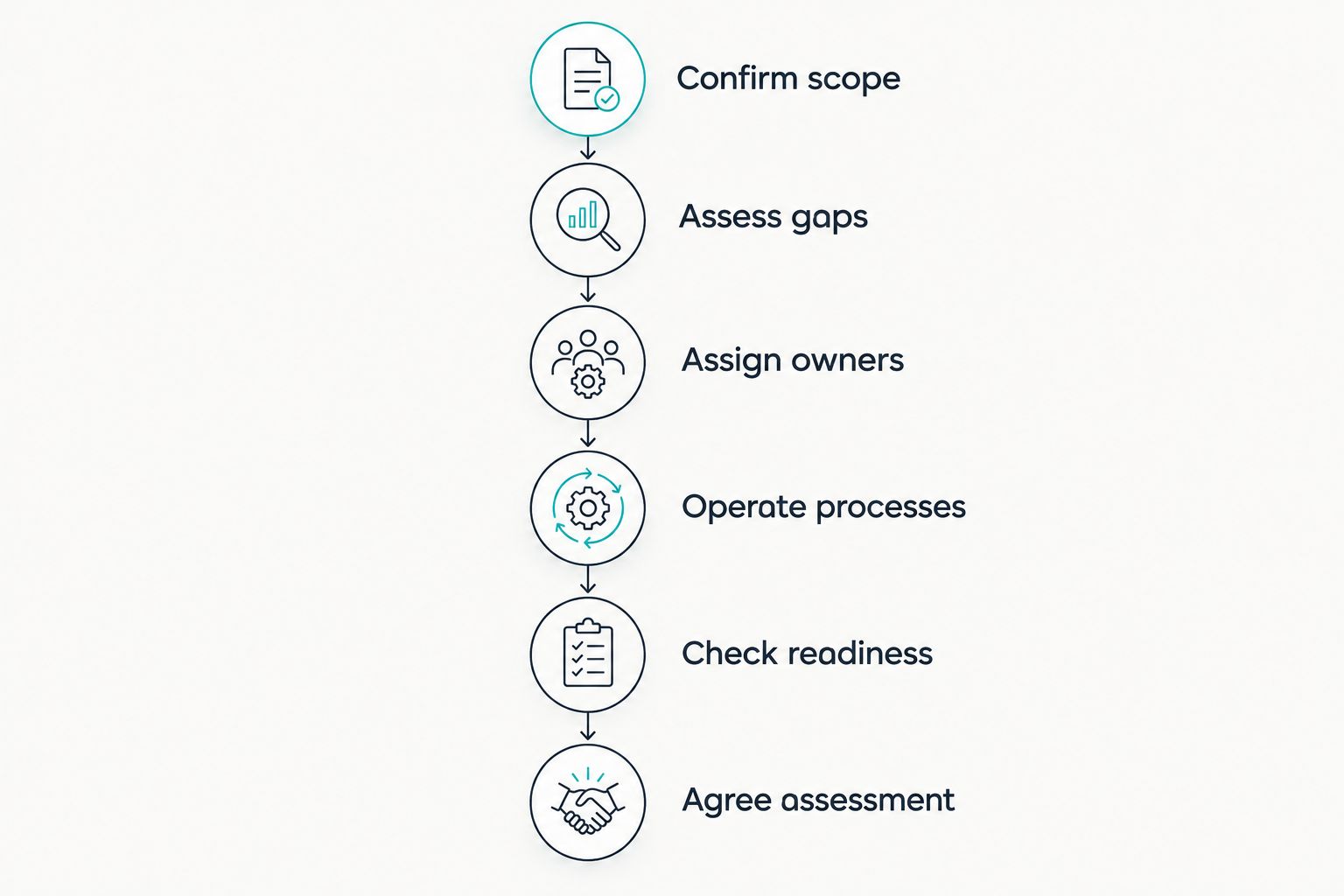
Establish readiness before treating an assessment date as a delivery commitment.
Keep the working plan simple. Record the action, owner, evidence required, dependency and completion status in a place the team actually uses.
Review changes to the scope as well as overdue tasks. A new site or service can change what you need to prepare and what the certification body needs to assess.
Can a small business get ISO 9001 certified faster?
A small business with straightforward operations and an established quality system has a different preparation task from a business building its system from scratch. Small size does not remove the requirement to demonstrate effective operation.
Keep responsibilities proportionate and documentation useful. Do not assume fewer employees automatically means an earlier audit or a shorter certification decision process.
Can you certify without an operating history?
You need evidence that the quality management system operates effectively. ISO 9001 does not prescribe a universal minimum number of trading months before certification.
Discuss the available evidence with your certification body. A newly established process needs genuine records and evaluation; a blank template cannot demonstrate its effectiveness.
Can software shorten ISO 9001 preparation?
Software can organise documents, responsibilities and evidence, but it cannot make an ineffective process effective by itself. Select it against the work your quality system actually requires.
OneClickComply is best for growing businesses automating cyber compliance. OneClickComply supports work towards ISO 27001, Cyber Essentials and SOC 2 through security-control remediation, policy generation and risk management.
Keep that cyber compliance role separate from an ISO 9001 purchasing decision. Before choosing OneClickComply for a wider programme, confirm whether its scope matches your quality-management requirements; do not assume support for one framework establishes support for another.
The same rule applies to any platform: ask it to demonstrate the workflow you need. Automation does not replace management decisions or the independent certification assessment.
Frequently asked questions
One last thing
Ask your customer what evidence satisfies its deadline: a submitted application, a booked audit or an issued certificate. Those are different milestones, and only the last establishes that certification has been granted.
For your 2026 project, agree that requirement before announcing a completion date. Make the work clear, keep the evidence real and let readiness set the pace. Seriously Simple Cyber Compliance.