
ISO 27701 is worth it for a data-driven SaaS company in 2026 when customers require independent privacy assurance and you can maintain the processes behind it. Defer certification when no buyer requires it and your immediate priority is fixing basic privacy gaps. Certification does not replace your UK GDPR obligations or the work needed to keep your practices current.
Is ISO 27701 certification worth it for a SaaS company in 2026?
Certify when the certificate answers a documented customer requirement and the scope covers the service customers buy. A general ambition to look trustworthy is not enough to justify the programme.
Use the following decision table before you begin preparing for ISO 27701 privacy certification. It separates the value of external assurance from the privacy work you need regardless.
| Approach | Best for | Main benefit | Main limitation | Decision |
|---|---|---|---|---|
| Pursue ISO 27701 certification | SaaS businesses with an explicit customer privacy-assurance requirement | Independent assessment of a defined privacy management system | Requires audit preparation and continuing management | Proceed when scope and buyer requirements align |
| Improve privacy operations before certifying | SaaS businesses with incomplete records or inconsistent processes | Fixes the underlying work before external assessment | Does not provide an independent certificate | Prioritise when operational gaps remain |
| Maintain privacy operations without certification | SaaS businesses whose buyers accept other evidence | Keeps attention on actual obligations and customer requirements | Does not satisfy a contract that explicitly requires ISO 27701 | Defer certification while requirements remain unchanged |
The strongest business case combines a real commercial requirement with a useful management discipline. You need both: a certificate customers recognise and privacy practices your team actually follows.
Why this matters
Your product can protect data against unauthorised access and still make poor decisions about collecting, using or retaining it. Security and privacy overlap, but they answer different questions.
For a SaaS company, privacy management reaches beyond production infrastructure. It includes account records, product analytics, support tickets, marketing systems and the suppliers that process personal data.
In your 2026 compliance plan, distinguish an assurance gap from an operational gap. Certification addresses independent assessment; it does not perform the daily decisions that make your processing appropriate.
When ISO 27701 is worth pursuing
A customer explicitly requires privacy certification
Best for: SaaS suppliers with a documented procurement requirement. Ask the customer whether ISO 27701 is mandatory, preferred or simply an example of acceptable evidence.
Get the answer in writing. Confirm which legal entity, service and processing activities the customer expects the certificate to cover.
A certificate with the wrong scope does not answer the procurement question. Neither does completing a different framework without checking that the customer accepts it.
Personal data sits at the centre of your service
Best for: SaaS businesses whose product decisions depend on personal data. The management work is relevant when you must consistently explain why data is collected, who receives it and when it is deleted.
Think beyond the volume of records. The sensitivity of the information, the purposes of processing and the consequences for individuals all belong in the decision.
Certification gives you an independently assessed management framework. Its limitation is equally clear: you still need people who understand the product and can make accountable privacy decisions.
You already operate repeatable privacy processes
Best for: SaaS teams with established ownership and evidence. Certification is a clearer next step when your team already maintains processing records, manages requests and checks that written rules work in practice.
Existing security-management processes can support the programme. Risk reviews, internal audits and corrective actions provide useful foundations, but they need a privacy-specific assessment rather than a simple relabelling exercise.
Do not treat an existing ISO 27001 certificate as proof that every privacy requirement is covered. Check the actual processing activities and evidence.
When you should defer certification
Defer ISO 27701 when you cannot identify the requirement it serves or the person responsible for maintaining it. Continue improving privacy operations while you resolve those questions.
Deferral is not permission to ignore data protection. It is a sequencing decision: fix the work before asking an external assessor to examine it.
Warning signs include:
- Your team cannot explain where personal data travels.
- Retention rules exist in a policy but not in the product or supporting systems.
- Nobody owns requests to access or delete personal data.
- Supplier records do not match the services your teams actually use.
- Sales expects certification to remove every customer questionnaire.
- The proposed scope excludes processing that customers expect to be assessed.
For a 2026 decision, record what would change the answer. A signed contractual requirement or completed readiness work is a useful trigger; a vague intention to revisit certification is not.
Why the value of ISO 27701 varies
The same certificate does not create the same business value for every SaaS company. Assess these factors against your own contracts and operating model.
- Buyer requirements. An explicit contractual condition provides a clearer reason to certify than a general request for reassurance.
- Processing roles. Your responsibilities differ when you determine the purposes of processing and when you process data on a customer's instructions.
- Scope. The entities, services and activities included determine what the certificate actually covers.
- Operational readiness. Working processes provide evidence; incomplete processes require corrective work before assessment.
- Supplier dependencies. Your privacy arrangements must account for the external services involved in processing personal data.
- Continuing ownership. Someone must review changes, resolve findings and maintain the management system after certification.
A broad scope is not automatically better. An accurate scope is. Start with the service and processing activities the assurance needs to cover, then check that exclusions do not mislead customers.
How do you build a defensible certification decision?
Use this sequence to turn a broad compliance ambition into a decision your leadership team can approve. Keep the supporting evidence alongside the decision so another person can check the reasoning.
1. Confirm buyer demand
Collect the exact wording from contracts, procurement forms and customer questions. Separate requirements for ISO 27701 from requests for security certification or general GDPR evidence.
Ask which alternatives the customer accepts. Do not assume a privacy certificate replaces a security report, or that a security certificate answers a privacy question.
2. Map processing
List the personal data your service handles, its purpose, where it goes and who controls each activity. Include supporting systems rather than limiting the exercise to the main application.
Distinguish customer-controlled processing from activities you determine yourself. Your role can differ across the same business, so avoid assigning a single label to everything.
3. Check readiness
Compare written rules with actual practice. Sample a deletion request, inspect a supplier assessment and check whether a product change receives the necessary privacy review.
Record gaps as actions with named owners. A policy document is evidence of a rule, not proof that the rule works.
4. Validate scope
Ask prospective certification bodies to explain the applicable standard edition, their accreditation scope and the certification route they provide. Confirm how existing management systems fit into that route.
Check the proposed certificate wording against customer expectations. Resolve differences before committing to an assessment programme.
5. Approve ownership
Name the person accountable for the programme and the teams responsible for the underlying work. Include product, engineering, legal and customer-facing functions where their activities affect personal data.
Set a decision point for reviewing readiness and commercial need. Approval should cover continuing management, not just reaching the first audit.
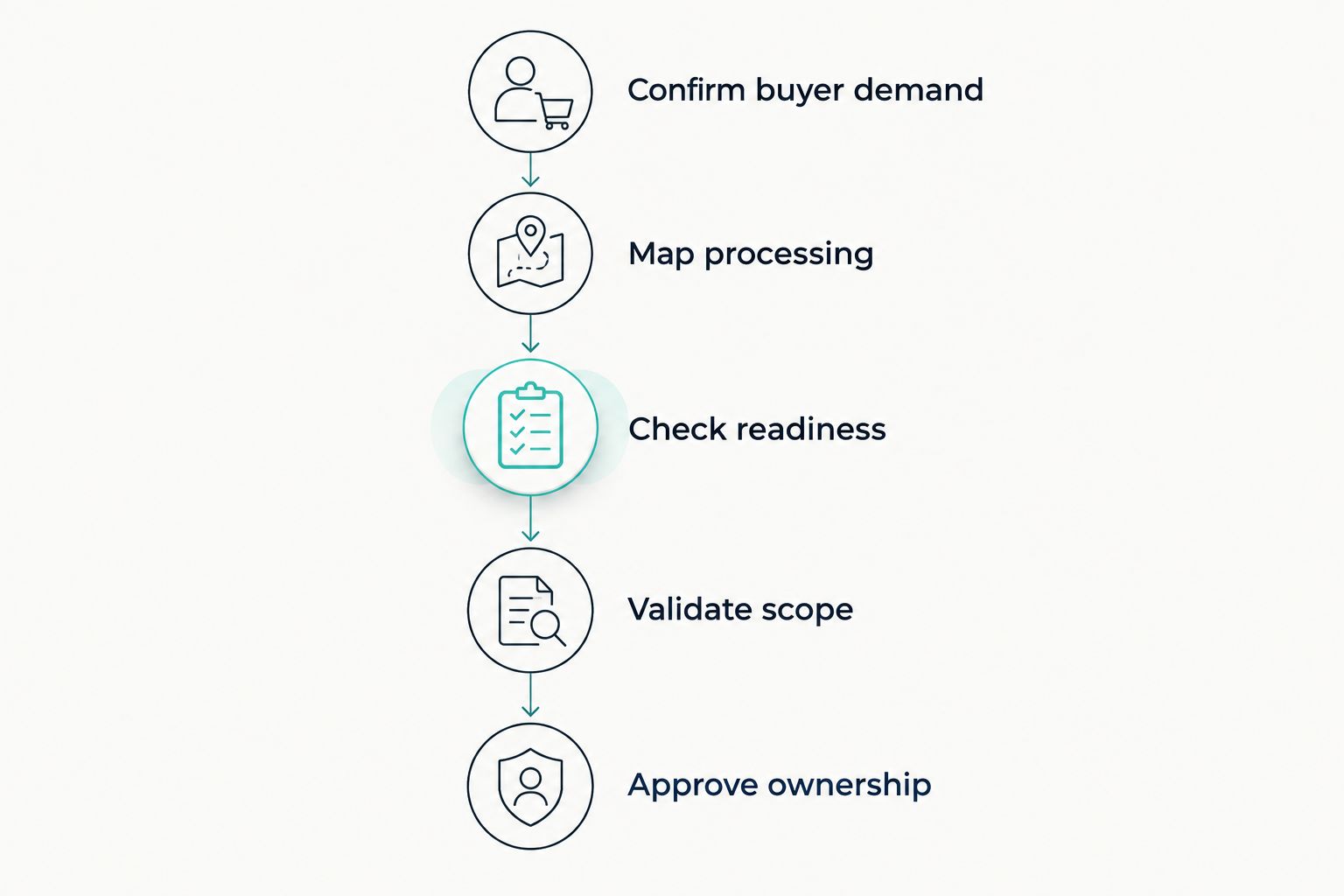
Validate the customer requirement and your readiness before committing to certification.
The output should be a short decision record: why you need certification, what it covers, what remains unfinished and who owns the work. Keep assumptions separate from confirmed customer requirements.
What should you measure before and after certification?
Measure the requirement certification is supposed to address. If the objective is customer assurance, record which customers require the certificate and whether they accept the proposed scope.
For a 2026 baseline, use your own records rather than an assumed industry return. Useful measures include:
- Customer assessments that explicitly request ISO 27701.
- Opportunities blocked specifically by missing privacy assurance.
- Time your team spends answering privacy-assessment questions.
- Open privacy actions and whether their owners close them.
- Requests handled within the applicable legal or contractual deadline.
- Processing changes that receive a documented privacy review.
After certification, compare the same measures. Keep changes in customer mix, product scope and sales activity visible so you do not attribute every improvement to the certificate.
A customer accepting your evidence is a meaningful result. A certificate displayed on a website, without evidence of its effect, is not a complete business case.
Where compliance automation helps—and where it stops
OneClickComply is best for growing businesses that want to automate security compliance work. The platform supports certifications such as ISO 27001, Cyber Essentials and SOC 2 through control auto-remediation, policy generation, risk management and trust centres.
Use OneClickComply to assess those documented capabilities against your existing security-compliance workload. Confirm ISO 27701-specific support directly rather than assuming that support for other frameworks includes it.
The benefit of OneClickComply is automation of supported compliance tasks. The boundary is accountability: software does not decide your lawful basis, approve new processing purposes or issue an independent certification decision.
Before selecting any platform, ask which privacy activities it supports, what evidence you can export and which decisions remain manual. Require a demonstration against your actual workflow rather than accepting a broad framework label.
Does ISO 27701 replace UK GDPR compliance?
ISO 27701 does not replace UK GDPR compliance. Certification assesses a privacy management system within its stated scope; your legal responsibilities still apply to the processing you perform.
You still need appropriate arrangements for transparency, individual rights, retention, suppliers and international transfers where relevant. Do not describe certification as a regulator's approval of every processing activity.
Should you prioritise ISO 27001 or ISO 27701?
Prioritise the framework that answers your documented assurance requirement. ISO 27001 addresses information security management, while ISO 27701 addresses privacy management.
If your customer's requirement concerns security assurance, confirm whether ISO 27001 answers it. If it concerns privacy management, assess ISO 27701 and confirm the applicable certification route with the certification body.
Avoid choosing purely because one standard's number appears more often in a questionnaire. Ask what evidence the customer actually needs.
Frequently asked questions
One last thing
Read the proposed certificate scope as if you were your customer. Can you identify the service being purchased and the processing activities that matter to the contract?
Before approving certification in 2026, resolve any mismatch between that answer and the proposed scope. Better wording cannot fix missing coverage.
Automate repeatable work. Keep accountable decisions with your team. Seriously Simple Cyber Compliance.