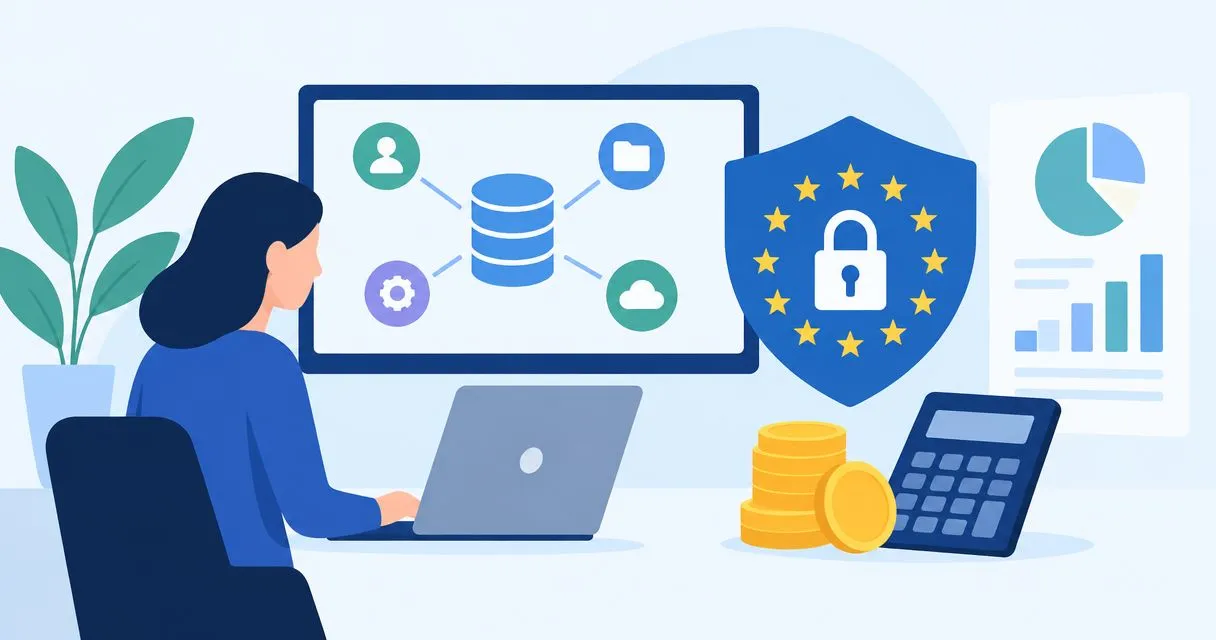
Data mapping software has no single standard cost for GDPR compliance; you need a quote tied to your systems, processing activities and required features. The subscription alone does not cover the full job: include setup, data collection, staff review and ongoing maintenance in your 2026 budget. Compare the cost of keeping an accurate map, not just buying access to a tool.
How much does data mapping software cost for GDPR compliance?
The useful answer is your total cost for an agreed scope. Ask each supplier to quote against the same systems, business entities, users and outputs, then separate recurring charges from implementation work.
Start with the record you need to maintain. A record of processing activities documents how your organisation uses personal data; your buying brief should explain how the proposed tool will help you create and update it.
Use this breakdown for your 2026 purchasing brief. Treat every item as a question for the supplier, not an assumed inclusion.
| Budget component | What to establish | What to request in writing |
|---|---|---|
| Subscription | The charging unit and included functions | Licence scope, limits and renewal terms |
| Setup | Who configures the workspace and imports existing records | Deliverables, responsibilities and acceptance criteria |
| Connections | Which systems the tool can access | Supported connections and any separate charges |
| Internal work | Who supplies and checks processing information | Your team's tasks during setup and operation |
| Ongoing support | Who handles questions and configuration changes | Support scope and exclusions |
| Exit | How you retrieve records and supporting history | Export formats and contractual arrangements |
A quote is only comparable when its scope and exclusions are clear. An apparently smaller subscription does not tell you whether implementation or manual work sits elsewhere in the budget.
Why this matters
Your data map needs to reflect what your business actually does. A software licence cannot establish why you collect personal data, decide whether a purpose is lawful or confirm that every department has supplied accurate information.
For UK organisations assessing their obligations in 2026, UK GDPR Article 30 is the relevant starting point for records of processing activities. It specifies information that controllers and processors must record, with different requirements for each role.
Article 30(5) contains a limited exemption for organisations employing fewer than 250 people. That exemption does not apply to processing that is non-occasional, presents the specified risk, or includes the special-category or criminal-offence data described in that provision. Do not use headcount alone to decide whether records are required.
The regulation does not prescribe a particular commercial data mapping product. Buy software to support accurate records and workable updates, not because a subscription itself proves GDPR compliance.
Choose the type of tool before comparing quotes
Separate your record-keeping problem from your technical discovery problem. You need different capabilities to collect answers from department owners, find personal data inside systems and manage a wider compliance programme.
These approaches can support different parts of the work. The table describes buying categories, not guaranteed features of any named product.
| Approach | Best for | Practical benefit | Limitation to check |
|---|---|---|---|
| Structured manual register | A bounded set of activities with clear owners | Direct control over fields and review decisions | Your team must organise updates and track changes |
| Questionnaire-led mapping software | Collecting processing information across departments | A defined process for gathering and approving answers | Answers still depend on staff knowledge and review |
| Technical discovery software | Finding personal data within connected systems | Technical evidence about data locations | Discovery does not establish business purpose or lawful basis |
| Wider compliance platform | Coordinating policies, risks and certification work | Related compliance work can sit within a shared process | Specialist privacy mapping capabilities need separate verification |
Choose questionnaire-led mapping when the main gap is business knowledge. Choose technical discovery when the main gap is knowing where data sits. If you need both, ask the supplier to demonstrate how the findings connect.
Do not buy technical discovery solely because it sounds more automated. First establish whether it can inspect your relevant systems, what access it needs and who will validate its findings.
Why data mapping software costs vary
Use these factors to explain differences between quotes. Ask suppliers which factors affect their charges rather than assuming they all use the same pricing model.
- Coverage: List the systems, business units and legal entities that need mapping. Ask what happens when you add another.
- Collection method: Specify whether you need staff questionnaires, technical discovery, imports or a combination.
- Connections: Name the applications and data stores you need to connect. Ask whether configuration work falls inside the proposal.
- Review process: Explain who contributes, approves and updates records. Ask whether the required access roles are included.
- Starting position: Show the supplier your existing registers and diagrams. Request a clear allocation of migration and clean-up work.
- Service scope: Separate software access from implementation, training and specialist privacy advice. Assign each task to an owner.
A supplier should explain how the proposed scope produces the records you need. If the explanation stops at a feature list, ask for a worked example using your own processing activity.
Build a like-for-like buying brief
You do not need a finished data map before speaking to suppliers. You do need enough information to stop each supplier quoting for a different job.
Define coverage
List the departments, systems, suppliers and entities within scope. Identify whether you act as a controller, a processor or both, because the required records differ by role.
Include personal data outside your central business applications. Ask department owners about local files, shared folders, paper records and transfers to external organisations.
Set outputs
Describe the records you expect to create and maintain. For controller records, Article 30 includes processing purposes, categories of people and personal data, recipient categories and other specified information.
Ask for a sample export before you commit. Check whether the output preserves the information you need rather than offering only a visual diagram.
Assign owners
Name who supplies information, who checks it and who approves changes. Separate the software administrator from the person accountable for the accuracy of a processing record.
Include your team's work in the buying decision. A supplier-led setup still needs people who understand your processes and can resolve incomplete or conflicting answers.
Test changes
Ask the supplier to show how you add a system, change a supplier and update a processing purpose. Check how reviewers identify what changed and what still needs attention.
Test exports at the same time. Your records should remain usable outside the platform, subject to the agreed export capability and contract.
Compare scope
Send the same brief to each shortlisted supplier. Request a written response against every requirement, with exclusions clearly marked.
Compare implementation responsibilities alongside the subscription. Do not count a task as automated until the supplier has shown what the tool does and what your team still handles.
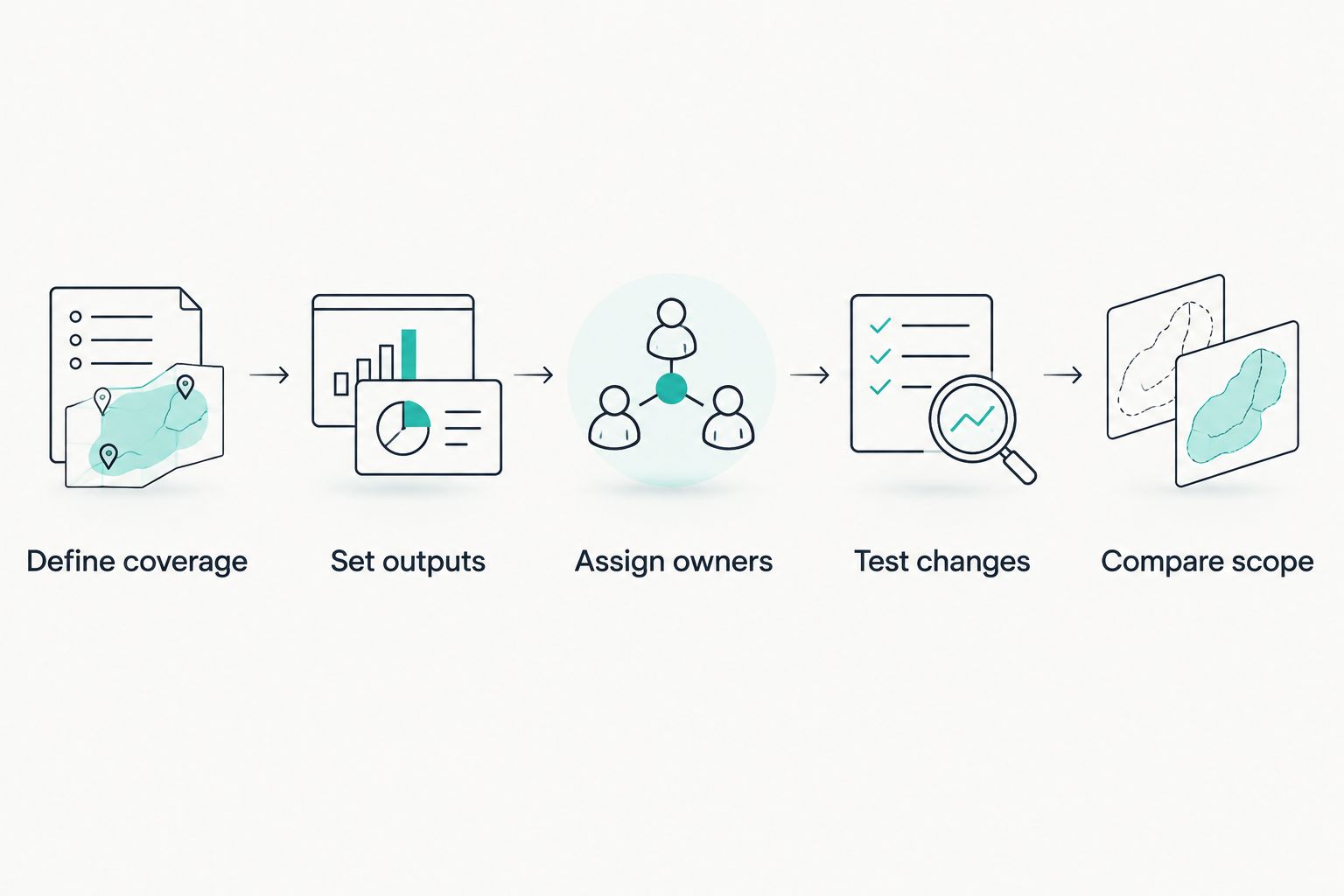
Compare supplier proposals only after you define the same coverage and outputs.
Separate the first-year budget from ongoing work
For your 2026 business case, distinguish getting the map into shape from keeping it accurate. Migration and configuration belong in the implementation plan; review and change management belong in the operating plan.
Ask suppliers to show the subscription commitment over 12 months and the contractual position over 3 years. These are comparison periods, not assumptions about a supplier's minimum term or renewal model.
Keep the budget in separate lines:
- Software access and agreed modules.
- Setup, configuration and record imports.
- Connection development or configuration, where required.
- Internal collection, validation and approval work.
- Specialist advice that falls outside the software service.
- Ongoing administration and change reviews.
Avoid double-counting benefits. If a tool helps gather information but your privacy lead still checks every record, retain that review task in your plan.
Approve a documented workload, not an unsupported savings estimate. Ask process owners what work disappears, what changes and what remains before assigning any financial benefit.
Does data mapping software include GDPR advice?
Software access does not establish that specialist GDPR advice is included. Ask the supplier to distinguish product support, implementation assistance and advice about your legal obligations.
Keep decisions about lawful basis, retention and international transfers assigned to appropriately qualified owners. A completed field is not proof that the underlying decision is correct.
Can you use a spreadsheet instead?
A spreadsheet is not ruled out merely because it is a spreadsheet. The relevant test is whether your records meet applicable requirements and stay accurate, accessible and controlled.
Use a structured register when you can assign ownership and manage changes reliably. Consider software when gathering answers, coordinating reviews or maintaining records becomes the problem you need to solve.
Test the workflow before you sign
Use 1 processing activity as a demonstration brief. This is a recommended test scope, not a claim about how long implementation takes.
Choose a real activity such as employee recruitment or customer account administration. Ask the supplier to show how you capture the purpose, data categories, recipients, systems and responsible owner, alongside the other fields your record requires.
Then change something. Replace a recipient, revise a retention decision or add a system, and watch how the tool records and routes the update.
Your acceptance checklist should cover:
- Can the right people contribute without gaining unnecessary access?
- Can a reviewer identify incomplete information?
- Can you distinguish draft records from approved records?
- Can you retrieve the fields and history your organisation needs?
- Can you export usable records without rebuilding them manually?
Treat gaps as explicit decisions. Accept a manual workaround only after you assign its owner and understand the ongoing work.
Where broader compliance automation fits
OneClickComply is best for growing businesses that need compliance automation for certification work. The platform supports ISO 27001, Cyber Essentials and SOC 2 through security-control remediation, policy generation, and risk and trust centre management.
That makes OneClickComply relevant when your buying decision includes a wider certification programme. It does not establish specialist data discovery or GDPR mapping capability; assess those requirements directly rather than treating certification support as an equivalent.
For a combined 2026 procurement, ask whether proposed tools would duplicate policy and risk work or leave privacy records disconnected. Keep specialist requirements visible even when you prefer a single platform.
Frequently asked questions
One last thing
Test the second update, not just the first import. A polished initial map tells you less about ongoing work than changing a real process and getting the revised record approved.
For your 2026 purchase, make that update test part of acceptance. Keep the mechanism simple and the responsibility clear. Seriously Simple Cyber Compliance.